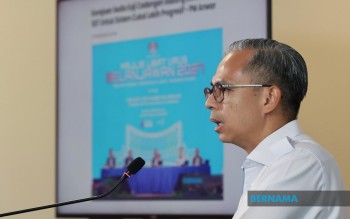
The Malaysian government is pursuing a methodical approach to exploring a novel taxation framework that would merge features of the Goods and Services Tax with the existing Sales and Services Tax regime. Finance Minister II Datuk Seri Amir Hamzah Azizan has been granted an extended timeline to conduct a thorough examination of this hybrid system, with findings eventually escalating to the Cabinet for deliberation, according to MADANI Government spokesperson Datuk Seri Fahmi Fadzil.
The initiative stems from Prime Minister Datuk Seri Anwar Ibrahim's directive to the Ministry of Finance to undertake an in-depth assessment of the proposed combined taxation structure. Speaking at a weekly post-Cabinet press briefing in Putrajaya, Fahmi emphasised that this undertaking remains in preliminary phases and requires careful groundwork before advancing to higher-level decision-making forums. The deliberate pacing reflects the complexity inherent in overhauling a nation's tax architecture, particularly one affecting commercial operations across diverse sectors.
Fahmi underscored that rushing such an analysis would be counterproductive, given the multifaceted considerations at stake. The Ministry of Finance must synthesise lessons drawn from Malaysia's previous experience implementing the GST system, which was introduced and subsequently repealed amid considerable public discourse. Equally important are the documented operational challenges and unresolved issues emerging from the current SST framework, which has been in operation since 2018. Both taxation regimes carry distinct advantages and complications that require systematic evaluation before any synthesis can be meaningfully contemplated.
The Finance Ministry's mandate encompasses a comprehensive review that transcends simple technical reconciliation. Officials must assess whether selective incorporation of GST principles into the SST structure would enhance progressivity in the national taxation system—a stated governmental objective. This involves weighing broader economic implications, competitive positioning relative to regional trading partners, and compliance burdens on businesses of varying sizes and operational sophistication. The analytical scope necessarily extends beyond tax revenue projections to encompass sectoral impacts and distributional consequences across income groups.
When queried about whether the Prime Minister had stipulated completion deadlines or indicated the findings might feature in the forthcoming budget presentation, Fahmi declined to confirm either possibility, noting these specifics had not been discussed during the Cabinet session. This ambiguity suggests the government is maintaining flexibility regarding both the timeline and the venue for initial public disclosure. Such measured openness prevents premature expectations and allows policymakers to adjust the review's pace based on emerging evidence and stakeholder feedback.
Anwar's preceding remarks contextualised the government's intellectual positioning on this matter. He indicated that Malaysia would maintain the SST as its foundational taxation architecture while investigating whether selectively adopting GST characteristics could fortify the system's fairness and effectiveness. This formulation signals an incremental modernisation philosophy rather than a wholesale departure from the current regime. The distinction matters considerably for businesses and taxpayers who have invested in understanding and adapting to existing SST procedures, compliance protocols, and exemption categories.
The proposed hybrid model represents a middle-ground approach that acknowledges both the theoretical sophistication of value-added taxation mechanisms and the political and operational realities constraining Malaysia's immediate choices. A pure GST reimplementation would face the formidable political obstacle of reversing an earlier reversal—the original GST's unpopularity contributed to the government's 2018 decision to abolish it and introduce SST as a purportedly simpler alternative. Conversely, maintaining the status quo without refinement leaves acknowledged inefficiencies unaddressed, potentially constraining revenue generation and complicating enforcement.
The Finance Ministry's investigation will necessarily examine comparative taxation models deployed throughout Southeast Asia and beyond. Singapore, Thailand, and Indonesia operate value-added systems with varying configurations, offering instructive benchmarks regarding implementation challenges and outcomes. Regional coordination considerations may also factor into the analysis, particularly regarding cross-border commercial transactions and digital services taxation—domains where misalignment between national regimes creates economic friction and avoidance opportunities.
Cabinet deliberation on this matter, whenever it materialises, will occur against a backdrop of broader fiscal pressures confronting the Malaysian government. Revenue adequacy, development financing, and subsidy sustainability all intersect with taxation policy decisions. The hybrid proposal's viability depends partly on demonstrating that selective GST feature adoption would strengthen revenue collection without imposing disproportionate compliance costs on small and medium enterprises, a constituency to which the government has publicly committed support.
The extended preparation period allocated to the Finance Ministry reflects an understanding that taxation reform, particularly involving structural modifications to how goods and services are taxed, demands rigorous technical work and stakeholder consultation. Civil society organisations, business associations, and economic research institutions typically contribute valuable perspectives during such reviews, though Fahmi's statement did not specify whether such engagement had commenced.
For Malaysian businesses and consumers, the current pause in the policy development cycle offers an interim period of stability regarding taxation arrangements. However, the government's serious engagement with reform possibilities signals that the SST framework, despite its relative youth as Malaysia's principal consumption tax, may evolve notably within the medium term. Those affected by taxation policy would benefit from monitoring the Finance Ministry's progress and anticipating the Cabinet discussion that will eventually follow.
The eventual outcome of this investigation could significantly reshape Malaysia's fiscal landscape, influencing business planning horizons, investment decisions, and consumer prices across the economy. By proceeding deliberately and comprehensively rather than precipitously, the government is positioning itself to make an informed determination about whether and how to reconcile the competing advantages and disadvantages inherent in value-added taxation versus simplified consumption tax frameworks.

