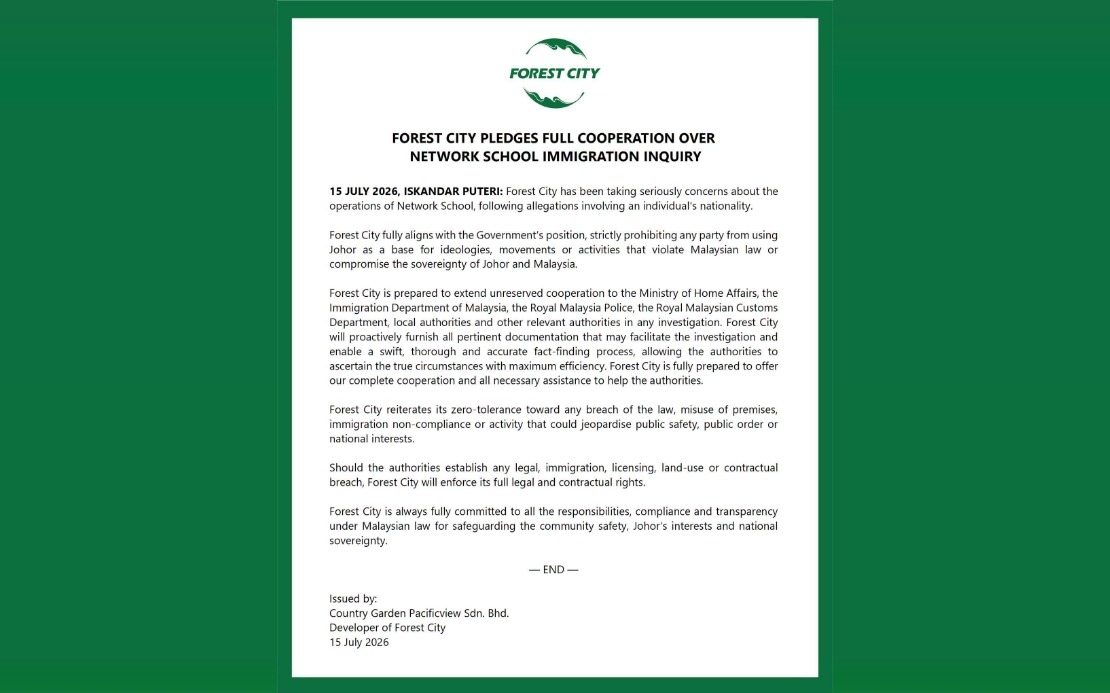
The developer of Forest City in Johor Bahru has signalled its willingness to work closely with government agencies investigating a contentious educational programme allegedly involving Israeli citizens. In a formal statement, Country Garden Pacificview Sdn Bhd, which operates the sprawling waterfront development, committed to providing unrestricted assistance to law enforcement and immigration authorities as they probe the circumstances surrounding the Network School operation.
The matter has drawn heightened scrutiny in recent weeks after allegations emerged that foreign nationals, believed to be Israeli, participated in the programme by entering Malaysia under alternative passports. For a country with Malaysia's strategic position in the Middle East and its stated foreign policy principles, such revelations carry significant diplomatic and national security implications. The involvement of a major commercial development in the controversy has intensified public concern about whether adequate oversight exists over activities conducted within gated residential and mixed-use communities.
Country Garden Pacificview's response reflects the gravity with which it is treating the situation. The developer emphasised that it takes the allegations seriously and aligns itself with the government's position that Johor—and by extension, all Malaysian territory—must not become a staging ground for unlawful activities or initiatives that compromise national sovereignty. This positioning is crucial for the company, which operates one of Southeast Asia's largest real estate projects and has significant commercial interests dependent on maintaining public confidence and regulatory goodwill.
The developer has indicated it stands prepared to engage with multiple state and federal agencies, including the Home Ministry, the Immigration Department, the Royal Malaysia Police, the Royal Malaysian Customs Department, and relevant local authorities. This multi-agency cooperation underscores the complexity of the investigation, which touches on immigration compliance, national security, law enforcement, and regulatory oversight of private developments. The willingness to facilitate such broad-based scrutiny suggests the company recognises that opacity would only deepen suspicions and further damage its reputation.
Country Garden Pacificview also pledged to provide comprehensive documentation to support investigators' fact-finding efforts. The company stated it would submit all relevant records without reservation, a commitment that could prove instrumental in establishing timelines, participant identities, financial transactions, and operational authorisations related to the Network School. For Malaysian authorities, access to such internal records may prove more valuable than preliminary inspections, as they would reveal patterns of activity and decision-making that could not be discerned from surface-level checks.
The developer simultaneously reinforced its commitment to maintaining strict compliance standards within Forest City. Country Garden Pacificview announced a zero-tolerance policy toward legal violations, misuse of facilities, breaches of immigration rules, and activities that threaten public safety and community order. This declaration serves a dual purpose: it reassures the broader public that the company takes its responsibilities seriously, and it establishes clear parameters for future operations and tenant conduct within the development.
The investigation was formally prompted by Johor Menteri Besar Datuk Onn Hafiz Ghazi, who publicly called on federal authorities to conduct a thorough examination of the Network School operation. Onn Hafiz highlighted concerns that participants had reportedly used second-country passports to gain entry into Malaysia, a practice that raises alarm bells about potential document fraud, identity deception, and circumvention of immigration screening procedures. His intervention elevated the matter from a local concern to a statewide priority, signalling to the federal government that regional leaders expect decisive action.
The Immigration Department responded swiftly by conducting an inspection of 266 foreign nationals residing in Forest City across 40 different nationalities. The preliminary findings indicated that all individuals inspected possessed valid immigration documentation, a result that provided some reassurance but did not fully resolve the underlying questions. However, officials emphasised that investigations were continuing, suggesting that the initial sweep may have been a preliminary assessment rather than a comprehensive probe. The sheer number of foreign residents inspected—266 individuals—illustrates the cosmopolitan nature of the development and the challenge authorities face in monitoring compliance across such large expatriate populations.
For Malaysia's broader regulatory environment, this incident highlights vulnerabilities in oversight mechanisms governing private developments that host international communities. Forest City, as a major integrated resort and residential complex, operates in a space where property development, hospitality, education, and immigration intersect. The revelation that activities potentially involving foreign nationals with questionable documentation may have occurred without detection raises questions about the adequacy of existing monitoring systems, the clarity of responsibilities among agencies, and the enforcement capacity of local authorities.
The controversy also carries implications for Malaysia's international standing. As a nation that maintains a carefully calibrated foreign policy in the Middle East and projects itself as a responsible developing economy, any suggestion that its territory is being used for activities that circumvent immigration controls or potentially involve deception reflects poorly on governance standards. The swift official response and the developer's cooperation serve to mitigate reputational damage, but the underlying incident demonstrates that even well-resourced private developers can become inadvertent vectors for regulatory failures.
Looking forward, this matter may catalyse broader policy discussions about oversight mechanisms for major private developments, the training and capacity of frontline immigration and local authority personnel, inter-agency coordination protocols, and the responsibilities of property developers toward ensuring that premises are not misused. Country Garden Pacificview's cooperative stance provides authorities with an opportunity to conduct a thorough investigation and establish precedents for how such situations should be handled. Whether this investigation uncovers systemic gaps or proves to be an isolated incident will likely shape regulatory frameworks governing large mixed-use developments in Malaysia for years to come.

