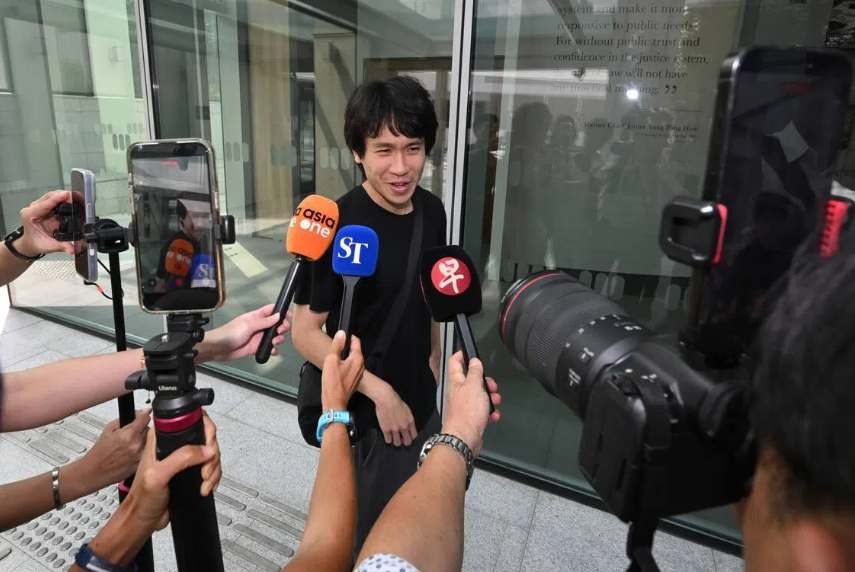
The legal troubles of 27-year-old Amos Yee, a former child actor in Singapore, have intensified dramatically with the addition of four fresh charges when he appeared before the District Court on August 26. The accumulation brings his total legal burden to seven distinct charges spanning multiple offences that touch on sensitive areas of Singapore's legal and social framework. The new charges compound existing allegations under the Enlistment Act, presenting a complex criminal case that addresses both national service obligations and contentious speech matters that have drawn the attention of authorities across the city-state.
Central to the prosecution's case is an allegation that Yee attempted to deliberately stoke racial tensions through his online content. Specifically, he is accused of promoting disharmony through blog posts published on April 7 and April 11, in which he reportedly made claims that Malays and Indians face systemic discrimination from Singapore's Chinese majority population. These assertions allegedly went further, with Yee purportedly encouraging members of these communities to mount organised protests against the Government. Such charges carry significant weight in Singapore's legal system, where maintenance of racial and religious harmony remains a paramount governmental concern, given the nation's multicultural composition and historical sensitivity around inter-ethnic relations.
A second charge related to racial matters stems from video content Yee allegedly uploaded on May 27. In this material, he reportedly made similar claims regarding discrimination against the Malay and Muslim community by ethnic Chinese Singaporeans. The distinction between written and video-based content reflects how modern prosecutions must adapt to the varied formats through which individuals disseminate information online. Each medium potentially reaches different audiences and carries different implications for how messages spread and amplify across digital networks, a consideration that Singapore's authorities appear to have factored into their charging decisions.
Perhaps the most controversial allegations involve what Yee purportedly advocated regarding child sexual abuse material and the criminalisation of paedophilia. Under the Protection from Harassment Act, he faces two separate charges related to videos created in 2021 in which he allegedly argued for expanded free speech protections extending to paedophiles. More startlingly, the materials apparently contained contentions that children and infants could provide meaningful consent to sexual activity. Court documents indicate he further advocated for the elimination of laws governing the production and possession of child abuse material, positions that place him at extreme odds with both Singapore's legal frameworks and international child protection standards. An additional related post from June 30 is cited in the charges, suggesting a pattern of behaviour rather than isolated statements.
The bail conditions imposed on August 26 attempt to restrict the specific behaviours authorities view as most harmful. Yee was released on S$15,000 bail contingent upon his compliance with provisions prohibiting him from publishing online commentary regarding his views on paedophilia or content that could generate racial tensions. These conditions represent Singapore's evolving approach to managing harmful online speech, balancing the right to bail against public safety concerns. The restrictions effectively muzzle particular categories of expression while allowing his continued freedom, a middle-ground approach that reflects judicial caution regarding pre-trial detention.
Significantly, the Singapore Police Force revealed that its investigation began following multiple public complaints lodged between April and July concerning the blog posts in question. This citizen-initiated reporting mechanism demonstrates how Singapore's regulatory model depends partly on community vigilance and reporting, empowering ordinary residents to flag content they deem harmful. The police statement, issued on August 25, framed the investigation as responsive to public concern rather than proactive government surveillance, though the timeline raises questions about whether the discrepancy between complaint periods and posting dates reflects investigative delays or reporting lags.
The criminal penalties attached to conviction reveal the seriousness with which Singapore's legislature treats these offences. If found guilty of knowingly promoting racial disharmony, Yee faces potential imprisonment of up to three years, fines, or both. Each charge under the Protection from Harassment Act carries a potential fine of up to S$5,000 upon conviction. These penalties signal that Singapore does not treat such speech as minor infractions but rather as matters warranting substantial criminal consequences, a position that reflects the city-state's prioritisation of social stability and harmony over broader free speech principles.
Digital platforms have already responded to official pressure regarding Yee's content. Following a disabling direction issued by police under the Online Criminal Harms Act on August 18, the social media platform X removed video content attributed to Yee. Additionally, authorities issued stop communication directions requiring removal of posts from his blog, demonstrating how government action can compel private platforms and individuals to suppress particular content. This multi-layered approach—combining law enforcement action, platform cooperation, and individual compliance demands—represents Singapore's comprehensive strategy for controlling online speech deemed harmful.
Beyond the inflammatory content charges, Yee confronts serious allegations under Singapore's Enlistment Act, a separate legal domain addressing mandatory national service obligations. He stands accused of failing to report for pre-enlistment medical screening for national service, a critical prerequisite in a country where male conscription remains compulsory. Additionally, he allegedly departed Singapore without proper exit permits across two separate periods: from December 13, 2015, to April 19, 2016, and again from December 15, 2016, to March 19, 2026. The second timeframe extends particularly far, suggesting extended residence outside Singapore without authorisation. These violations represent distinct concerns from his speech-related charges, touching instead on civic duty and compliance with sovereign border controls.
Violations of national service enlistment requirements carry penalties matching those for the speech offences: fines up to S$10,000, imprisonment up to three years, or both. This equivalence in sentencing frameworks highlights how Singapore's legal system treats Yee's failure to comply with conscription obligations as equally serious as his alleged advocacy of child abuse material decriminalisation—a perspective that underscores the paramount importance placed on national service compliance in Singaporean society. For a city-state with limited population and high security concerns, universal male conscription serves as both a practical defence necessity and a foundational principle of national identity.
Yee's case carries broader implications for understanding how Singapore regulates online speech and enforces standards around racial harmony. For Malaysian observers, particularly those concerned with how regional governments balance free expression against social stability imperatives, the charges and proceedings offer instructive lessons in one approach to managing controversial digital content. The accumulation of charges across different legal categories—speech-related, child protection, and national service—demonstrates how a single individual's online activities can trigger responses from multiple regulatory frameworks, creating compounding legal jeopardy.
The scheduled pre-trial conference on September 18 will determine how the case progresses toward trial. This procedural juncture represents an opportunity for defence arguments to be aired, for potential plea negotiations to unfold, or for the court to clarify contested factual matters before full proceedings commence. For a case spanning such disparate legal domains and touching on such sensitive social issues, the trajectory from here will likely generate continued scrutiny from free speech advocates, child protection campaigners, and those concerned with maintaining social harmony in multicultural urban environments.

