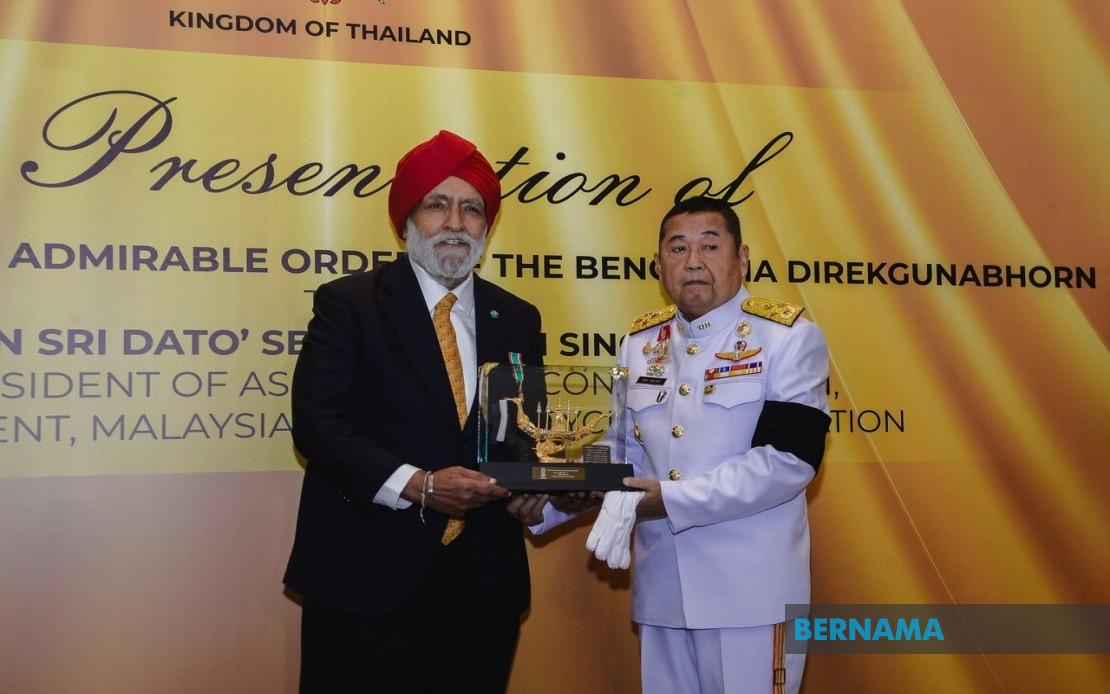
Tan Sri Darshan Singh Gill, a towering figure in Asian cycling administration, has received one of Thailand's most prestigious royal honours in acknowledgement of his transformative leadership across multiple decades. The presentation of The Most Admirable Order of the Direkgunabhorn (Fifth Class - Benjama Direkgunabhorn) took place in Kuala Lumpur on August 6, delivered by ACC senior vice-president General Decha Hemkasri acting under the royal patronage of the Thai monarchy. The decoration, originally conferred by His Majesty the late King Bhumibol Adulyadej The Great, Rama IX, recognises Singh's unrelenting commitment to elevating cycling standards throughout Malaysia, across the Asian continent, and on the international stage.
Singh's tenure in cycling governance spanned critical periods of institutional development. As president of the Malaysian National Cycling Federation from 1988 to 1990, he laid groundwork during a formative era for the sport in the country. His presidency of the Asian Cycling Confederation from 1996 to 2005 proved particularly consequential, positioning him at the helm during a decade when Asian cycling began establishing itself as a competitive force in global competitions. These leadership positions, spanning nearly two decades across both national and continental structures, positioned Singh as an architect of cycling's institutional development in the region during its period of greatest expansion and professionalisation.
In accepting the honour, Singh characterised the recognition as extending beyond personal achievement to encompass Malaysia's broader advancement as a cycling nation. He deliberately framed the award not as an individual accolade but as validation of collective progress by athletes, coaches, administrators, and federations that have collectively elevated Malaysian cycling's international standing. This perspective reflects the political reality that sporting achievement operates as a form of soft power and national prestige, particularly within Southeast Asia's competitive sporting landscape. By repositioning his personal honour as reflective of institutional and national capability, Singh emphasised continuity between his era of leadership and contemporary Malaysian cycling accomplishments.
Singh drew direct parallels between cycling excellence in different eras, noting how athletes such as M. Kumaresan and Rosman Alwi represented Malaysia's competitive cycling tradition during the late twentieth century. He highlighted the contemporary emergence of Datuk Mohd Azizulhasni Awang as evidence of sustained competitive progress, noting that Awang had recently captured a gold medal in the men's keirin event at the Commonwealth Games in Glasgow, ending Malaysia's sixteen-year drought in track cycling gold medals at the Games. Awang's achievement represents a watershed moment for Malaysian track cycling, demonstrating that despite periodic gaps in performance, the infrastructure and talent pipeline continue generating world-class athletes capable of winning on prestigious international stages.
Beyond athletic accomplishment, Singh underscored administrative advancement as equally important to Malaysia's cycling credibility. He specifically referenced the elevation of Datuk Amarjit Singh Gill to the position of UCI (International Cycling Union) vice-president following his election during the 194th UCI Congress held in Kigali, Rwanda, the previous year. Amarjit's appointment for the 2025-2029 term carries particular significance as he became the first Malaysian ever to occupy such a senior position within the international cycling movement's governing structure. This administrative breakthrough indicates that Malaysian cycling has matured beyond athlete development to encompass sophisticated governance capability recognised and valued by the global cycling establishment.
The UCI vice-presidency represents a pivotal institutional achievement for Malaysian sport administration. The position places Malaysian cycling leaders at the table where major decisions affecting international competition formats, calendar development, and regulatory frameworks are deliberated. This level of influence typically emerges only after decades of demonstrated organisational competence, consistent technical engagement, and diplomatic credibility within the international sporting community. Amarjit's election therefore validates the professional standards that predecessors like Darshan Singh established, suggesting that Malaysian cycling administrators have moved beyond merely participating in international forums to shaping policy and direction at the highest levels.
The timing of Singh's recognition carries additional resonance given Malaysia's current trajectory in track cycling specifically. Azizulhasni's Commonwealth Games victory occurred within days of Singh's honour ceremony, creating a symbolic convergence between historical leadership contributions and contemporary competitive success. This synchronicity allows for narrative continuity—the honour acknowledges foundational work by Singh's generation while recent medals confirm the viability of frameworks and systems those leaders put in place. For Malaysian sports stakeholders, the honour reinforces the principle that institutional development, when sustained across administrations and decades, generates tangible sporting returns.
The award also reflects Thailand's recognition of Malaysia's importance within regional cycling governance structures. The presentation by a Thai general acting under royal patronage indicates formal diplomatic acknowledgement of Malaysia's significance to Asian cycling development. Bilateral relations between Malaysia and Thailand frequently operate through multiple channels beyond traditional diplomacy, with sporting organisations providing important avenues for institutional collaboration and mutual recognition. By formally honouring a Malaysian cycling leader, Thailand simultaneously reinforces regional sporting bonds and acknowledges Malaysia's elevated status within Asian cycling governance hierarchies.
For Malaysian readers, Singh's honour encapsulates broader questions about how long-term institutional leadership translates into tangible national sporting achievement. The award trajectory from his tenure leading Malaysian cycling federations through to contemporary gold medals illustrates the extended timeframes required for sporting infrastructure to mature and produce results. It equally demonstrates how administrative excellence, though less visible than athletic performance, constitutes essential foundation-work that enables medal-winning athletes to emerge. Singh's recognition thus serves as implicit acknowledgement that Malaysian cycling's competitive resurgence rests upon decades of governance work, not merely contemporary athlete talent.

