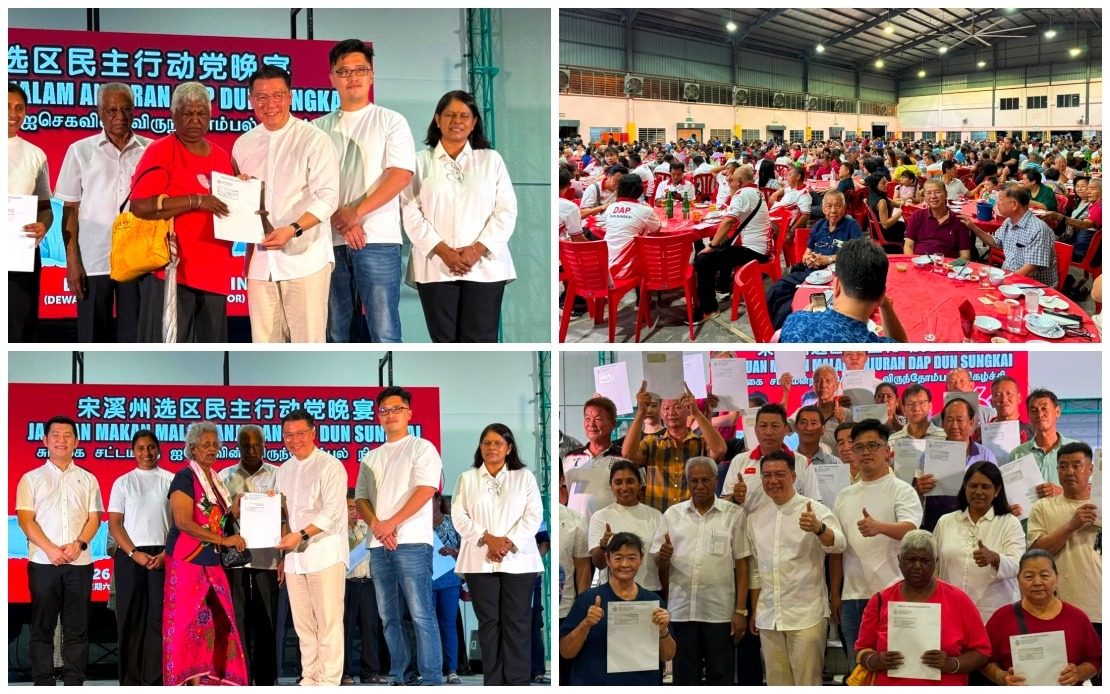
A longstanding housing crisis affecting 120 families across the Sungkai and Kuala Bikam areas of Perak has finally reached resolution, with Housing and Local Government Minister Nga Kor Ming distributing land grants to the beneficiaries at a community dinner on August 8. The initiative marks the closure of a dispute that had persisted for over four decades, offering displaced residents the prospect of secure land ownership and greater stability for their families.
The presentation ceremony, held during a DAP Sungkai state constituency anniversary celebration attended by more than 1,200 guests, underscored what government officials characterised as the administration's commitment to equitable development across all communities. Nga positioned the settlement as emblematic of the broader MADANI Government agenda, framing the resolution within the wider political narrative of inclusive nation-building and the principle that no segment of Malaysian society should be excluded from developmental progress.
The minister drew direct connections between this housing resolution and the government's engagement with the Indian community, citing multiple concurrent initiatives designed to strengthen support for this demographic. Among these are RM20 million earmarked specifically for Indian settlements nationwide, RM50 million allocated to Tamil vernacular schools, and a substantial increase in funding for the Malaysian Indian Transformation Unit (MITRA), which now receives RM150 million in annual allocation. These figures illustrate a coordinated approach to addressing longstanding inequities rather than isolated interventions.
Nga acknowledged the role of Sungkai state assemblyman Datuk A. Sivanesan, who chairs the state's Human Resources, Health, Indian Community Affairs and National Integration Committee, crediting him alongside civil service personnel for their sustained effort in achieving the settlement. This recognition highlights the cross-institutional coordination required to resolve entrenched administrative challenges, particularly those involving land tenure and urban development planning.
For Malaysian observers, the settlement carries significance beyond the immediate relief it provides to 120 families. Squatter communities represent a persistent structural challenge within Malaysia's urban development framework, reflecting historical gaps between rapid urbanisation and adequate affordable housing provision. The Sungkai and Kuala Bikam resolution, while affecting a specific locality, speaks to broader questions about how governments can address informal settlements accumulated over decades.
The minister's emphasis on performance over perception during his remarks reflected an underlying defensiveness regarding critiques of government effectiveness. By juxtaposing concrete policy outcomes against what he termed outdated, divisive politics, Nga attempted to redirect political discourse toward developmental metrics. This rhetorical strategy suggests awareness that political legitimacy increasingly hinges on tangible policy delivery rather than ideological messaging alone.
The gathering itself carried symbolic weight, bringing together political representatives from multiple constituencies and party affiliations—Ipoh Timur MP Howard Lee Chuan How, assemblymembers from Buntong, Malim Nawar, and Astaka, alongside local community leaders. This breadth of attendance underscored cross-party recognition of the settlement's importance, even as political competition continues at state and national levels.
For Southeast Asian context, Malaysia's approach to resolving long-standing informal settlement disputes reflects tensions common across the region between formal property systems and the practical realities of low-income urban housing. Other nations grappling with similar challenges may observe how Malaysia balances market-based land frameworks with targeted redistributive interventions, though successful implementation requires sustained bureaucratic coordination and political will.
The RM20 million Indian settlements allocation and expanded MITRA funding deserve particular attention within Malaysia's broader affirmative action framework. While the government's engagement with Indian community concerns has historically been less visible than its Bumiputera policies, these initiatives signal a recalibration of priority. Whether such financial commitments translate into measurable improvements in community outcomes will determine their long-term political and social significance.
The four-decade timeline itself warrants scrutiny, as it raises questions about institutional capacity and political attention over successive administrations. That this particular administration has resolved what previous governments had not may reflect either genuine policy prioritisation, improved administrative efficiency, or simply the accumulated pressure of sustained community advocacy. The answer shapes interpretation of whether this represents exceptional government performance or merely deferred obligation finally discharged.
Moving forward, the distribution of land grants to these 120 families establishes a model that government officials may reference when defending their housing and development record. However, squatter issues persist in numerous other Malaysian towns and cities, suggesting that while this settlement offers genuine relief to its beneficiaries, the broader housing affordability crisis extends far beyond Sungkai and Kuala Bikam.
The stated commitment to ensuring "no Malaysian is left behind or marginalised in development" carries substantial weight in contemporary Malaysian politics, where concerns about equitable distribution of resources intersect with debates about racial and religious inclusion. By anchoring the settlement resolution to this broader principle rather than treating it as an isolated local matter, government messaging positions the initiative within a comprehensive national vision.

