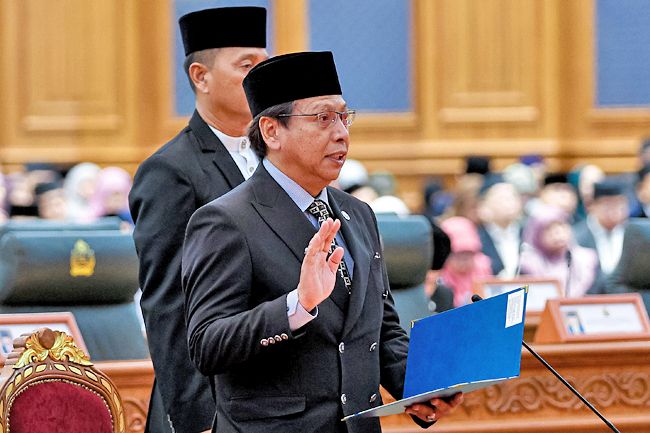
Brunei has expanded its Legislative Council with the formal swearing-in of four Cabinet ministers, marking the beginning of the Second Meeting of the 22nd Legislative Council Session on Monday, August 3. The ceremony, held in Bandar Seri Begawan, followed constitutional protocols established under the 1959 Brunei Constitution, which provides for Cabinet members to take up ex-officio positions in the legislative chamber. This procedural step underscores Brunei's structured approach to integrating executive leadership directly into its lawmaking body, a practice that reflects the sultanate's hybrid governance model.
The four ministers elevated to the Legislative Council represent key portfolios within Brunei's government apparatus. Among them is Datuk Seri Setia Awang Sufian Sabtu, who assumes his role as Minister at The Prime Minister's Office overseeing security and law matters. His entry into the chamber signals the continued emphasis placed by Brunei's administration on security governance during a period of regional geopolitical fluidity. Security and legal frameworks remain central to Brunei's domestic policy agenda, particularly as the nation navigates its role within Southeast Asian integration initiatives and addresses transnational challenges.
Also sworn in was Datuk Seri Setia Awang Mohamad Azmi Mohd Hanifah, who holds the portfolio of Minister at the Prime Minister's Office with responsibility for energy, upstream and downstream operations. This appointment reflects Brunei's continued focus on optimising its oil and gas sector, which remains the lifeblood of the nation's economy. As a significant energy producer in Southeast Asia, Brunei's energy policies carry implications beyond its borders, influencing regional energy security dynamics and investment patterns in the hydrocarbon sector.
The religious affairs portfolio has been represented through the inclusion of Pengiran Datuk Seri Setia Mohammad Tashim Pengiran Hassan. The Ministry of Religious Affairs holds particular significance in Brunei, where Islam occupies a constitutionally entrenched position and shapes national identity and governance frameworks. The minister's presence in the Legislative Council ensures that religious policy considerations are directly embedded in legislative deliberations, reflecting the country's explicit commitment to Islamic principles in state governance.
Transport and information communications responsibilities have been assigned to Datuk Seri Setia Awang Mohammed Riza Datuk Paduka Mohammed Yunos, whose entry into the council highlights Brunei's strategic attention to digital infrastructure and connectivity. In an increasingly interconnected Southeast Asian landscape, transport and communications policies become pivotal for economic competitiveness and regional integration. Brunei's approach to these sectors influences how effectively it can participate in digital initiatives and cross-border trade frameworks within the Association of Southeast Asian Nations.
The swearing-in ceremony was witnessed by the Legislative Council Speaker, Pehin Orang Kaya Seri Lela Datuk Seri Setia Awang Abdul Rahman Datuk Setia Mohamed Taib, whose presence formalised the procedural integrity of the occasion. The speaker's role underscores the institutional architecture through which Brunei conducts its legislative business and ensures constitutional compliance. The presence of the speaker emphasises that these appointments represent not merely administrative adjustments but substantive modifications to the composition of Brunei's legislative chamber.
Brunei's Constitutional framework, dating to 1959, establishes an institutional relationship between executive and legislative branches that differs markedly from purely parliamentary systems common in neighbouring democracies. The provision enabling Cabinet ministers to assume ex-officio legislative positions reflects a governance philosophy that prioritises direct executive input into lawmaking processes. This structural arrangement creates closer alignment between policy formulation and legislative oversight, though it also concentrates executive influence within the chamber.
The timing of this swearing-in ceremony coincides with broader policy discussions within Brunei regarding domestic development priorities and regional engagement strategies. The composition of the Legislative Council, enriched by these four ministerial appointments, will shape how the sultanate addresses economic diversification, investment climate enhancement, and participation in ASEAN initiatives. The energy minister's presence will be particularly significant as global energy markets shift toward renewable sources and nations across the region reassess their hydrocarbon strategies.
For Malaysian observers, Brunei's legislative processes merit attention as both nations share certain constitutional and institutional heritage whilst pursuing distinct governance philosophies. The incorporation of executive ministers directly into legislative bodies remains a comparative rarity in Southeast Asia, offering insights into alternative models of integrating executive accountability with lawmaking authority. Brunei's approach reflects conscious choice regarding how to balance executive efficiency with legislative oversight, a balance that merits ongoing analysis as the region navigates complex policy challenges requiring coordinated responses across multiple governmental levels.

