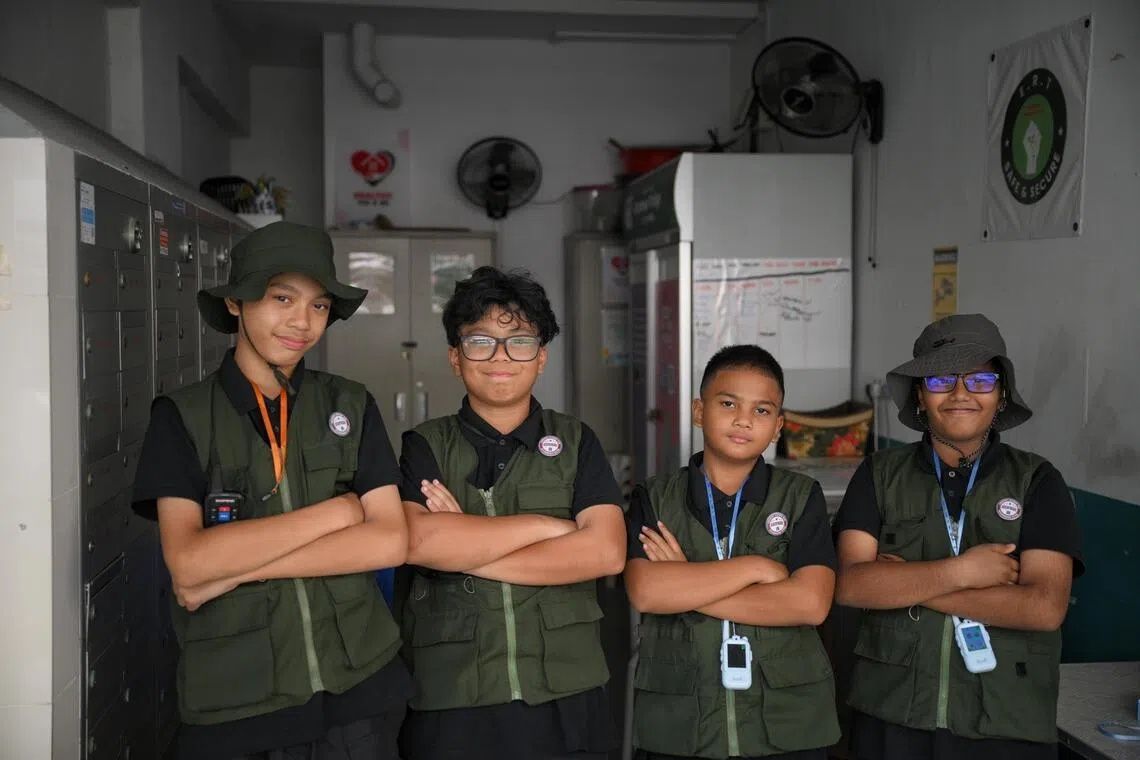
When 12-year-old Rafieq Sahin Rafizal witnessed a community fridge repeatedly being emptied of milk and drinks meant for low-income children, he moved beyond frustration to action. Rather than simply guarding the refrigerator established by his mother, Marlina Yased, he channelled his concern into something more ambitious: a formal neighbourhood patrol involving his peers. What began as a response to one problem has evolved into a structured community safety initiative that is now gaining recognition at the national level.
The Emergency Response Team LB, named after Singapore's police Emergency Response Team, comprises four boys aged between 11 and 14 from Gan Eng Seng Primary School. Rafieq, Aaron Sarandev, Al-Mirza Danish, and Didie Andiqa Muhaimin now conduct daily patrols across up to six blocks in their Lengkok Bahru housing estate, equipped with matching vests and walkie-talkies. Their mission extends far beyond protecting a community fridge. The young volunteers systematically monitor their neighbourhood for hazards including illegal dumping of bulky waste, vandalism, and dangerously charged personal mobility devices in shared spaces that could trigger fires. Upon discovering issues, they document the problems photographically and report findings to Marlina, who then escalates matters to estate management and relevant authorities.
The initiative, which commenced in August 2025, has already produced tangible results that demonstrate how youth engagement can strengthen community resilience. The team has assisted an elderly resident with mobility difficulties by carrying her groceries, intervened to resolve disputes among neighbourhood children, and most significantly, helped authorities respond to a serious welfare situation. Early in 2026, the boys detected a foul odour emanating from a residential unit and reported it immediately. Their prompt action enabled cleaners and police to discover the decomposed body of an elderly man who had died alone in the flat—a discovery that underscores how informal monitoring networks can prevent isolated deaths, particularly among vulnerable seniors in dense urban environments.
The backdrop to this initiative reveals the creative approach Marlina adopted to address community needs with limited resources. In 2023, she established the community fridge with sponsorship support, positioning it at the void deck of her two-room rental flat at Block 59 Lengkok Bahru. The arrangement incorporates two distinct sections: one locked cabinet holding food and groceries, and a separate unlocked refrigerator stocked exclusively with milk and drinks for neighbourhood children before school hours. Marlina observed that while some residents would take individual drinks for personal use, others would empty the fridge and remove substantial quantities of milk. Rather than implementing restrictive security measures, she conceptualised the patrol team as a positive alternative that would build community cohesion while addressing the underlying behaviour.
The operational structure of the Emergency Response Team LB reflects careful planning and adult supervision. Following school hours, the boys don their personalised vests bearing individual names and the team logo before departing in pairs to conduct systematic patrols. Communication with adult coordinators—Marlina and 21-year-old volunteer Fahmidah Farihullah—is maintained continuously through walkie-talkie systems, ensuring safety and accountability. The team originally comprised seven members but has stabilised at four, suggesting a natural consolidation around committed core participants. The boys balance their patrol responsibilities with academic obligations and recreation, dedicating approximately one hour daily to community service while maintaining normal childhood activities including homework and leisure time with peers.
Rafieq's inspiration for naming the group after Singapore's police Emergency Response Team reflects how young people conceptualise civic responsibility through existing institutional frameworks. As a Primary 6 student, he articulated a philosophy that resonates across generational divides: the acknowledgment that protecting one's community represents a deliberate choice to allocate personal time meaningfully rather than pursuing purely individual interests. Didie Andiqa Muhaimin, the oldest team member at 14, joined the initiative after concluding that involvement in meaningful community work would provide greater satisfaction than unstructured leisure. Aaron Sarandev, a Primary 5 student, has identified personal development outcomes from regular patrols, noting that the experience has cultivated his sense of responsibility and taught him perseverance, particularly on occasions when motivation wanes but commitment to the schedule prevails regardless.
Community reception to the boys' activities has evolved from initial scepticism to genuine appreciation among residents. Nasha Asrin, a 27-year-old mother of five living in the estate, explicitly welcomed the visible presence of engaged young people performing constructive work rather than congregating idly around the neighbourhood. This observation touches on a broader social concern in urban communities: the tension between youth engagement and perceptions of youth idleness. The patrol team addresses this dynamic by channelling youthful energy into visible, purposeful activity that benefits the collective. Marlina has observed measurable behavioural improvements in several team members, with feedback from their mothers indicating improved school attendance and enhanced concentration during academic activities, suggesting that structured community responsibility may positively reinforce educational engagement.
The national recognition accorded to the Emergency Response Team LB represents a significant validation of youth-led community initiatives. In August, the four boys will participate in Singapore's National Day Parade, featured in a segment dedicated to ordinary Singaporeans who contribute meaningfully to national development and social cohesion. For Rafieq, Aaron, Al-Mirza Danish, and Didie, this represents their inaugural participation in the annual parade, an occasion they collectively describe as the most significant event in their experience. The inclusion signals official acknowledgment that community safety and neighbourhood cohesion depend not exclusively on formal governmental structures but substantially on informal networks of engaged residents, particularly when younger generation members are mobilised toward protective purposes.
The Lengkok Bahru initiative carries implications extending beyond the immediate estate context. In Southeast Asia's densely populated urban centres, where municipal resources for community monitoring remain constrained and social fragmentation poses growing challenges, youth-led voluntary networks offer scalable models for enhancing neighbourhood safety and elder welfare surveillance. The model demonstrates that comprehensive community protection emerges not from expensive institutional mechanisms alone but from creative activation of existing social relationships and careful cultivation of civic consciousness among young people. Marlina's approach—transforming a problem of resource depletion into an opportunity for youth engagement and community strengthening—illustrates how reframing challenges within broader frameworks of collective welfare can generate solutions that address multiple objectives simultaneously.

