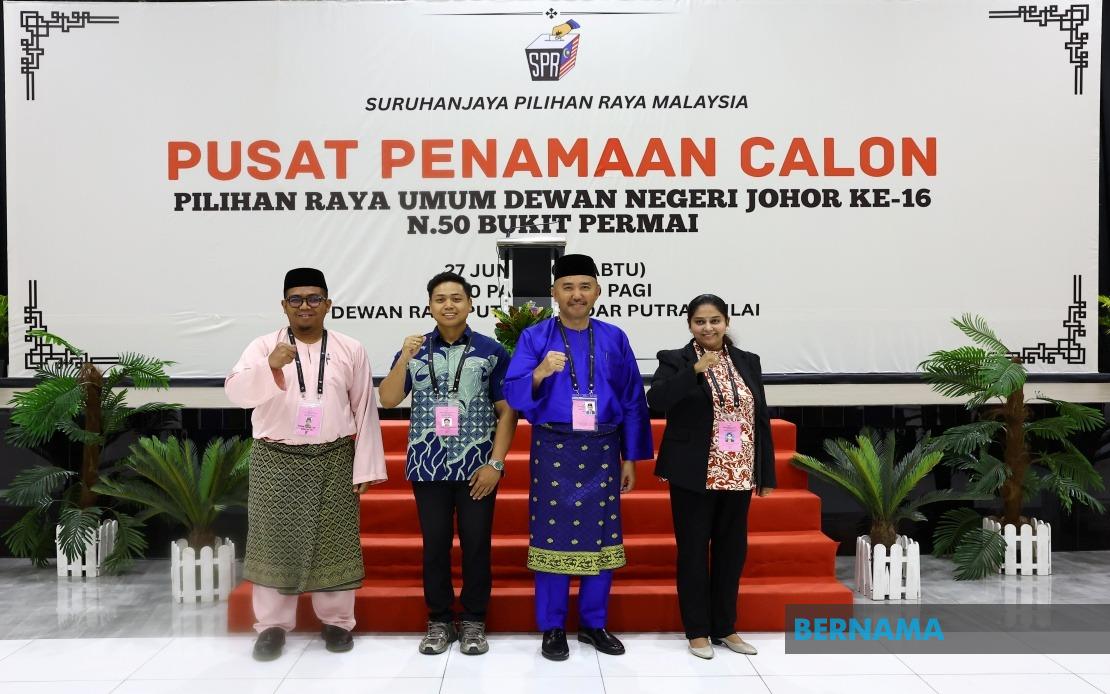
Datuk Mohd Jafni Md Shukor, the Barisan Nasional representative holding Bukit Permai, will contest a fiercely competitive four-way battle in the forthcoming 16th Johor state election, as candidates officially filed their nominations yesterday. The returning officer, Afzan Azhari, confirmed the candidacy list at the nomination centre located at Dewan Raya Putra in Bandar Putra after the submission deadline passed at 10 am, setting the stage for what promises to be a tightly contested race in this Batu Pahat constituency.
The challenge to the incumbent comes from three opposing candidates representing different political camps that reflect the fragmented nature of Malaysian opposition politics. Mohamad Shafwan Ani carries the Pakatan Harapan banner, representing the broader coalition that had contested the previous election with significant backing. M. Lina Manoh represents Perikatan Nasional, the newer alliance that has been gaining traction in selected constituencies across Johor and the wider country. Meanwhile, Muhammad Aidil Riduan Mohd Yusof stands as the Parti Bersama Malaysia candidate, representing the political force that emerged from the Merdeka Negaraku political platform. This splintering of the opposition vote across multiple contestants underscores the complexity of Malaysia's evolving electoral landscape at the state level.
The Pakatan Harapan campaign in Bukit Permai received a boost when Johor DAP chairman Teo Nie Ching arrived at the nomination centre at 8.26 am to accompany Mohamad Shafwan's candidacy announcement, signalling party solidarity and strategic focus on the constituency. The presence of such senior figures at nomination proceedings often indicates where larger political parties believe their competitive opportunities lie and where they are willing to invest organisational resources and campaign energy during the election period.
Mohd Jafni's track record in this constituency provides him with a significant platform heading into the election. In the 2022 Johor state election held two years ago, he captured the seat with a majority of 4,755 votes, demonstrating his appeal to local voters even in a four-cornered context. This previous victory suggests established grassroots support and voter familiarity, though the passage of time since the last election and shifting political dynamics could alter voter preferences, particularly if national political developments influence local sentiment.
The structure of this contest reflects broader patterns in contemporary Malaysian politics, where the traditional binary competition between government and opposition has evolved into more complex multi-party scenarios. The presence of candidates from BN, PH, PN and Bersama indicates how the political field has expanded at state level, with regional coalitions and newer parties attempting to build constituencies outside traditional frameworks. For Johor voters in Bukit Permai, this means a genuine choice among fundamentally different political visions and platforms rather than simply selecting between establishment and opposition.
The geographic and demographic profile of Bukit Permai within Batu Pahat adds another layer of electoral interest. As a state constituency in one of Malaysia's traditionally important political states, Bukit Permai represents the kind of swing territory that can determine overall state government control. The cumulative effect of results across constituencies like this will determine whether Johor returns a government led by BN, or whether alternative coalitions can secure sufficient seats to form an alternative administration.
Electoral procedures for this contest are now set in motion following the official candidate announcements. The Election Commission has scheduled early voting for Johor's 16th state election on July 7, providing voters with advance polling options. The main polling day is scheduled for July 11, giving candidates and political parties approximately two weeks to campaign and mobilise their respective support bases. This compressed timeframe, typical for state elections, concentrates campaign activity and often determines which parties can most effectively reach and persuade voters through grassroots organisation and media presence.
For BN, retaining Bukit Permai represents part of the broader effort to maintain control of Johor state government, a critical objective given the state's economic importance and political significance as a bellwether for national trends. The ruling coalition's ability to defend seats it currently holds, particularly through incumbents with established records like Mohd Jafni, will substantially influence whether it can secure the simple majority needed to form government following the election.
Pakatan Harapan's push in this constituency reflects its continuing efforts to recapture voter support after the 2022 state election, where it failed to form government despite significant campaigns. The coalition's decision to contest Bukit Permai aggressively, marked by senior leadership involvement in nomination proceedings, suggests party strategists believe the seat represents opportunity for recovery in Johor.
The emergence of PN and Bersama as serious electoral contenders in individual constituencies demonstrates how Malaysia's political ecosystem continues to evolve and fragment beyond the traditional dominant coalitions. Both parties are attempting to establish footholds and build voter bases that could translate into longer-term political influence, even if initial results fall short of forming government majorities.
For Malaysian voters more broadly, the Johor state election represents a significant opportunity to assess current political sentiment at state level and observe how national political divisions translate into local electoral outcomes. Results in constituencies like Bukit Permai will provide crucial indicators about voter preferences, coalition viability, and the direction of Malaysian politics as the country continues navigating post-electoral transitions and coalition management.

