The quarter-final meeting between France and Morocco in Boston on Thursday represents far more than a straightforward competition between two national football teams. Woven through this fixture are threads of post-colonial history, family migration, educational exchange, and individual friendships forged in the corridors of European football clubs. The relationship between these two nations finds perhaps its most authentic expression on the pitch, where the complexities of their intertwined past and present converge in ways that transcend conventional sporting rivalry.
Historical bonds between France and Morocco run deeper than most international football encounters. Morocco existed under French protectorate governance from 1912 until its independence in 1956, a period that fundamentally shaped institutions, language, and cultural networks that persist today. The decades since have witnessed deepening ties through education, commercial enterprise, and significant population movement in both directions. Football has become one of the most visible and emotionally resonant channels through which these connections manifest, offering Moroccan athletes pathways to development and competitive opportunities while simultaneously enriching French football with talented players shaped by North African roots and experiences.
The composition of Morocco's squad itself tells the story of this relationship. Six members of the team were born on French soil, while numerous others developed their craft in French academies or competed in Ligue 1 before committing to Moroccan national representation. This pattern reflects a conscious strategy by Morocco's football federation to harness its diaspora as a competitive asset. Young players raised in France, exposed to elite coaching and rigorous youth development systems, eventually choose to represent Morocco, bringing with them technical refinement and experience gained in one of Europe's strongest leagues. This approach has proven remarkably effective in building a squad capable of challenging traditional football powerhouses.
Ayyoub Bouaddi exemplifies the layered identity that defines this fixture. Born in France, trained at Lille's renowned academy, capped by France at youth international level, Bouaddi ultimately selected Morocco as his senior representative nation. His journey encapsulates the dual footballing consciousness that many players navigating Franco-Moroccan connections experience. Such decisions, while primarily individual choices based on competitive opportunity and personal heritage, carry symbolic weight in how both nations understand integration, belonging, and the evolving nature of national identity in contemporary sport.
The personal friendship between Kylian Mbappe and Achraf Hakimi provides another illuminating lens through which to view this encounter. Their bond, forged during shared seasons at Paris Saint-Germain, demonstrates how club football creates relationships that transcend national boundaries. These connections between players of different nations, built through daily training ground interaction and shared professional ambition, exist in parallel to the official rivalry their countries' teams must contest. Such relationships humanise international competition, reminding observers that athletes often regard opposing players as colleagues and friends despite representing different flags.
Boston's geographical and cultural context offers an intriguing setting for this rematch. Unlike Paris, where security concerns and historical sensitivities carry particular weight, Boston hosts a more modest but firmly established Moroccan community integrated into the wider metropolitan area. Moroccan-born residents have constructed a network encompassing families, students, professional workers, and business operators who have put down roots in New England. This community provides a genuine constituency for Moroccan support, yet the broader Boston context avoids the charged atmosphere that might characterise the fixture in French cities where larger populations and deeper historical tensions could surface.
The anticipated atmosphere reflects the relationship's essential character. As Mohammed Saadi, a 57-year-old taxi driver, observed, neighbours and colleagues from both nations often inhabit the same buildings and communities. The quarter-final will not necessarily create division but rather become an occasion for shared engagement with sport's drama. Saadi's perspective captures an important truth: in Boston, the fixture retains its sporting significance without acquiring the secondary tensions that historical memory might otherwise impose. Soccer becomes, in his framing, a family affair where competition and mutual respect coexist.
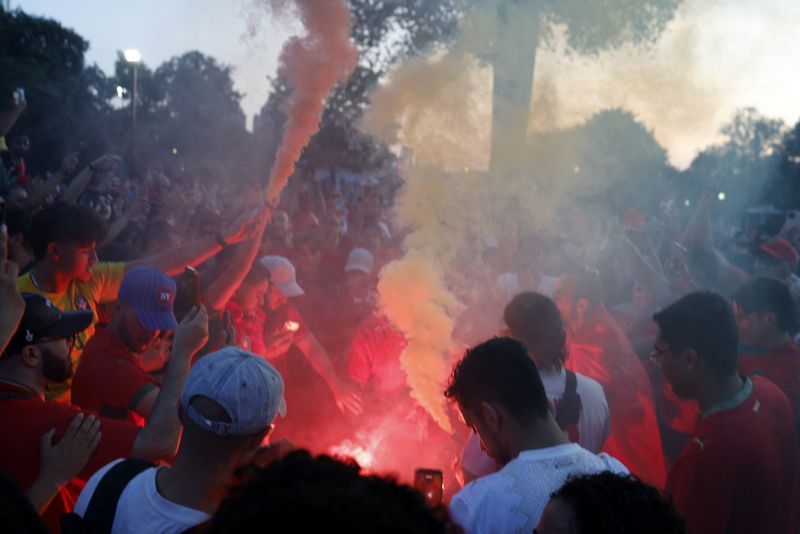
The gathering in Boston Common ahead of Thursday's match underscored this communal spirit. Over one thousand supporters assembled peacefully, singing Dima l-Maghrib (Always Morocco) and displaying flags in celebration rather than confrontation. International supporters travelled considerable distances, with one 36-year-old software engineer journeying from Finland specifically to experience Morocco's continued World Cup campaign. The tone across these gatherings suggested genuine festivity and shared enthusiasm for watching compelling football rather than nationalist tension seeking outlet through sporting competition.
Morocco's evolving stature in international football has fundamentally altered the nature of this fixture compared to their 2022 encounter. Four years ago, when France defeated Morocco 2-0 in Qatar's semi-final, the Atlas Lions represented remarkable underdogs who had exceeded expectations by becoming the first African nation to reach that stage. Their current iteration commands different respect. Morocco has developed systematic player development infrastructure, maintained organisational discipline, and cultivated genuine belief that they can challenge football's established powers. Their dominant 3-0 victory over Canada demonstrated the pace, defensive solidity, and attacking ambition that has sustained their tournament run.
France approaches this quarter-final as defending World Cup champions with established credentials and formidable attacking resources. Yet Morocco's trajectory demands caution. The French federation and coaching staff recognise they face opponents shaped by rigorous development rather than fortunate circumstance, a team whose diaspora recruitment strategy has generated genuine competitive advantage. France's victory over Paraguay secured their quarter-final position, but observers understand that Morocco's organised structure and proven capacity to frustrate stronger opponents present distinct challenges.
The fixture transcends typical international football rivalry through its fundamental nature as a meeting between nations whose histories are inseparable. Post-colonial legacies, migration patterns, shared language, educational networks, and individual relationships between players all converge to create an encounter that acknowledges competition while grounded in deeper recognition of mutual connection. Boston's setting, distant from the historical intensity of European venues, may allow this essential character to flourish without additional layer of nationalist tension. The match becomes not a clash between enemies but a contest between countries whose peoples, despite distinct national identities, remain bound through countless personal, professional, and familial ties that football merely brings into sharp focus.

