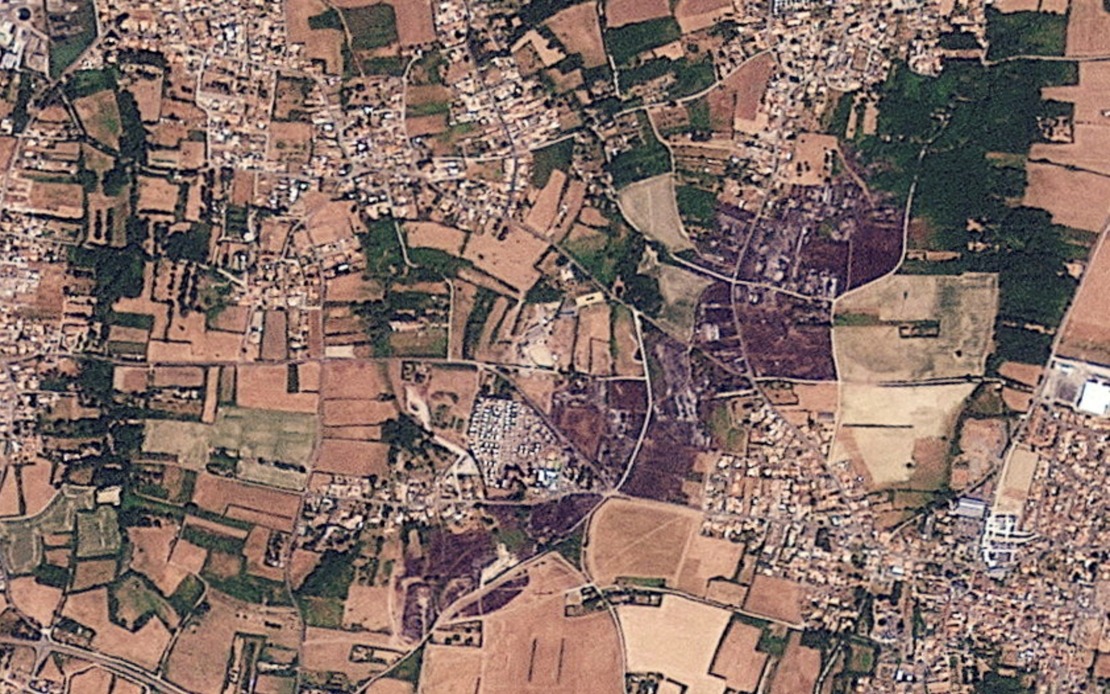
France is grappling with an escalating wildfire crisis as two separate blazes in the Fontainebleau forest continue their destructive spread, with combined damage reaching approximately 1,920 hectares of forest and vegetation. The situation remains precarious as overnight operations failed to halt the fires' advancement, prompting authorities to maintain a substantial firefighting presence and investigate potential criminal involvement in igniting at least one of the conflagrations.
The initial fire, which ignited on Sunday, has consumed roughly 1,500 hectares of the iconic Fontainebleau woodland, while a second blaze has laid waste to between 300 and 400 hectares of additional terrain. Both incidents continue to demand intensive resource deployment, with approximately 600 firefighters stationed on the ground to manage containment and suppression efforts. The scale of destruction underscores the severity of France's current fire season and the strain being placed on emergency response infrastructure throughout the nation.
Investigations have already borne fruit in identifying perpetrators, with law enforcement authorities apprehending two individuals suspected of deliberately initiating the primary Fontainebleau fire. This discovery has prompted stern messaging from government officials regarding consequences for those found guilty of arson. French Transport Minister Philippe Tabarot has publicly advocated for punitive judicial action, explicitly calling for prosecutions that would result in "very harsh sentences" for confirmed perpetrators of intentional forest fires.
Tabarot's pronouncements reveal the complexity of addressing wildfire causation, as he acknowledged the distinction between deliberate criminal arson and pathological fire-setting behaviour. While demanding severe penalties for those who knowingly set fires, he simultaneously emphasised that individuals suffering from pyromania—an impulse control disorder—should receive psychiatric intervention rather than purely punitive measures. This dual-track approach suggests French policymakers recognise both the criminal and medical dimensions of intentional fire-setting.
The incidence of deliberate wildfire-setting has emerged as a significant enforcement challenge across France. Since the commencement of the current fire season, national authorities have arrested 59 individuals on suspicion of intentionally igniting woodland and brush fires throughout the country. This statistic reveals the pervasiveness of arson as a contributor to France's fire crisis and highlights why government officials are pursuing stringent deterrence policies.
Beyond the Fontainebleau situation, France confronts simultaneous fire emergencies in geographically dispersed regions, disrupting civilian infrastructure and displacing residents. The Trevillach wildfire, which erupted earlier in July within the Pyrenees-Orientales region, has damaged critical railway infrastructure along routes connecting Perpignan, Villefranche, and Vernet-les-Bains. This damage has necessitated suspension of train services between Ille-sur-Tet and Villefranche-Vernet-les-Bains, with national railway operator SNCF announcing that normal operations would not resume before July 20 at the earliest.
The disruption to transport networks illustrates how wildfires extend their impact far beyond immediate environmental destruction, affecting economic activity and civilian mobility across affected regions. The Perpignan-Villefranche-Vernet-les-Bains corridor serves communities in the Pyrenees foothills, and extended service suspensions create logistical challenges for residents and businesses dependent on rail connectivity. Such cascading consequences demonstrate why wildfire prevention and rapid suppression constitute priorities transcending pure environmental considerations.
Fires have simultaneously erupted in Brittany, where authorities dealt with a heath fire outbreak proximate to Cap Fréhel in the Côtes-d'Armor department. This incident necessitated the evacuation of more than 100 residents as the fire consumed approximately 38 hectares of heathland. The evacuation demonstrates how wildfires pose direct threats to human safety even in coastal regions typically viewed as lower-risk environments compared to Mediterranean zones.
The Lozère region has similarly experienced fire activity, with authorities reporting approximately 107 hectares consumed by wildfire. This distribution of fire activity across multiple, non-adjacent regions—from Fontainebleau in the north-central territory to the Pyrenees in the south and Brittany in the northwest—indicates that France faces a geographically diffuse crisis rather than a localised phenomenon. Such spatial dispersal complicates resource allocation and suggests that weather patterns and vegetation conditions across extensive territorial areas are conducive to fire spread.
For Southeast Asian observers, France's wildfire experience offers instructive parallels to periodic fire crises affecting Malaysia and neighbouring nations. While climate and vegetation types differ substantially, the challenges of rapid suppression, investigation of deliberate fire-setting, and managing cascading impacts on transport and civilian populations remain relevant. Malaysia has confronted similar questions regarding adequate firefighting resources, the balance between punitive and preventive measures in addressing deliberate fire-setting, and the protection of vulnerable populations in fire-prone zones.
The French response, emphasising both enforcement against arsonists and treatment for those with impulse control disorders, reflects an increasingly nuanced understanding of wildfire causation in developed nations. This framework contrasts with approaches in some developing regions where enforcement capacity is more constrained. Yet Malaysia's sophisticated emergency response apparatus means that elements of the French approach—particularly the rigorous investigation of suspicious fires and the pursuit of enhanced penalties—align with domestic priorities.
The immediate humanitarian and ecological consequences of France's wildfire episode remain evolving, but the underlying vulnerabilities exposed by the crisis—including the prevalence of deliberate fire-setting, the adequacy of suppression resources, and the resilience of essential infrastructure—merit sustained attention. Authorities must balance punitive deterrence with treatment interventions while ensuring that firefighting capacity maintains pace with the scale of threats presented by increasingly variable climate conditions and growing fire seasons.

