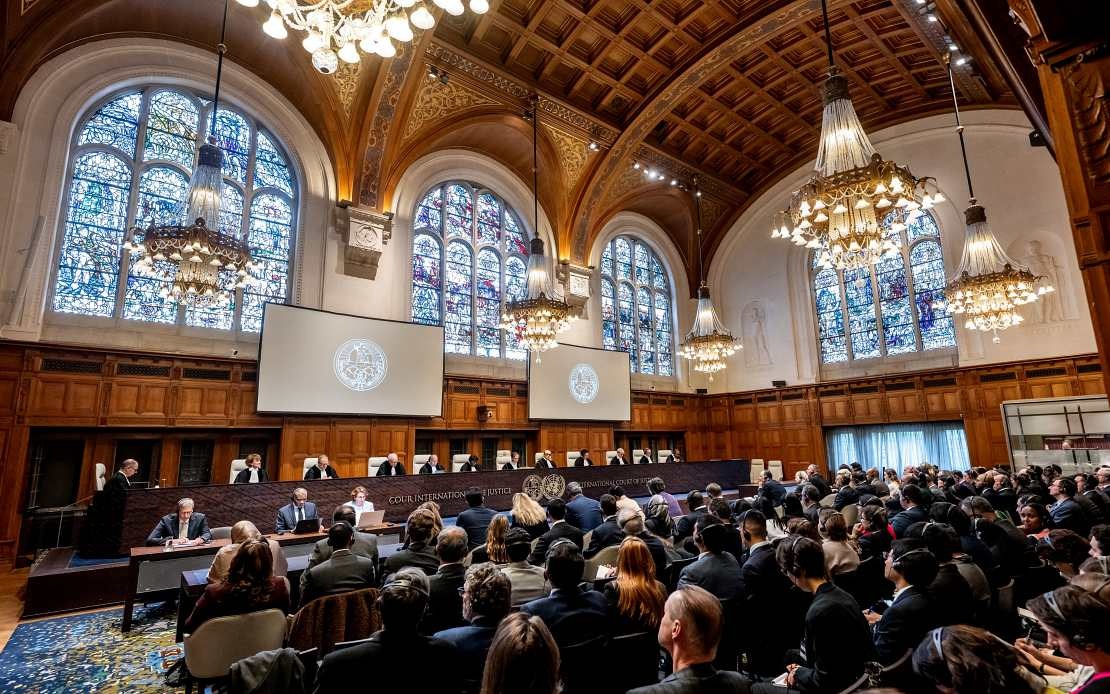
France has reaffirmed its unwavering commitment to the International Criminal Court, directly contradicting assertions from the United States that the institution poses a fundamental threat to national sovereignty. Speaking on Thursday, Foreign Ministry spokesman Pascal Confavreux dismissed American concerns as misguided, emphasizing that the ICC's mandate focuses exclusively on holding individuals accountable rather than challenging state authority. This public declaration represents Paris's clearest response yet to the escalating diplomatic row between Washington and the world's premier international justice body, signalling that Europe's major powers have no intention of abandoning their support for the institution despite mounting American pressure.
The timing of France's statement is significant, arriving in the wake of strong criticism from US Secretary of State Marco Rubio, who has characterized the ICC as an overreaching institution that threatens American interests. Rubio's position goes beyond rhetorical opposition; the State Department has reportedly launched a coordinated initiative specifically designed to constrain what officials describe as the court's ability to challenge American sovereignty. Washington has further signalled its intention to campaign actively among other nations to withdraw their membership, effectively attempting to isolate the court from the international consensus that has sustained it for more than two decades.
Confavreux's remarks merit closer examination for what they reveal about the structural differences between how the court operates and how American officials perceive its role. The French spokesperson made clear that the ICC prosecutes individuals accused of humanity's gravest offenses—genocide, war crimes, crimes against humanity, and the crime of aggression—not governments as institutional entities. This distinction proves central to understanding the contemporary dispute. The United States, having never ratified the Rome Statute that established the court, operates under a different conceptual framework regarding international accountability and the relationship between sovereignty and justice.
France's position reflects a broader European consensus that has crystallized around the ICC as a necessary counterbalance to impunity for mass atrocities. By publicly reiterating support for the institution and emphasizing its resilience, Paris signals that European nations view the court as a legitimate, indeed essential, component of the international legal architecture. This stance carries particular weight given France's permanent seat on the United Nations Security Council and its traditional influence in shaping international norms and institutions.
The French government also extended its criticism to what it characterized as unacceptable attacks and threats directed against ICC personnel and officials. This reference likely encompasses not only rhetorical pressure from Washington but also reports of intimidation campaigns against court staff. By highlighting such conduct, Confavreux positioned France's defense of the ICC within a broader narrative about the rule of law and the protection of those who work to enforce international justice mechanisms.
For Southeast Asian observers, this transatlantic dispute carries particular relevance. Several nations in the region maintain complicated relationships with international justice institutions. Indonesia and Malaysia, while not ICC members, have engaged with the institution's work on various matters. The Philippines, meanwhile, withdrew from the ICC in 2019 amid tensions with the court over investigations into the country's drug war. The current American campaign to undermine the court could influence how regional governments calibrate their own positions on international justice mechanisms and their broader alignment with either Washington or the European approach to global governance.
The ICC's establishment in 2002 represented a landmark achievement in international law, creating the first permanent institution dedicated to prosecuting individuals responsible for the world's most serious crimes. The court's location in The Hague reflects the institutional preferences of its founding nations, predominantly Western democracies committed to liberal international order. However, the institution has since broadened its geographical reach, investigating situations across Africa, the Middle East, Asia, and Europe, though this expansion has itself generated controversies about selectivity and bias.
US opposition to the ICC predates the current administration. American administrations have long harbored concerns about the court's potential jurisdiction over American citizens and military personnel, preferring to maintain what Washington views as appropriate national control over accountability for its own forces. However, the contemporary push to actively discourage other nations from membership represents a notably aggressive posture compared to previous American strategies of passive non-engagement with the institution.
France's reaffirmation of support also implicitly critiques the underlying American premise that international justice mechanisms necessarily threaten sovereignty. From the French perspective—and indeed from that of most ICC member states—genuine sovereignty includes the capacity and responsibility to contribute to a functioning international system that prevents the worst atrocities. Rather than viewing the ICC as an infringement on state authority, France and its allies conceive of membership as an expression of sovereign choice to participate in collective security and justice arrangements.
The strategic implications of this dispute extend beyond the immediate question of the ICC's institutional authority. The US campaign against the court reflects broader tensions within the international system regarding the relative weight accorded to national sovereignty versus universal principles of accountability. These tensions have become particularly acute in debates surrounding investigations into situations involving major powers or their allies, where the line between principled justice and selective accountability becomes contested.
For Malaysia and other Southeast Asian nations, the unfolding dispute presents a choice between two competing visions of global governance. One model, represented by France and other ICC supporters, envisions international institutions as legitimate expressions of collective commitments to accountability and the rule of law. The alternative model, preferred by Washington, places greater emphasis on national prerogatives and the preservation of state control over accountability mechanisms affecting citizens and military forces. How regional governments ultimately respond to American pressure to distance themselves from the ICC will reflect both their strategic alignment and their own evolving perspectives on the proper role of international justice.
France's Thursday statement should not be dismissed as mere diplomatic positioning. It represents a substantive commitment to the idea that lasting international peace and security depend on robust mechanisms for addressing atrocities, however politically inconvenient the consequences might be for particular states at particular moments. Whether this European determination to defend the ICC can withstand sustained American opposition—especially if the US campaign succeeds in recruiting other nations to withdraw—remains an open question with potentially significant consequences for the future of international criminal justice.

