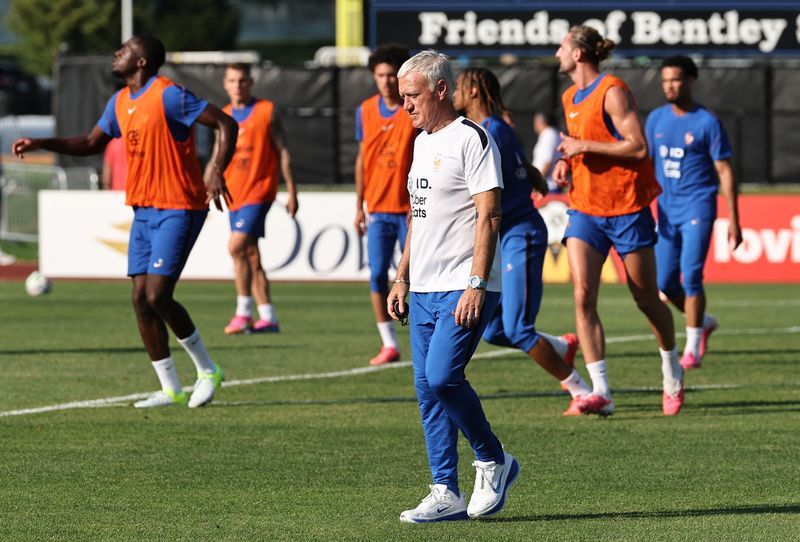
France enters their Round of 32 World Cup encounter against Sweden on Tuesday riding a wave of attacking dominance that has left observers convinced of their credentials to win the tournament. The French swept through the group stage undefeated, amassing an impressive ten goals across victories against Senegal, Iraq and Norway, establishing themselves as one of the competition's most potent offensive forces. Coach Didier Deschamps has assembled an array of world-class attacking talent that has produced consistently spectacular performances, yet underlying vulnerabilities on the team's left side remain a concern heading into knockout football where defensive solidity becomes increasingly crucial.
The attacking arsenal at Deschamps' disposal is genuinely formidable. Kylian Mbappe continues as the standout performer and driving force behind France's ambitions, while Ousmane Dembele's clinical finishing, highlighted by his three-goal haul against Norway, showcases the quality available across the frontline. Michael Olise has provided creative thrust and directness that opponents have struggled to contain, making the right-flank combination of Mbappe-Dembele-Olise arguably the tournament's most destructive attacking unit. This depth of talent extends far beyond the starting eleven, with Bradley Barcola, Desire Doue, Rayan Cherki, Jean-Philippe Mateta and Marcus Thuram among the alternatives available on the bench—a level of forward reinforcement that few international squads can match.
Yet Deschamps faces a tactical puzzle on the opposite flank. Theo Hernandez, France's starting left back, has failed to deliver the assured performances expected from a player of his stature at the San Carlo fortress. His positioning and defensive reliability have occasionally appeared uncertain, prompting the French coaching staff to consider alternatives. Lucas Digne is poised to replace Hernandez for the Swedish encounter, bringing more disciplined defensive work and improved crossing accuracy from the left touchline. This adjustment represents more than a simple defensive switch; it signals Deschamps' intention to construct greater tactical balance across his formation.
Further up the left flank, Bradley Barcola is expected to displace Desire Doue from the starting lineup, a change reflecting Deschamps' desire for more incisive attacking movement in wide areas. Barcola offers direct running, explosive pace in transition and the kind of natural width that can stretch opposing defences sideways rather than concentrating play in central zones. The shift represents Deschamps recalibrating his attacking approach for knockout football, where efficiency becomes paramount and creative phases must be sharper and less laboured than in group-stage football where opponent fatigue becomes an advantage.
Sweden present themselves as a stern but not spectacular obstacle. They qualified from Group F in second position behind the Netherlands, opening with an emphatic 5-1 demolition of Tunisia before suffering their own 5-1 mauling at Dutch hands and salvaging a 1-1 draw against Japan. Their record demonstrates both the capacity to produce clinical displays and vulnerability against elite opposition, suggesting they are dangerous opponents rather than likely challengers to France's dominance. The Swedish team possesses sufficient physical presence and organisational discipline to create problems for France if the French lose concentration, yet their attacking resources—headlined by Alexander Isak, Viktor Gyokeres and Anthony Elanga—pale alongside France's embarrassment of talent.
The defensive stabilisation of France's backline through William Saliba's return to the centre of their defence offers reassurance during this transition period. Saliba's experience and positional discipline should provide security in the central areas where Sweden might seek to exploit space, particularly on the counter-attack if France commits numerous players forward. Yet the French defence has occasionally been caught unawares during the group stage, suggesting that even with Saliba's presence, vulnerability to quick transitions remains a realistic possibility that Sweden will attempt to exploit.
France's record in knockout football at World Cups provides substantial confidence. Beyond their defeat in the 2022 final against Argentina, France have not lost a knockout-stage match at the World Cup since 2014, a run spanning multiple tournaments and emphasising the team's ability to concentrate when stakes intensify. The transition from group-stage football, where overwhelming opponents through sustained attacking pressure proves effective, to the compressed and more defensive nature of knockout encounters represents a significant shift in tactical requirement. France's capacity to manage this transition while maintaining their attacking threat will likely determine whether they progress to the Round of 16, where they would face either Germany or Paraguay.
Former England striker Gary Lineker, commenting in French sports publication L'Equipe, dismissed notions of Swedish upset potential, acknowledging that while Isak, Gyokeres and Elanga represent respectable attacking threats, they operate at a fundamentally different level from France's exceptional depth. Lineker conceded that France's four primary forward options create counter-attacking vulnerabilities, a pattern glimpsed during Friday's group-stage fixture against Norway's second-string eleven, yet maintained that France's superior goal-scoring firepower should prove decisive in any attacking exchange. The fundamental imbalance in attacking resources between the teams suggests that French superiority in the final third will ultimately prove too substantial for Swedish defensive structures to withstand.
Deschamps' tactical adjustments on the left side represent intelligent preparation rather than panic. By introducing greater defensive security and more direct attacking movement from Barcola, the French coach is seeking to eliminate the soft underbelly that opponents might probe. Sweden will inevitably defend with defensive discipline and seek opportunities through set-piece situations, hoping to capitalise on any momentary loss of concentration from the French defence. Yet France's ability to generate multiple goal-scoring chances—and crucially, to convert those opportunities—suggests that Sweden will find the defensive burden increasingly exhausting as the match progresses, eventually leading to the breakthrough that sends France into the knockout rounds as serious tournament contenders.

