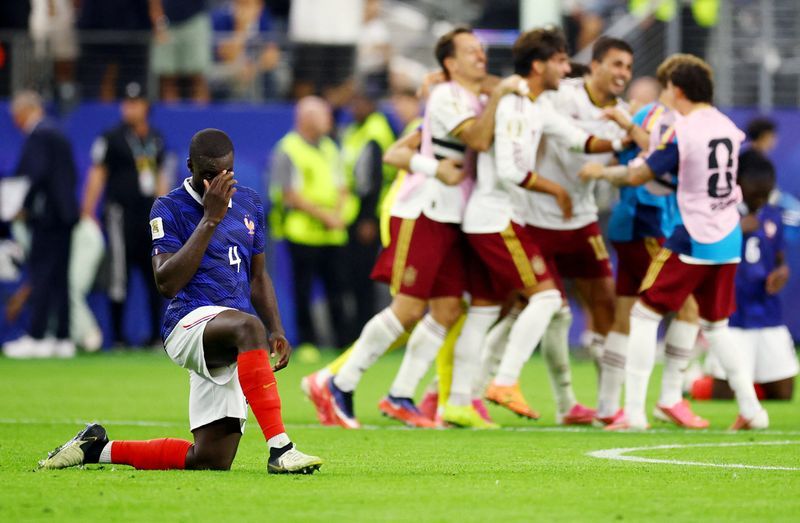
France's World Cup campaign came to an abrupt and humbling end on Tuesday in Arlington, Texas, when they succumbed to a comprehensive 2-0 semi-final defeat at the hands of Spain, ending months of speculation about whether the tournament favourites could repeat their deep playoff success from the 2022 campaign. The loss represented far more than a simple knockout elimination; it exposed critical vulnerabilities in a squad that had entered the competition as one of the most heavily backed contenders, only to crumble entirely when genuine adversity arrived.
Coach Didier Deschamps offered a candid post-match assessment that underscored the scale of the underperformance. Rather than seeking refuge in excuses or circumstance, he confronted the fundamental reality that France had simply been outplayed by a superior Spanish side. The acknowledgement carried particular weight given the extensive preparation and confidence surrounding the squad's technical abilities heading into the knockout stages. For all the talk of cohesion and unity that dominated pre-match discussions, the performance on the field told a starkly different story.
The collapse echoed uncomfortable parallels to France's opening performance in the 2022 World Cup final against Argentina, where they similarly appeared out of sorts for extended periods. However, that night in Qatar provided redemption of sorts, as Didier Deschamps' players rallied to force extra time and penalties, ultimately losing only on the penalty shootout while contributing to what many observers regarded as one of the tournament's greatest matches. No such comfort existed in Texas. France were reduced to spectators watching a Spanish masterclass unfold, unable to mount any meaningful response to their opponents' measured dominance.
Spain's tactical execution proved decisive in neutralising France's attacking threats. The Spanish approach, built around controlling the game's tempo and forcing opponents to operate at a deliberately reduced pace, completely stymied the French rhythm. Rayan Cherki, who entered the match as a second-half substitute, later acknowledged that France had fundamentally misjudged how effectively Spain would implement their strategic blueprint. The French midfield became increasingly pedestrian as the match progressed, unable to find the dynamic transitions that had characterised their earlier tournament performances.
Michael Olise emerged as perhaps the most visible symbol of France's collective technical failure. The midfielder, widely heralded as an old-school playmaker whose creative brilliance had thrust him into Ballon d'Or conversations heading into the competition, appeared utterly adrift on the Dallas Stadium pitch. Operating in an environment where Rodri's methodical control suffocated any French opportunity to build momentum, Olise surrendered possession on twenty separate occasions while failing to complete a single dribble. The statistical profile painted a damning picture of a player expected to unlock Spain's defensive organisation but instead comprehensively outclassed by an opponent who dictated proceedings with clinical authority.
Beyond Olise's struggles, France's entire attacking cohort failed to register meaningful impact when the tournament stakes reached their zenith. Ousmane Dembele's contributions amounted to little more than peripheral involvement, while the forward line's supposed potency evaporated almost completely. Bradley Barcola and his replacement Desire Doue offered similarly blunt attacking contributions, leaving the vaunted French offensive arsenal appearing strangely impotent against Spanish organisation. Even Kylian Mbappe, whose mercurial talents had animated France's campaign up to that point, never found the moments of decisive intervention that had defined his tournament performance. The afternoon's loudest roar came not from the pitch but from the sidelines when David and Victoria Beckham appeared on the giant screen, an ironic punctuation mark on France's inability to generate excitement through their own play.
Spain's opening goal, arriving in the twenty-second minute through a Mikel Oyarzabal penalty conversion, stemmed directly from vulnerabilities in France's defensive organisation. The penalty itself resulted from clumsy defending that suggested mental disorganisation from the outset. Pedro Porro's goal just before the hour mark highlighted a recurring problem throughout the evening: France's middle defensive unit proved inadequate to the task of shielding a persistently exposed backline. Deschamps' midfield pairing, the supposed twin anchors of defensive solidity, crumbled under Spanish pressure almost immediately.
Adrien Rabiot's early yellow card substantially constrained his ability to provide the physical intervention that might have disrupted Spain's rhythm. Aurelien Tchouameni, already compromised by missing the previous two matches with a hamstring injury, found himself unable to match the pace and positioning demands that Spain's controlling brand of football imposed. The absence of a third midfielder to provide defensive support meant France's backline faced wave after wave of Spanish movement, with insufficient midfield resistance to blunt the threat.
France's vulnerability throughout the contest extended beyond specific personnel failures to encompass fundamental tactical misjudgement. The collective assumption that France's individual quality would suffice to neutralise Spain's sophisticated technical approach proved catastrophically wrong. Those who had installed France as tournament favourites appeared to have fundamentally misread the balance of competitive power, and the French players themselves had compounded this analytical error through inadequate respect for Spanish capabilities. Lamine Yamal's pre-match declarations, made with the swagger of youthful confidence that France should fear Spain rather than the reverse, proved precisely calibrated to reality.
The final whistle brought visceral displays of emotional devastation that illustrated the magnitude of the disappointment. Mbappe stood alone on the pitch as his teammates responded variously with kneeling, buried faces, and visible anguish. The carefully cultivated narratives about squad unity and cohesion suddenly felt remote and unconvincing, replaced by the raw reality of a tournament campaign that had promised so much but delivered so little when the moment of genuine examination arrived. For Southeast Asian observers, the collapse serves as a reminder that competitive football at the highest level punishes complacency and misjudgement without mercy, regardless of pedigree or pre-tournament billing.

