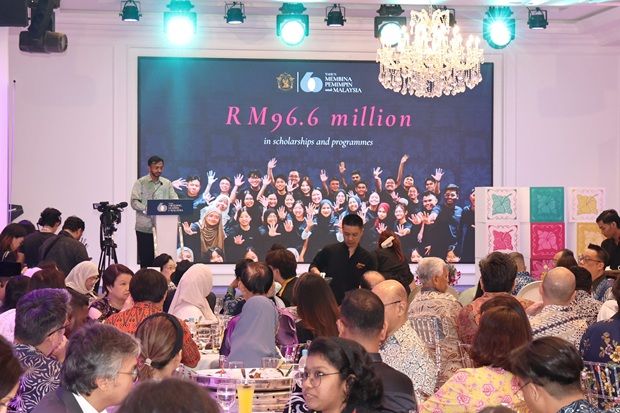
The Tunku Abdul Rahman Foundation reached a significant milestone on August 13 as it commemorated its 60th anniversary at Bangunan Sultan Abdul Samad, reflecting on six decades of commitment to expanding educational opportunities for Malaysian youth. The occasion brought together current and former scholars, government officials, and institutional supporters to recognise the organisation's enduring contribution to nation-building through investment in human capital. National Unity Minister Datuk Aaron Ago Dagang presided over the ceremony, acknowledging how the foundation has evolved from a straightforward scholarship provider into a comprehensive talent identification and development institution that remains deeply embedded in Malaysia's educational ecosystem.
The foundation's origins reveal a compelling story of grassroots nation-building. When the government proposed honouring Malaysia's first Prime Minister, Tunku Abdul Rahman Putra al-Haj, the initiative took an unusual and democratic form. Rather than establishing a top-down memorial, Utusan Melayu launched a nationwide fundraising campaign on Tunku's birthday that captured the public imagination, ultimately accumulating more than M$60,170.20—an amount equivalent to approximately RM380,000 in contemporary value. This community-driven effort demonstrated the widespread desire among Malaysians to channel resources towards educational advancement, laying the philosophical groundwork for what would become a national institution.
The transformation from crowdfunded campaign to statutory body occurred through legislative action when Education Minister Tan Sri Mohamed Khir Johari championed the creation of Yayasan Tunku Abdul Rahman via the Tunku Abdul Rahman Foundation Fund Act 1966 (Act 43). This legislative framework distinguished the foundation as one of the earliest institutions established to honour a national leader while simultaneously serving as a functional vehicle for social mobility. Rather than functioning merely as a ceremonial entity, the foundation was designed to directly address Malaysia's pressing need for an educated workforce capable of driving national development during the critical post-independence period.
Over the past six decades, the foundation's reach has extended across the breadth of Malaysian society, transcending communal and economic boundaries. The organisation has channelled support to more than 12,000 Malaysian youths without regard to race, religion, or socioeconomic background, disbursing a cumulative RM96.6 million across scholarships, loans, financial assistance programmes, and increasingly, employability initiatives that prepare graduates for workforce entry. This evolution from purely educational funding to a more holistic talent development approach reflects changing economic and social conditions that demand not merely academic credentials but also practical skills and professional competencies.
Two distinguished alumni, who received recognition at the anniversary celebration, exemplify the foundation's transformative capacity. Ch'ng Kim See, a scholarship recipient since 1967, described receiving her award as providential at a moment when financial hardship threatened to derail her university education. Her subsequent career as one of Southeast Asia's most prominent librarians and regional authorities on library science and South-East Asian history represents the type of intellectual contribution the foundation was designed to nurture. Similarly, Dr Zakaria Ali, a pioneering figure in Malaysian fine arts and an accomplished painter, writer, and academic, traced his scholarship journey through an improbable chain of advocacy that included direct appeals to the monarchy and government, resulting in an educational opportunity that fundamentally altered his life trajectory and subsequently enriched Malaysian cultural and intellectual life.
The foundation's institutional philosophy emphasises education as more than academic attainment. Datin Sri Sharifah Menyalara Syed Hussein, the late Prime Minister's granddaughter and current YTAR chairperson, articulated how Tunku Abdul Rahman understood education as fundamentally about character formation and purposeful citizenship. This conception extended the foundation's mission beyond credentials to encompassing values development and preparation for meaningful social contribution. Over six decades, the institution has progressively evolved its approach, moving from basic financial aid provision toward identifying high-potential individuals and providing them with capital, opportunities, skills development, and values orientation designed to equip them for comprehensive societal participation.
The alumni network demonstrates the foundation's multiplier effect within the national development framework. Tunku Scholars have dispersed across every profession and sector—from education and civil service to law and medicine—united by a shared conviction regarding collective responsibility for national advancement. This diffusion of foundation-supported individuals throughout institutional hierarchies means that the organisation's philosophy and values permeate decision-making across numerous sectors simultaneously, creating indirect returns on investment that extend well beyond individual career trajectories into systemic institutional influence.
Minister Aaron Ago's remarks at the anniversary ceremony carried particular significance regarding future directions, as he urged Malaysian corporations to prioritise education and talent development within their corporate social responsibility agendas through partnerships with foundations such as YTAR. This call represents recognition that sustainable national development increasingly requires collaborative engagement between public institutions, statutory bodies, and private sector entities. The foundation's experience over six decades provides a proven model and institutional framework that business organisations can leverage to magnify the impact of their social investment programmes while simultaneously addressing Malaysia's evolving human capital requirements.
CEO Kularetnam Vijayakumar emphasised that the foundation's longevity derives not from individual leadership but from generations of custodians and supporters who have sustained its mission and adapted its operations to changing circumstances. This institutional resilience reflects a governance structure capable of transcending individual tenures and maintaining continuity of purpose across shifting political and economic contexts. The foundation has successfully navigated Malaysia's transformation from a newly independent nation focused on basic educational access to a middle-income country requiring specialised talent development in knowledge-intensive sectors, demonstrating organisational flexibility without sacrificing core mission integrity.
The anniversary celebration concluded with the announcement of two significant developments. National Unity Minister Datuk Aaron Ago Dagang opened nominations for the 2026 Pingat Tunku Award, a recognition programme honouring distinguished alumni contributions to nation-building. More notably, the foundation introduced self-nomination eligibility for the first time, extending the award process to graduates of both public and private higher education institutions throughout Malaysia beginning August 31 through September 30. This democratisation of the nomination process reflects institutional confidence in reaching accomplished alumni across Malaysia's expanding and diversified higher education ecosystem.
As Malaysia confronts twenty-first-century challenges requiring sophisticated technical expertise, entrepreneurial innovation, and ethical leadership grounded in national values, the foundation's accumulated experience with talent identification and development assumes renewed significance. The YTAR model of combining financial support with values formation offers relevant lessons as the country grapples with ensuring that economic advancement translates into inclusive, sustainable national development. The foundation's six-decade journey from grassroots crowdfunding initiative to statutory national institution demonstrates how educational investment, pursued with consistency and purpose, generates returns extending across generations and institutional domains, fundamentally shaping the character and capabilities of the nation.

