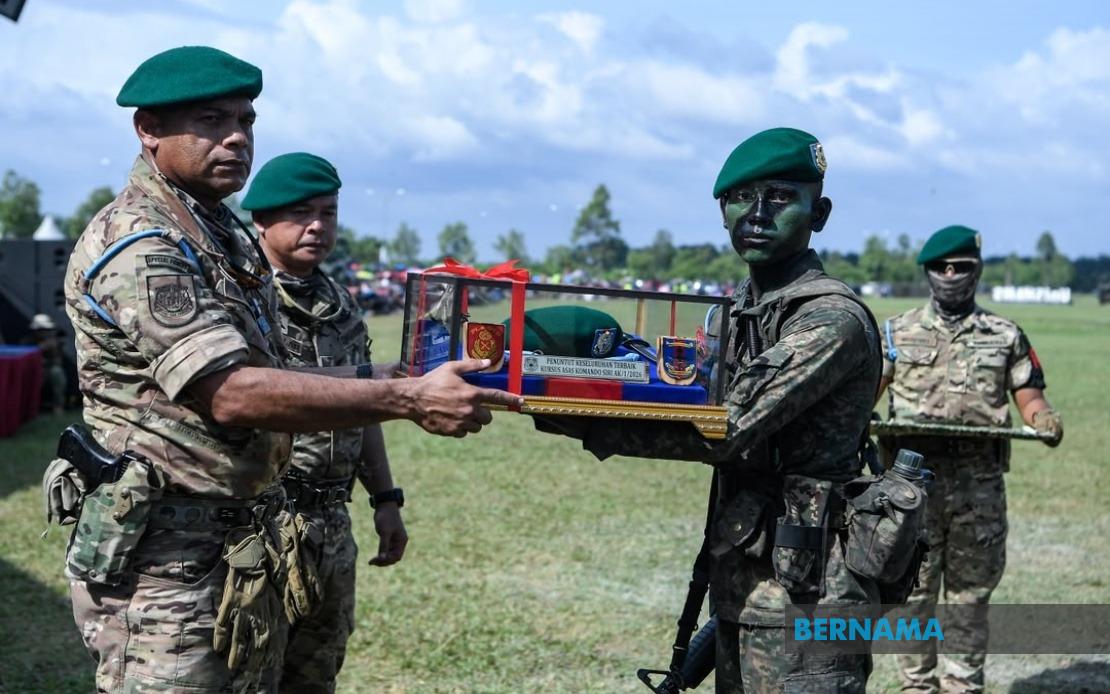
Second Lieutenant Muhammad Fadli Jamalluddin has emerged as the outstanding graduate of the Basic Commando Course Series AK/1/26, a prestigious distinction that came only after he rebounded from an earlier failed attempt at the gruelling three-month programme. The 24-year-old officer from Ampang, Kuala Lumpur, completed the course at Universiti Sultan Abdul Halim Mu'adzam Shah in Kuala Ketil on July 11, earning recognition for excellence amid some of Malaysia's most demanding military training.
Fadli's journey to this achievement underscores a narrative increasingly valued in professional military contexts worldwide: the capacity to learn from setback and demonstrate greater determination. Having failed to complete the Basic Commando Course Series 3/2024, he returned with renewed focus, ultimately not merely passing but distinguishing himself among his peers. His resolve reflects a personal philosophy that adversity, rather than constituting defeat, represents an opportunity for transformation and growth.
The officer's military ambitions took root during his secondary education, establishing a foundation that led him to pursue formal military studies at the National Defence University of Malaysia, commonly known as UPNM. Upon graduation, he commissioned as an officer in the Royal Malay Regiment in 2024, positioning himself for the challenging path toward commando qualification. As the third of five siblings, Fadli cited both personal aspiration and family motivation as driving forces, particularly his desire to honour his father and achieve a milestone widely regarded within military circles as one of the profession's pinnacle accomplishments.
The decision to pursue commando training was neither casual nor inevitable. During his final year at UPNM, Fadli consciously evaluated the direction of his military career and concluded that the commando specialisation represented the natural culmination of his commitment. He recognised that while officer training provided essential foundations, the 21st Special Service Group, Malaysia's elite commando unit, demanded an additional dimension of capability that few attain. This deliberate choice set the stage for the extraordinary challenges ahead.
The severity of the course became evident during the second attempt. In the eighth week of training, Fadli encountered what appeared to be a career-threatening failure during one of the core exercises—a setback that could have necessitated withdrawing from the entire programme. By that point, he had already endured over 100 kilometres of exhausting endurance marches, testing the limits of physical stamina and mental fortitude. The prospect of repeating this ordeal disheartened him, prompting tears in the moment of failure. Yet, contrary to well-meaning advice from associates urging him to accept defeat, Fadli chose to persist.
This resilience proved consequential. Completing a commando officer training course presents distinctive challenges compared to enlisted ranks. Beyond the physical demands—land and sea operations under extreme conditions, sleep deprivation, and sustained exertion—the officer track requires cultivation of leadership acumen, tactical thinking, and the capacity to make sound decisions under pressure. The blend of physical endurance with intellectual sharpness distinguishes commando officers, preparing them for complex special operations that demand both warrior capability and strategic judgment.
Fadli's academic background in Global Policing and Intelligence provided intellectual preparation for these dimensions. The honours degree signalled capacity for analytical thinking and specialist knowledge relevant to contemporary security challenges. Yet, as he acknowledged during interviews following his achievement, no amount of classroom learning fully replicates the proving ground of field training. The commando course remains fundamentally experiential, designed to push individuals beyond perceived limitations and identify those capable of functioning effectively in extreme operational environments.
The completion rate itself underscores the course's selectivity. From a cohort comprising five officers and 33 other ranks, all successfully graduated from Series AK/1/26, yet Fadli's designation as Best Overall Trainee reflected exceptional performance across the programme's multiple dimensions. This distinction, presented by Colonel Nordin Abu, Commandant of the Special Warfare Training Centre (PULPAK), carries particular weight within Malaysia's military establishment, marking Fadli as an emerging leader of uncommon capability.
Beyond the individual achievement, Fadli's journey holds significance for his family, particularly his father, who suffered a stroke over a year prior to the course completion. Though his father could not attend the closing ceremony, Fadli hoped this accomplishment would serve as both source of family pride and, symbolically, a wellspring of strength for his father's recovery journey. The personal dimensions of military achievement—often overlooked in public discourse—underscore how professional accomplishment interweaves with intimate family narratives.
Fadli's emergence as a distinguished commando officer arrives at a period when Malaysia's security framework continues evolving to address regional and transnational challenges. The 21st Special Service Group, as an elite unit, plays a crucial role in counterterrorism, special reconnaissance, and training operations across Southeast Asia. Officers like Fadli, who have demonstrated capacity to overcome adversity whilst maintaining focused excellence, represent an institutional asset in these contexts. His training, combined with his intelligence background and evident leadership qualities, positions him to contribute meaningfully to Malaysia's security capabilities.
The narrative of initial failure followed by distinguished success resonates beyond military contexts, embodying principles increasingly central to contemporary professional development discourse: the value of perseverance, the distinction between setback and terminal defeat, and the transformative potential of determined recommitment to challenging goals. In military culture particularly, where unit cohesion and individual reliability form the foundation of operational effectiveness, Fadli's demonstrated resilience carries functional significance alongside inspirational dimensions.
Looking forward, Fadli's commando qualification opens pathways toward advanced specialisation within Malaysia's special forces ecosystem. Officers who complete basic commando training frequently progress toward advanced courses, command positions within elite units, or specialised roles in counterterrorism and intelligence operations. His trajectory suggests potential for significant contribution to Malaysia's defence establishment across the coming decades. The combination of academic achievement, technical commando proficiency, and demonstrated resilience creates a foundation for sustained advancement within professional military ranks.

