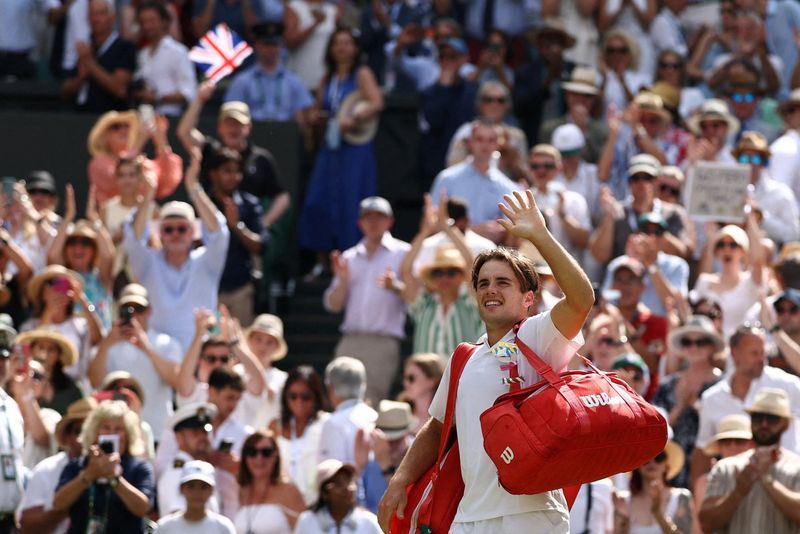
Arthur Fery had accepted an uncomfortable truth when he arrived at the All England Club as a wildcard entry: he would likely play one or two matches before heading off to sunbathe on a Greek island with friends. Instead, the 114th-ranked British tennis player has become the most improbable story of the tournament, reaching the semi-finals in a run that has captivated the nation and rewritten his professional trajectory overnight.
The 23-year-old Frenchman who represents Britain advanced further than anyone could have reasonably anticipated, becoming the first wildcard qualifier to reach the men's semi-finals at Wimbledon in a quarter-century. His path through the draw saw him defeat five opponents in succession, each victory adding another chapter to what increasingly felt like a scripted Hollywood narrative rather than genuine sporting competition. Yet Fery's cinematic journey came to an end on Friday when German star Alexander Zverev overwhelmed him in straight sets, bringing his fairytale run to a conclusion.
The gap between Fery's original summer itinerary and his actual Wimbledon experience underscores how dramatically sporting fortune can shift. While he had anticipated relaxing under Mediterranean sunshine, he instead found himself grinding through matches during London's oppressive heatwave, testing his physical and mental reserves in ways his holiday would never have demanded. The contrast between what might have been and what actually occurred would have made for amusing dinner conversation—if his Greece trip had proceeded as planned.
Fery's unexpected success even tested the loyalty of his social circle. One friend, so convinced that the youngster would exit early, travelled to Greece ahead of schedule in hopes of Fery joining him soon. Yet as Fery kept advancing, his friend's strategy unravelled entirely. After just two days in Greece, the friend cut short his holiday and returned to England to support Fery's improbable quest, transforming from pessimist to genuine believer in the process.
The British public's embrace of Fery extended far beyond casual supporters converting in his favour. The English men's football team, fresh from their own tournaments, sent recorded messages of encouragement to the young tennis player. More significantly, Queen Camilla and the Princess of Wales both attended matches at Centre Court to witness Fery's performances in person, providing royal endorsement that elevated his profile far beyond typical wildcard recognition. This constellation of support created an electric atmosphere around his matches, with spectators treating his unlikely progress as a genuinely historic moment.
Fery's previous record at Grand Slam tournaments had been almost comically limited. Before this Wimbledon campaign, he had managed to win only two matches across all major championships in his entire career. This context makes his current achievement—reaching a semi-final at one of sport's most prestigious venues—almost incomprehensible in statistical terms. The transformation from journeyman qualifier to semi-finalist represents not merely an improvement but a fundamental shift in how the professional circuit will perceive and accommodate him.
The financial rewards of his unexpected semi-final appearance will substantially reshape Fery's immediate circumstances. The £900,000 prize money he earned for reaching the last four represents a sum that will transform his capacity to plan future tournaments and training arrangements. More importantly, his ranking is now anticipated to climb into the mid-30s, a classification that opens institutional doors previously closed to him. With his new ranking, Fery can access tour events for the next twelve months with far greater regularity, removing the constant pressure of needing to qualify through preliminary rounds.
Fery's perspective on the transformation ahead reveals both excitement and realistic awareness of the challenges that accompany sudden elevation. He recognises that moving from the margins of professional tennis into regular tour-level competition will bring substantially higher expectations from multiple quarters. His own self-expectations will naturally increase, while public attention in Britain will intensify given his status as a fresh national success story. The expectations emanating from within the professional tennis community will shift as well, with opponents no longer dismissing him as an unproven wildcard.
The mental and physical recovery period following his semi-final loss will prove crucial for consolidating his new position. Fery explicitly acknowledged that he needs time to process the extraordinary events of the past two weeks and allow his body to properly recuperate from the intensity of six matches at tennis's highest level. This period of reflection and rest will determine whether his Wimbledon success represents a genuine breakthrough moment or a remarkable isolated achievement that proves difficult to replicate.
Looking ahead, Fery has identified the American hardcourt swing culminating at the US Open as the next critical proving ground for his credentials. His debut at Flushing Meadows as the newly elevated British number one—a title he has effectively claimed through his Wimbledon performance—will provide immediate context for assessing whether his Centre Court heroics translate across different surfaces and tournament conditions. The transition from grass to hard courts frequently reveals whether players possess the versatility necessary for sustained success across the calendar.
Fery's trajectory carries broader implications for British tennis, which has experienced relative success at the elite level through players like Andy Murray but lacks a consistent supply of emerging talent at the highest echelons. His breakthrough, however unexpected, provides a genuine homegrown success story that could inspire younger players and reignite public interest in the sport domestically. The combination of British representation, youth, and genuine competitive achievement creates powerful narrative elements that extend beyond immediate tennis circles.
The wider significance of wildcard entrants reaching semi-finals also deserves examination. Fery's achievement represents a validation of inclusion mechanisms that provide pathways for developing players to test themselves against elite competition. Rather than sealing quarterfinal spots purely through rankings, the wildcard system creates genuine opportunities for breakthrough moments that can reshape careers entirely. This philosophy has produced one of Wimbledon's most memorable recent stories, suggesting that the system's philosophical underpinnings retain genuine value.
As Fery contemplates his upgraded holiday plans and the considerably altered landscape of his professional future, his journey from expected Greek lounging to semi-final participant at Wimbledon illustrates how sporting competition can overturn assumptions and create moments of genuine drama. Whether he ultimately becomes a permanent fixture at the tour level or remains chiefly remembered for this one extraordinary fortnight depends on decisions he makes over the coming months. What remains certain is that Arthur Fery has announced himself as a serious contender in British tennis.

