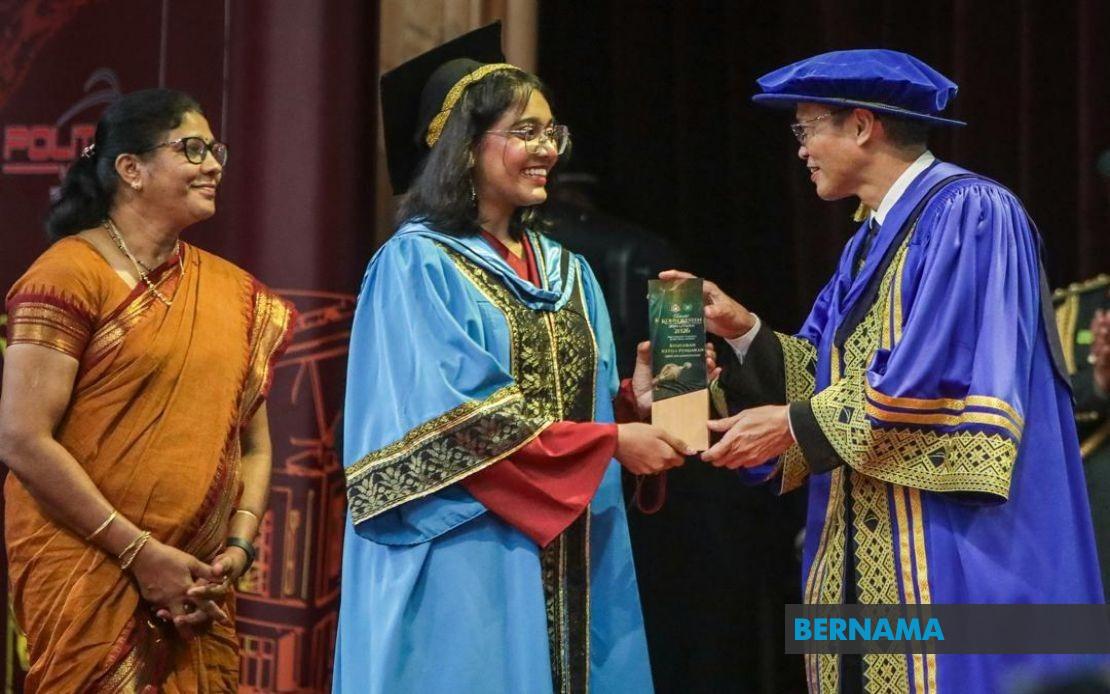
Teerti Ganapathi Rao's journey through her diploma studies at Politeknik Tuanku Syed Sirajuddin (PTSS) in Perlis stands as a testament to resilience in the face of profound personal hardship. The 22-year-old graduate of the Department of Information and Communication Technology (JTMK) received the Director-General's Award and the Academic and Co-Curricular Excellence Award during the Northern Zone Polytechnic and Community College Convocation Ceremony that commenced on August 3, 2026, attended by the Raja of Perlis, Tuanku Syed Sirajuddin Jamalullail. Her achievement proved particularly poignant given the circumstances under which she pursued her studies—her father's death occurred whilst she was in the midst of her Semester Two examinations in 2023, a moment that could have derailed her academic ambitions entirely.
Maintaining composure and focus through such an ordeal requires exceptional emotional fortitude, a quality Teerti demonstrated consistently throughout her three years at the polytechnic. She concluded her studies with a cumulative grade point average of 3.61, a result that reflects not merely academic capability but an extraordinary capacity to compartmentalise grief and channel it into productive effort. When notified of her award selection, Teerti expressed genuine astonishment, suggesting that she had internalized the notion that external recognition might be beyond reach given the turbulent circumstances of her final semesters. Her candid response to reporters reflected the humility characteristic of those who have navigated substantial adversity, transforming what could have been a barrier into a foundation for deeper meaning in her accomplishments.
The emotional scaffolding that sustained Teerti through her most challenging period came from her late father's counsel and unwavering encouragement. Though she briefly entertained the possibility of pursuing a foundation programme instead of completing her diploma, her father's insistent belief in her capacity to finish the three-year course became the anchor point to which she returned repeatedly during moments of doubt. This paternal guidance, internalized and carried forward after his passing, exemplifies how the influence of parental support transcends the immediate moment of its delivery and endures as a psychological resource during subsequent trials. For Teerti, these conversations were not merely motivational platitudes but concrete evidence that someone who knew her deeply believed in her potential, and that conviction proved sufficiently powerful to overcome the paralyzing effects of bereavement.
Beyond her core academic performance, Teerti's engagement with the broader institutional life at PTSS enriched her educational experience and contributed to the holistic development that the convocation ceremony celebrates. She received the Head of Department's Award across four separate semesters, demonstrating consistent excellence rather than isolated peaks of performance. Her active membership in the Student Representative Council (MPP) provided practical exposure to leadership dynamics, interpersonal communication, and collaborative problem-solving—competencies increasingly valued in technical fields dominated by team-based project delivery. These extracurricular commitments, pursued simultaneously with demanding coursework, reveal a student who grasped that technical proficiency alone was insufficient preparation for career advancement in the modern digital economy.
Teerti's intellectual scope extended well beyond the formal curriculum into collaborative international engagements that positioned PTSS within broader regional academic networks. She represented her polytechnic in a joint programme and seminar paper presentation at Universiti Putra Indonesia, an experience that exposed her to differing pedagogical approaches and research methodologies across Southeast Asia. Her final-year capstone project, the Koop Printing System, addressed a genuine operational challenge by designing technological solutions to enhance the efficiency of cooperative printing service management—work that demonstrates the capacity to translate abstract programming knowledge into concrete applications addressing real-world business problems. Such practical orientation distinguishes polytechnic graduates from their university counterparts and accounts for their particular value in Malaysia's evolving economy.
Linguistic versatility emerged as another distinctive dimension of Teerti's capabilities, one that opens significant professional pathways in Malaysia's increasingly multicultural business environment and across the broader ASEAN region. Beyond functional fluency in Mandarin, Tamil, and Telugu alongside Bahasa Melayu and English, she possesses foundational knowledge of French, Japanese, and Korean. This polyglot facility reflects both personal intellectual curiosity and practical recognition that digital technology professionals operating in regional contexts benefit considerably from the ability to interface directly with non-English-speaking stakeholders, clients, and collaborative partners. In an era when Southeast Asia's technology sector draws talent from across the region and beyond, such linguistic capacity becomes a competitive differentiator that enhances both individual career prospects and organizational effectiveness.
Teerti's entry into the digital technology field originated in an unconventional pathway that illuminates how contemporary career trajectories often diverge from traditional academic channeling. Her initial exposure to computers and coding came through social connections forged via video gaming at age sixteen, a space where technical skill and creative problem-solving merge naturally. Rather than dismissing this non-academic introduction as frivolous, Teerti recognized it as a genuine intellectual awakening and subsequently redirected that energy toward formal study of information technology. This narrative resonates particularly with younger Malaysians navigating career choices, suggesting that passion can be discovered in unexpected locations and subsequently transformed into professional direction through dedicated study. Her observation that the IT field, whilst genuinely challenging, becomes progressively more comprehensible through incremental learning and deep conceptual engagement offers practical encouragement to peers who may feel intimidated by technical subject matter.
Teerti's immediate academic trajectory points toward Universiti Malaya as her first-choice institution for pursuing a Bachelor's degree in Information Technology, a transition from polytechnic to university that represents an increasingly common pathway in Malaysia's tiered higher education system. The progression from diploma to degree-level study has become institutionalized within Malaysia's skills development architecture, with polytechnics explicitly positioned as entry points to the tertiary system rather than terminal educational stages. Teerti's ambition to eventually pursue doctoral studies in IT reflects both personal intellectual aspiration and recognition that Malaysia's competitive positioning in regional and global digital economies depends upon developing indigenous research capacity and technical expertise at the highest levels. Her trajectory, if realized, would exemplify the kind of human capital development that national technological advancement requires.
The broader context of Teerti's achievement gains particular salience when considered against the educational challenges that have accumulated across Malaysia's polytechnic sector since the onset of the COVID-19 pandemic. Students who entered polytechnic programmes in 2023 and 2024 faced the residual disruptions of hybrid learning formats, inconsistent access to laboratory facilities, and prolonged uncertainty regarding internship placements. That Teerti not only maintained academic standing but achieved distinction despite simultaneously grieving her father speaks to extraordinary personal resilience, certainly, but also to the institutional support structures and dedicated faculty that enable such outcomes. The convocation ceremony itself, attracting 6,104 graduates from polytechnics and community colleges across Perlis, Kedah, and Penang, represents a significant cohort entering Malaysia's workforce during a period of substantial economic transformation and technological acceleration.
Teerti's story carries particular resonance for female students navigating technical education pathways within Malaysia's still-male-dominated IT sector. Women constitute a considerably smaller proportion of diploma and degree graduates in information technology, computing, and engineering fields compared to their male counterparts, despite broadly comparable or superior academic performance. The visibility of female achievers like Teerti, articulate and accomplished, serves important signaling functions for younger girls considering career pathways in technical fields. Her multilingual facility and demonstrated capacity for both technical problem-solving and interpersonal leadership through her council work present a model of balanced professional development that extends beyond the stereotype of the isolated programmer. The Director-General's Award and institutional recognition she has received constitute not merely personal honors but visible affirmation that excellence in technical fields is entirely compatible with comprehensive personal development and community engagement.
Looking forward, Teerti's advancement into degree-level studies and potential doctoral research will position her among Malaysia's next generation of IT professionals capable of contributing to the nation's digital transformation agenda. Whether her eventual career unfolds in private sector technology firms, government agencies, educational institutions, or entrepreneurial ventures, the foundation she has constructed—combining technical competence with international exposure, linguistic capability, and demonstrated resilience—positions her to navigate the complex, rapidly evolving landscapes that characterize contemporary digital economies. Her willingness to attribute her perseverance to her late father's encouragement also speaks to the intergenerational transmission of values that extends the influence of parental investment beyond immediate familial relationships into the broader professional ecosystem. In this way, her achievement honors not only her own capacity for determination but the wisdom of those who shaped her character during formative years.

