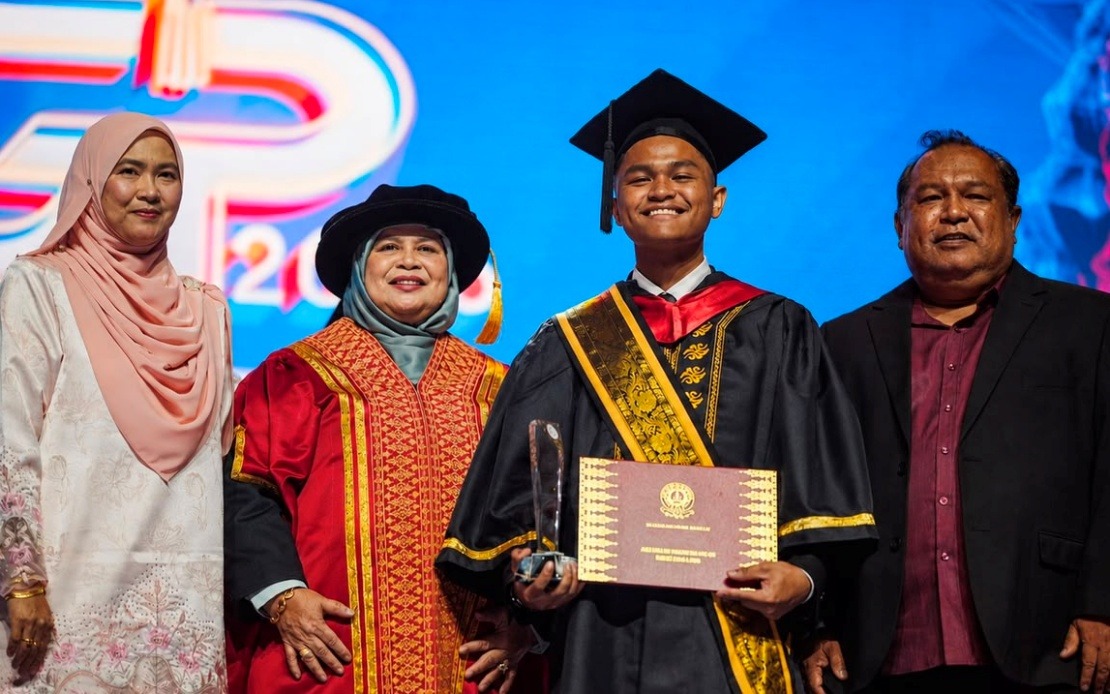
Muhammad Aaqif Dino Faezal has achieved a milestone that exemplifies how targeted government scholarship schemes can transform educational pathways for Malaysian students. Beginning his secondary education at MARA Science Junior College Tun Ghafar Baba in Melaka, the 19-year-old Selangor native has now secured admission to Imperial College London, where he will commence his undergraduate degree in geology this September. His trajectory underscores the tangible impact of Majlis Amanah Rakyat's investment in developing Malaysia's future talent through structured, merit-based support systems.
The catalyst for Aaqif's international educational opportunity was his selection into Kolej MARA Banting's International Baccalaureate Diploma Programme, made possible through MARA's Young Talent Development Programme. Receiving sponsorship to undertake the demanding IBDP curriculum from 2024 through May 2026 represented far more than financial assistance; it eliminated a critical barrier that would have otherwise prevented his family from affording both tuition and living expenses for international study. During a candid conversation with news agency Bernama, Aaqif articulated what many high-achieving Malaysian students from middle-income families experience: the reality that academic potential alone cannot overcome the substantial financial obstacles posed by premium international education.
The financial dimension of Aaqif's scholarship carries particular relevance for Malaysian policymakers and parents navigating the educational landscape. International education, whether at secondary or tertiary level, commands premium pricing that places it beyond reach for capable students whose families lack substantial disposable income. MARA's intervention in this space demonstrates how government agencies can strategically deploy resources to identify and nurture talent that might otherwise remain underdeveloped. For a country seeking to enhance its global competitiveness, such programmes represent an investment in human capital that yields returns across multiple sectors and timeframes.
Aaqif's academic performance at KMB proved remarkable, culminating in a score of 44 out of 45 points in the International Baccalaureate examination administered in May 2026. This result placed him among the highest-achieving IBDP candidates within the MARA college system and demonstrated that rigorous international curricula, when coupled with adequate support structures, enable Malaysian students to compete at elite levels. Beyond raw examination performance, he garnered the KMB Best Graduate Award and the Co-curricular Icon Award at the MARA Professional College and MARA College Inspiration Awards Day—recognition that validated achievements extending beyond traditional academic metrics.
The selection of Aaqif as the 2026 MARA College Graduate Icon reflects institutional commitment to identifying students who embody multidimensional excellence. The selection committee considered outstanding academic achievement, demonstrable leadership qualities, meaningful contributions to school and broader society, and perceived potential to serve as an influential figure for future MARA scholars. These criteria acknowledge that transformative educational institutions seek to cultivate individuals whose impact transcends their own professional trajectories, instead becoming exemplars and mentors within their communities and sectors.
During his tenure at KMB, Aaqif embraced leadership opportunities with particular emphasis on his role as president of the Students' Representative Council. This position placed him in a challenging intermediary role, simultaneously advocating for student perspectives while facilitating communication with institutional management. The experience, as he reflected during media engagement, contributed substantially to developing his self-confidence, refining interpersonal and organisational competencies, and cultivating the capacity to manage competing priorities—capabilities widely regarded as essential for students transitioning to competitive international university environments.
KMB's director Arfaseela Amir characterised Aaqif's trajectory as exemplifying the institution's holistic educational philosophy. Rather than narrowly prioritising examination results, KMB seeks to develop what Amir termed "human capital that is not only intellectually capable, but also possesses strong character." This approach recognises that sustainable excellence at institutions such as Imperial College London requires students to combine intellectual rigour with emotional intelligence, ethical grounding, and collaborative capacities. In this context, Aaqif's involvement in co-curricular activities and community engagement represented not peripheral distractions from academic focus but rather essential components of development.
The pathway from MRSM through KMB to Imperial College London represents a deliberate institutional sequencing designed to prepare students incrementally for international higher education. MRSM provides foundation-level science education within a structured residential environment, KMB introduces the International Baccalaureate framework and intensive preparation for university-level study, and Imperial College London offers research-intensive degree programmes at one of the world's most selective institutions. This progression, when supported by MARA sponsorship that mitigates financial constraints, creates conditions for capable students to perform at each stage without the distraction of financial anxiety.
Aaqif's choice to pursue geology at Imperial College London carries strategic significance for Malaysia's long-term resource management and energy transition. The earth sciences remain foundational to understanding subsurface resources, managing geological risks, and developing sustainable approaches to mineral extraction and hydrocarbon management. His stated intention to leverage expertise gained in London to contribute to Malaysia's oil, gas and energy sectors reflects the circular value proposition inherent in carefully targeted scholarship investments: MARA expends resources to enable a talented student to access elite global education, and that student commits to channelling acquired knowledge and networks toward domestic national benefit.
The broader significance of Aaqif's achievement extends beyond his individual accomplishment. His success story demonstrates the capacity of Malaysian educational institutions and scholarship schemes to identify and cultivate talent that meets international standards. In the context of regional competition for high-achieving students, and concerns about brain drain, such programmes serve multiple strategic functions: they validate Malaysia's educational quality, they retain and develop local talent, and they position Malaysian graduates within global networks that generate long-term competitive advantages across sectors.
For Malaysian families considering educational investments and for students navigating post-secondary pathway decisions, Aaqif's journey illustrates several applicable principles. Merit-based selection into competitive national programmes can provide access to international-standard education without proportional financial burden to families. Residential college environments that emphasise holistic development alongside academic achievement create conditions for students to develop resilience and interpersonal capacities that matter substantially at elite universities. Finally, recognition that personal achievement inherently reflects contributions from teachers, family members, institutional leaders, and policy frameworks cultivates the humility and collaborative orientation that distinguish genuinely impactful leaders from those merely accumulating credentials.

