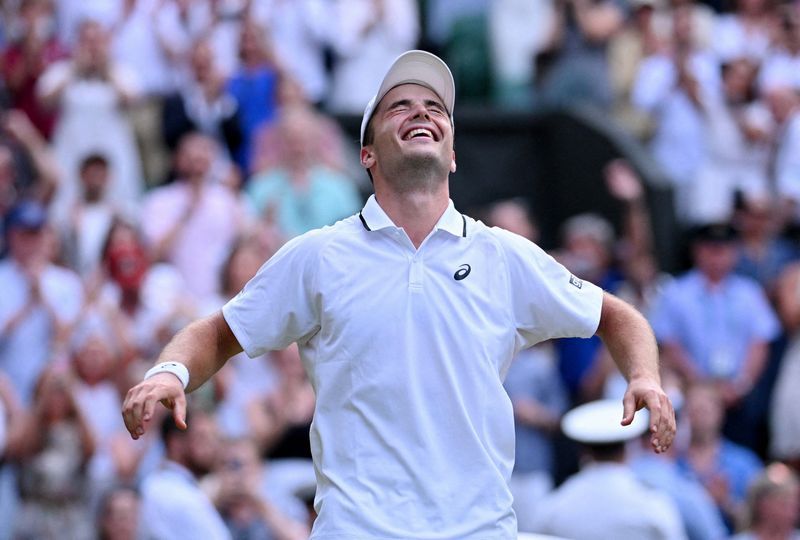
Arthur Fery's journey to the Wimbledon semi-finals reads like a cinema script that studio executives would reject as implausible. A 23-year-old wildcard from south London, ranked 114th in the world with just two previous Grand Slam match victories to his name, has shattered expectations to become only the fifth British man in the professional era to secure a place in the championship's final four. Should he overcome French Open champion Alexander Zverev this Friday, the second seed, he would face the final on Sunday—his 24th birthday—with the tantalizing prospect of emulating Goran Ivanisevic, who in 2001 became the only player ever to win the Wimbledon singles title as a wildcard entry.
The magnitude of Fery's achievement extends far beyond the tennis statistics. Growing up literally within walking distance of Centre Court, he inhabited a world where Wimbledon was the ambient backdrop of daily life rather than a distant aspiration. Yet this geographical proximity to greatness offered no automatic pathway; rather, it represented the paradox of his entire career trajectory. His measured temperament and deliberate life choices have defined his approach as much as his forehand. Rather than pursuing the traditional route of early professional commitment, Fery chose Stanford University, where he majored in science, technology and society and ascended to become the nation's top-ranked collegiate player—a decision that deferred but ultimately refined his professional ambitions.
Fery's composure under the glare of unprecedented attention speaks to his maturity. When asked about the intensity of his upcoming challenge, he responded with characteristic equanimity, focusing on the rhythm of competition rather than its magnitude. "It's good that I don't have two weeks before my next match. They keep coming fast. So that's good," he said, demonstrating the mental discipline that has carried him through this surreal fortnight. "Just staying in my bubble and just carrying on." This philosophical detachment—the ability to compartmentalize and concentrate on the immediate task—has proven essential as he navigates hostile territory against increasingly elite opposition.
His quarterfinal demolition of ninth-seeded Flavio Cobolli on Wednesday provided a masterclass in aggressive baseline tennis. Under sweltering Centre Court conditions, Fery appeared both invincible and inspired, dispatching the Italian 6-4, 7-6(4), 6-0 in a performance that transcended his modest stature of five feet nine inches. The crowd's energy transformed him; he retrieved balls with no reasonable expectation of success and constructed points with the craft of a seasoned strategist. The visual contrast between his physical dimensions and his commanding presence on court created a compelling narrative that resonated with spectators hungry for an underdog story.
The presence of British royal patronage has underscored the cultural significance of his run. Queen Camilla watched from the Royal Box during his victory over Cobolli and personally congratulated him afterwards. "The queen, she was waiting for me at the end of the match. She congratulated me. I told her how much of an honour it was for me to play in front of her. She just said, 'Congratulations, keep going'," Fery recounted to reporters, his measured tone reflecting genuine respect rather than sensationalism. Princess Kate had similarly cheered him during an earlier round against Otto Virtanen, further cementing the narrative of a homegrown hero capturing the nation's imagination.
Tennis establishment figures have also acknowledged the authenticity of his achievement. Roger Federer, the eight-time Wimbledon champion, offered tacit approval by attending Fery's five-set thriller against Grigor Dimitrov in the last 16—a grueling encounter that tested not merely his talent but his psychological resilience against experienced Grand Slam competition. Each victory has systematically elevated the quality of his opponents, yet he has continued to find answers and execute under pressure, suggesting that his ascent reflects genuine progress rather than fortunate draws.
Fery's emergence carries particular poignancy for British tennis, which has endured a torrid tournament thus far. Of the nation's 19 singles representatives, fifteen fell in the opening round, leaving Fery as an unlikely standard-bearer for home hopes. His unlikely status as Britain's leading contender speaks both to the depth of challenge facing domestic players and to the exceptional nature of his individual breakthrough. That a wildcard should prove more resilient than seeded compatriots underscores the unpredictability inherent in knockout competition.
The question of national identity that has occasionally shadowed Fery's career takes on fresh dimension given his ultimate trajectory. Born in Sèvres, a Parisian suburb adjacent to Roland Garros, with parents who are both French—his father Loic a hedge fund manager and owner of French football club Lorient, his mother Olivia a former professional player—Fery carried the genetic and cultural imprint of French tennis. Yet he moved to London as a child, attended King's College in Wimbledon, and progressed through the British tennis system. Despite briefly representing France as a junior competitor, his commitment to Britain was unambiguous. "There was no decision to make," he has insisted, a position validated by his father's perspective: "He's a true Wimbledon boy. It's like someone who grew up in Boulogne playing at Roland Garros. He went to school five minutes from here. He's always lived here."
This duality—the French sporting heritage married to profound English rootedness—enriches rather than complicates his identity. He represents the contemporary reality of professional sport, where talent development occurs across borders and within international networks. Yet his formation took place fundamentally in London, where the Wimbledon fortnight represents the ultimate expression of the sport he practices. For French observers, particularly those within the Federation Française de Tennis, his election to represent Great Britain might provoke mild regret, but his pathway was determined by genuine biographical circumstance and personal choice rather than mercenary calculation.
The challenge posed by Zverev on Friday represents an exponential leap in difficulty. The German second seed brings French Open pedigree, accumulated Grand Slam experience, and a ranking far superior to anyone Fery has previously encountered. Zverev possesses the weapons—power, court coverage, and tactical sophistication—to dismantle Fery's rhythm and limit the crowd's ability to generate momentum. Should Fery prevail, the narrative would transcend sporting achievement and enter the realm of genuine sporting mythology, comparable to the most improbable championship-winning trajectories in professional tennis history.
Regardless of Friday's outcome, Fery has already secured his place in Wimbledon lore. A 23-year-old who grew up watching the tournament unfold annually from the surrounding streets has penetrated to the semi-finals through a combination of talent, mental discipline, and categorical rejection of conventional wisdom about how top-level tennis careers develop. His deferral of full-time professionalism to pursue university education, his strategic patience, and his remarkable composure under unprecedented pressure have collectively produced a narrative that transcends the immediate sporting context. He has demonstrated that unconventional pathways remain viable in an era of professionalized junior development and early specialization, and that character—the ability to remain calm, focused, and purposeful amid extraordinary external pressure—remains fundamental to athletic excellence.

