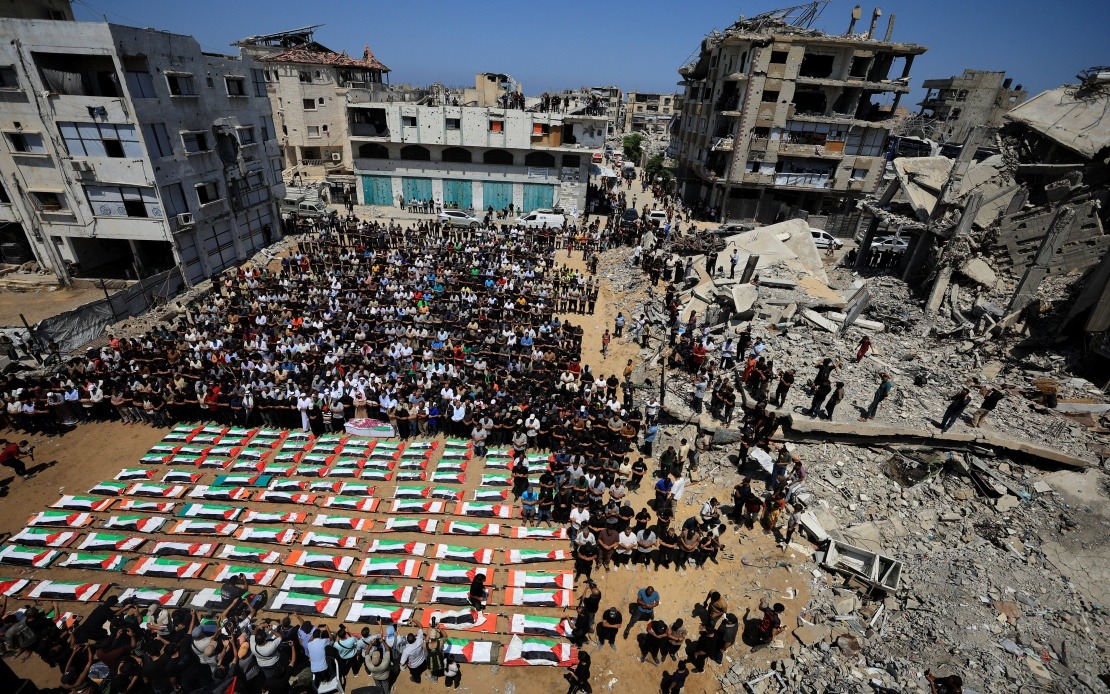
The grinding uncertainty surrounding Gaza's second-phase ceasefire negotiations has cast thousands of Palestinians into an agonising limbo, where each glimmer of progress is swiftly followed by renewed complications that push their most urgent needs further out of reach. For Saeed Helles, a 55-year-old father of five, this emotional rollercoaster has become a daily torment as he watches his 13-year-old daughter Saja battle cancer in a Gaza City hospital while remaining trapped in a territory where life-saving treatment is no longer available. The young girl's condition deteriorates with each passing day of delay, a stark reminder that the political stalemate unfolding in negotiating rooms has immediate, devastating consequences for vulnerable populations caught in the conflict's aftermath.
When Hamas publicly endorsed the mediators' proposal for moving forward with the second phase of the ceasefire agreement, it momentarily awakened genuine optimism among Palestinians who had endured months of conflict and displacement. For many families like Helles', this announcement signalled a possible pathway towards normalcy—the reopening of border crossings that would permit critical medical evacuations, the prospect of reconstruction in shattered communities, and the return of hundreds of thousands displaced by military operations. Helles himself began the administrative preparations for Saja's transfer to Egypt, securing travel documents and coordinating with treatment facilities, operating under the assumption that the diplomatic breakthrough everyone had been awaiting was finally materialising. Yet this fragile optimism would prove short-lived, evaporating as contradictory statements about implementation timelines and sequencing emerged from negotiators and officials.
The family's tentative relief crumbled entirely following a Monday announcement from the United States-led Board of Peace, which indicated that Israeli Prime Minister Benjamin Netanyahu had outlined preconditions that fundamentally altered the trajectory of discussions. According to statements released by the board, Israeli forces would only withdraw beyond the so-called Yellow Line after a comprehensive decommissioning process was fully completed, encompassing the destruction of light and heavy weapons alongside the dismantling of tunnel infrastructure. This declaration introduced a critical complication that Hamas had explicitly sought to avoid: linking Israeli military withdrawal to weapons disarmament sequencing, a condition the Palestinian faction viewed as extending indefinitely the occupation's security apparatus within Gaza. For Helles and countless others awaiting medical transfers, this technical disagreement translated into another postponement of their daughters', sons', and spouses' departure to hospitals capable of providing adequate care.
Hamas' position on these negotiations reflects deep concern about the implementation timeline and what officials characterise as a fundamental imbalance in obligations. The movement has publicly maintained that meaningful progress on the second phase, including substantive discussions concerning heavy weaponry, remains conditional upon Israel ceasing all military operations, scrupulously implementing the first phase's provisions, and executing a complete withdrawal from Gaza's territory. This linkage of obligations illustrates the profound mistrust characterising these negotiations, where each party views compliance by the other as dependent upon simultaneous verification of prior commitments. For ordinary Palestinians, these technical disputes over sequencing and verification mechanisms represent nothing more than bureaucratic delays robbing them of their chance to access medical treatment, return to destroyed homes, or begin rebuilding their lives. The gap between diplomatic language and lived experience has never been more starkly apparent.
The humanitarian dimension of this stalemate extends far beyond the individual cases of children like Saja. Mohammed Abu Nada, medical director of the Gaza Cancer Centre, articulated the scale of the crisis confronting the enclave's health sector: approximately 11,000 cancer patients are experiencing acute medication shortages while roughly 4,000 individuals who have received referrals for treatment cannot leave Gaza due to sustained restrictions at border crossing points. Abu Nada warned that the negotiation delays are directly responsible for the deaths of approximately three cancer patients daily, casualties that accumulate silently even as diplomatic representatives exchange proposals in air-conditioned conference rooms. This grim arithmetic underscores how protracted ceasefire talks, ostensibly aimed at ending suffering, inadvertently prolong the very humanitarian catastrophe they were designed to resolve. For Malaysia, a nation that has consistently advocated for humanitarian corridors and medical access in conflict zones, these developments represent a failure of the international framework to translate diplomatic language into tangible relief.
Beyond the medical emergency, the ceasefire's second phase carries profound psychological and practical significance for the hundreds of thousands displaced from their communities during the conflict. Mariam Qudaih, a 46-year-old mother of four forcibly displaced from eastern Khan Younis, embodies the desperation of those awaiting a realistic pathway toward home. Though her residence has been reduced to rubble—a fate shared by entire neighbourhoods across the southern Gaza Strip—she maintains a stubborn hope that the second phase would at least grant her family the opportunity to return to their land, to reclaim whatever fragments of life remained among the ruins. She had reassured her children that return was imminent, and they began rehearsing memories of their home, imagining themselves rebuilding life on their ancestral plot regardless of how modest those circumstances might be.
The whiplash of hope and disappointment has become a recurring pattern that Gaza's population experiences with increasing emotional toll. Each announcement suggesting diplomatic progress kindles a renewed belief that the long separation from home will soon end, that displacement camps and makeshift shelters might give way to reconstructed communities. Then, invariably, technical disagreements or missed deadlines deliver the crushing realisation that the roadmap toward normalcy remains fundamentally contested. For Qudaih and families positioned similarly, this cycle has become exhausting, with each disappointment reinforcing a bitter awareness that the political resolution necessary for their return remains distant and fragile. The psychological impact of this repeated cycle—the activation and dashing of hope—inflicts wounds that transcend the visible humanitarian metrics tracked by international organisations.
Gaza-based political analyst Mustafa Ibrahim identified a crucial structural problem embedded within the current negotiation framework: the insistence on linking Israeli military withdrawal directly to the completion of weapons disarmament processes grants Israel substantial leverage over the timing and pace of implementing the second phase's provisions. This arrangement, Ibrahim argues, introduces an asymmetry that fundamentally undermines the mediators' proposed roadmap, as it effectively permits one party to determine the conditions under which the other party's core demands—medical access, humanitarian aid corridors, and territorial withdrawal—will be satisfied. The analyst's observation illuminates why Palestinians view the current trajectory with profound scepticism; they perceive themselves as negotiating not with a mediator genuinely committed to balanced implementation but with a framework that systematically privileges the stronger military actor's preferences and timelines.
For Southeast Asian observers and policymakers, particularly those in Malaysia where the Palestinian cause maintains cultural resonance, these developments carry implications extending beyond regional conflict dynamics. They reveal the limitations of international mediation frameworks when asymmetric military capabilities permit one party to continuously defer obligations while maintaining the appearance of good-faith negotiation. They demonstrate how diplomatic processes, even those framed as humanitarian interventions, can inadvertently perpetuate suffering when structural incentives favour delay over rapid implementation. They underscore the necessity of mechanisms that move beyond sequential negotiations toward simultaneous verification of compliance, particularly when populations face urgent life-threatening crises such as medical emergencies and displacement.
As negotiations continue their fitful progress, Gaza's population finds itself trapped in an exhausting holding pattern where hope and despair follow each other in predictable succession. Saeed Helles continues monitoring medical bulletins regarding his daughter's condition, calculating how many more weeks the body might endure without specialised treatment. Mariam Qudaih maintains conversations with her children about home, knowing their excitement about return may be premature once again. Thousands of cancer patients depend on medicines that grow increasingly scarce with each passing day of border restrictions. The negotiation process, designed ostensibly to end their suffering, has instead created a perverse situation where diplomatic progress offers only the prospect of suffering ending at some undetermined future point rather than immediately and conclusively. Until structural imbalances within the mediation framework are addressed, Palestinians will continue cycling between hope and heartbreak, their fates determined not by the urgency of their medical and humanitarian needs but by the calculus of power favouring indefinite postponement over decisive implementation.

