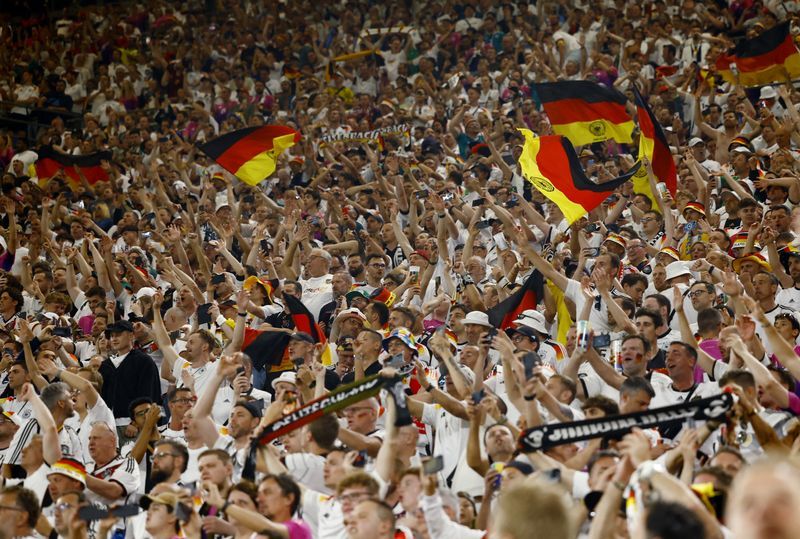
German law enforcement agencies have launched a sweeping investigation into suspected irregularities surrounding ticket distribution for the Euro 2024 football championship, with searches extending to the offices of the Deutscher Fussball-Bund (DFB), the country's national soccer governing body. The coordinated operation, reported by the Bild newspaper on Wednesday, marks a significant development in a growing controversy that threatens to tarnish what was otherwise considered a successful tournament hosted on German soil.
The raids, which took place across multiple locations throughout Germany, appear to focus on how tickets were allocated and distributed among various parties connected with the championship. According to Bild's reporting, the investigation centres on suspected violations of ticket allocation procedures, though the precise nature of these breaches has not yet been formally detailed by authorities. The fact that the DFB's own headquarters became a focus of the investigation suggests that concerns about irregularities may extend into the highest administrative levels of German football's governing structure.
While official statements from police and prosecutors confirmed that searches were being conducted at several sites across Germany, they initially refrained from explicitly naming the DFB or detailing the specific allegations. This measured public communication approach is typical in German criminal investigations, where authorities often withhold certain details to protect the integrity of ongoing inquiries. However, the Bild newspaper's identification of the DFB's involvement and the targeting of its offices signal that the investigation has reached a sufficiently advanced stage to warrant scrutiny of the association's records and operations.
According to reporting, the investigation involves individuals of various nationalities, including at least one German national and one French national among those being examined. This international dimension to the inquiry raises questions about whether the suspected ticket irregularities involved cross-border networks or coordinated schemes that extended beyond Germany's borders. Such complications would add layers of complexity to what prosecutors must navigate, potentially requiring cooperation between German authorities and their counterparts in other European nations.
The Euro 2024 tournament, which concluded in mid-July following Spain's victory over England, had been widely praised for its organisation and smooth execution across German venues. For Malaysian readers familiar with regional sports governance issues, the discovery of such breaches underscores how even well-resourced organisations in developed football nations can struggle with transparency and procedural integrity. The incident offers cautionary lessons about the vulnerability of large-scale event management systems to manipulation, regardless of administrative sophistication.
Ticket allocation for major sporting events remains a chronically contentious issue globally. Premium access and desirable seating locations are inevitably scarce commodities, creating powerful incentives for various actors—from officials to scalpers to corporate intermediaries—to circumvent standard distribution procedures. When governing bodies like the DFB prove unable to maintain watertight controls over such processes, public confidence in the fairness and legitimacy of their operations inevitably suffers. For football fans who successfully obtained tickets through official channels, discoveries of irregular allocations understandably generate frustration and resentment.
The timing of these raids, coming shortly after the tournament's conclusion, suggests that authorities may have received complaints or detected anomalies during or immediately after Euro 2024. German investigators likely needed sufficient time to gather preliminary evidence and establish probable cause before executing searches of such a sensitive and prominent institution. The decision to move forward with raiding the DFB itself indicates that accumulated evidence reached a threshold compelling authorities to act, despite the reputational implications for German football's governing body.
For the DFB, already navigating complex challenges related to fan behaviour, governance reforms, and competitive performance, this investigation represents an additional institutional headache requiring management attention. The association will need to balance cooperation with law enforcement investigations against protecting its interests and reputation. Depending on investigation findings, the DFB may face pressure to implement structural reforms around ticket distribution procedures to prevent future irregularities and restore stakeholder confidence.
The investigation's broader implications for European football governance merit consideration. Major tournaments like the Euros generate enormous revenues and attract intense competition for access to matches. When irregularities emerge, they prompt uncomfortable questions about whether similar problems might exist within other national associations or international football bodies. These discoveries can catalyse wider systemic reviews and transparency initiatives across the sport.
As German authorities continue their examination of the suspected ticket allocation violations, the case will likely generate significant media attention and public scrutiny. The DFB's willingness to cooperate transparently with investigations, alongside any self-initiated reforms it implements, will substantially influence how this episode ultimately affects the organisation's credibility. For Southeast Asian football enthusiasts and administrators, the incident underscores why robust institutional checks and independent oversight mechanisms prove essential for maintaining integrity in sports governance, regardless of a nation's development level or administrative capacity.

