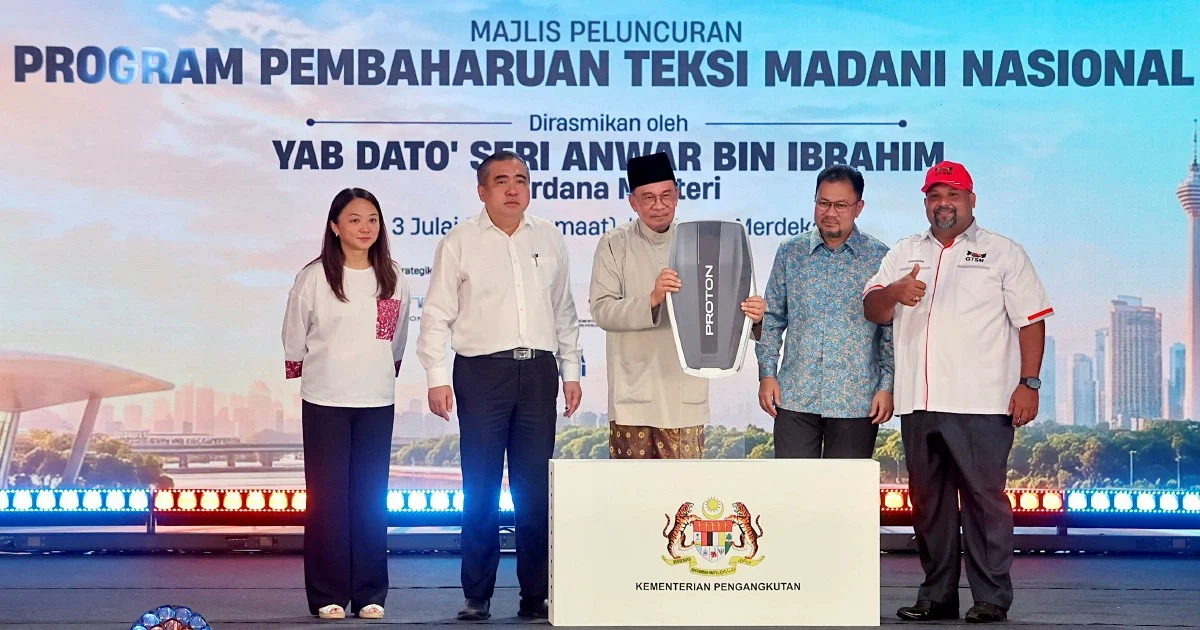
The government has committed an additional RM10 million to support the replacement of ageing taxis through a matching grant initiative, Prime Minister Datuk Seri Anwar Ibrahim revealed today, signalling continued investment in modernising Malaysia's public transport infrastructure and improving service standards across the nation's taxi industry.
This fresh injection of capital represents a targeted intervention aimed at accelerating the renewal cycle for vehicles that have been in service for years, many of which fall below contemporary safety and emission standards. The matching grant model requires participating taxi operators to contribute their own funds alongside government support, creating a co-investment framework that encourages stakeholder commitment to the modernisation agenda.
The ageing taxi fleet has long been a concern for urban mobility planners and consumer advocates. Many vehicles operating on Malaysian roads predate modern safety features and fuel efficiency improvements, contributing to both higher operational costs for drivers and reduced comfort and security for passengers. The approval of this supplementary funding seeks to address these systemic challenges by reducing the financial burden that individual operators face when upgrading to newer models.
Matching grant schemes operate on the principle that government contributions unlock private investment. By requiring operators to fund a portion of vehicle replacement costs, the programme ensures that only genuinely committed stakeholders proceed, while government resources are deployed strategically alongside private capital. This approach has demonstrated effectiveness in other markets pursuing fleet modernisation objectives.
For Malaysian taxi drivers, many of whom operate as independent contractors or through loose cooperative arrangements, the availability of matching grants substantially eases the capital requirements for fleet renewal. The programme thereby addresses a critical market failure: without such support, older vehicle operators lack sufficient financial capacity to upgrade, trapping them in older, costlier-to-maintain vehicles that erode their earning potential over time.
The announcement arrives amid broader government efforts to enhance public transportation quality and sustainability across urban and semi-urban areas. Taxi services form a critical component of Malaysia's public transport ecosystem, particularly in areas where formal transit networks remain limited. Modernised fleets would contribute to improved air quality in cities, reduced noise pollution, and enhanced passenger safety through contemporary vehicle systems.
Implementation of the matching grant programme will likely involve coordination between transport authorities, vehicle financing institutions, and taxi industry associations to establish eligibility criteria, vehicle specifications, and disbursement procedures. The mechanics of the scheme will determine its uptake rate and ultimate impact on fleet renewal timelines across different regions.
Regional variations in taxi service quality across Malaysia mean that the additional funding's geographic allocation will carry significance. Kuala Lumpur and other major urban centres may see more rapid vehicle replacement, while smaller towns and suburban areas might experience extended modernisation periods depending on operator density and financial capacity in those locations.
The financial implications for government extend beyond the immediate RM10 million outlay. Improved fleet conditions generate downstream benefits including reduced accident rates and associated healthcare costs, lower environmental remediation expenses, and enhanced tax compliance as operators with modern vehicles demonstrate improved business sustainability. These positive externalities justify public investment in the modernisation initiative.
Industry stakeholders have previously highlighted the competitive disadvantage faced by taxi operators managing deteriorating vehicle fleets. Ridesharing platforms operating with newer vehicles have captured market share partly through superior user experience. Government support for fleet modernisation narrows this gap, helping traditional taxi services remain competitive in an evolving transportation marketplace.
The sustainability angle merits particular attention for Malaysia's climate commitments. Newer vehicles typically achieve better fuel efficiency and lower emission profiles, directly supporting the nation's carbon reduction targets while simultaneously lowering operational costs for drivers. This alignment between environmental and economic objectives strengthens the programme's policy rationale.
Taxi industry observers will watch closely for programme launch timelines and the specific terms governing operator access to the matching grants. Clarity on vehicle age thresholds, price limits for eligible models, and regional allocation formulas will prove essential for determining the scheme's real-world effectiveness in accelerating fleet renewal and improving service standards nationwide.

