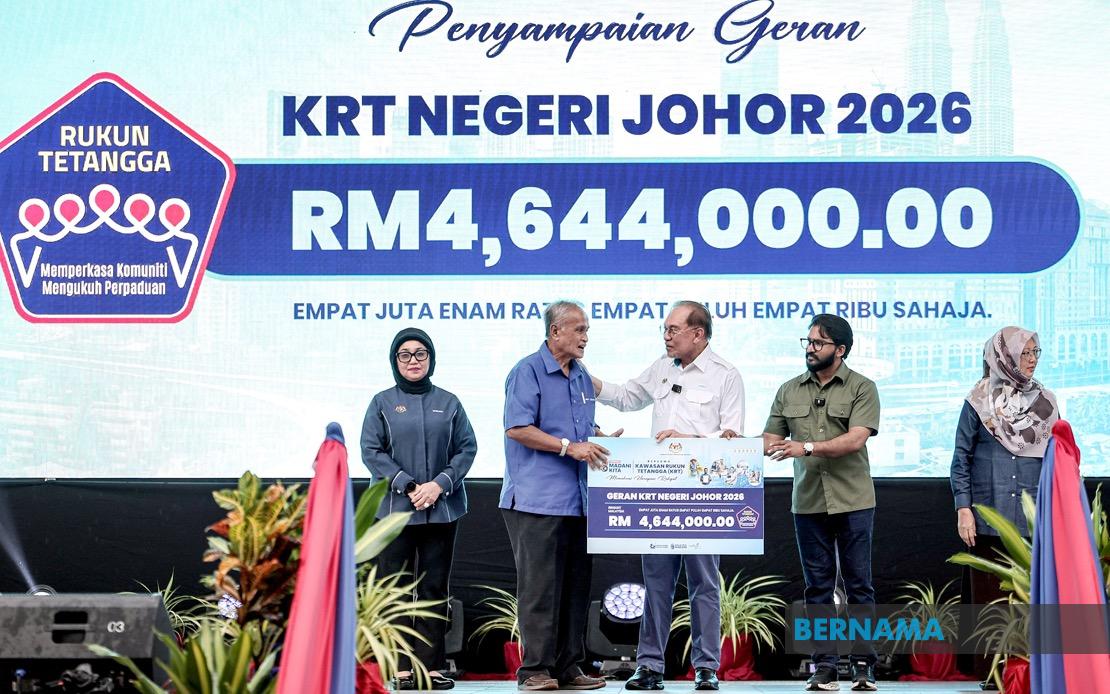
Prime Minister Datuk Seri Anwar Ibrahim has announced a substantial boost to grassroots community policing efforts across Malaysia, approving an increase in annual grants for Neighbourhood Watch Area (KRT) units from RM6,000 to RM10,000. The enhanced allocation, which will take effect from January 1, 2027, marks the first significant adjustment to KRT funding in a decade and reflects the government's renewed emphasis on community-level security and social cohesion initiatives. The announcement was made during the MADANI KITA Programme held at Dataran Segamat, underscoring the administration's commitment to strengthening institutional support at the neighbourhood level.
The decision to raise KRT funding carries symbolic weight beyond mere financial adjustment. For ten years, the grassroots security units had operated with unchanged allocations despite playing a crucial role in addressing local security concerns, neighbourhood disputes, and community welfare matters. This prolonged stagnation reflected a broader governance gap where essential community institutions received minimal resource updates despite inflation and increasing operational demands. By approving the 67 percent increase, the government acknowledges both the mounting pressures on these volunteer-led organisations and their indispensable contribution to maintaining order at the most fundamental levels of Malaysian society.
KRT groups serve as critical intermediaries between ordinary residents and official security apparatus, functioning as early-warning systems for crime, dispute resolution forums, and mobilising units for community development. Their effectiveness depends substantially on operational capacity, from basic administrative expenses to equipment and activity funding. The enhanced grant recognises that these neighbourhood units cannot sustain their peace-building functions indefinitely without adequate resource support, particularly as living costs and operational expenses have risen considerably over the preceding decade. The timing of the announcement, with disbursement scheduled for early 2027, allows KRT administrators adequate notice for budget planning and activity scheduling.
Prime Minister Anwar linked the funding increase directly to KRT's role in preserving Malaysia's multicultural equilibrium. He emphasised that the institutions help revive and sustain the spirit of consensus, democratic participation, and national unity—foundational principles that have enabled Malaysia's diverse population to coexist despite racial, religious, and cultural differences. This framing positions KRT funding not merely as administrative efficiency but as strategic investment in social stability. In a region witnessing periodic communal tensions and polarisation, Malaysia's capacity to maintain harmony across religious and ethnic divides remains exceptional, and KRT groups contribute substantially to this achievement through their grassroots mediation and community-bonding functions.
The Prime Minister's remarks on racial and religious plurality carried contemporary relevance. He explicitly cautioned against weaponising Malaysia's diversity as a divisive tool, instead urging society to recognise and celebrate these differences as collective strength. This messaging appears directed at countering rising sectarian and identity-based rhetoric within certain political and social spheres. By coupling KRT support with such statements, the administration signals that resource allocation and ideological positioning align—grassroots unity mechanisms warrant investment precisely because they counter divisive narratives and reinforce shared national identity.
Beyond the KRT announcement, the Prime Minister deployed the Segamat programme to address multiple infrastructure deficits simultaneously, projecting an image of comprehensive governance attention. An immediate RM3.205 million allocation was approved for sixteen basic infrastructure repair projects at Islamic educational institutions throughout Johor, encompassing religious schools, madrasahs, study centres, and tahfiz facilities in Batu Pahat, Muar, and Segamat districts. This component of the announcement reflects broader government commitment to Islamic educational infrastructure, ensuring that religious learning institutions maintain conducive environments. For Malaysian education policy, such targeted funding demonstrates recognition that Islamic institutions often operate with constrained resources and require systematic government support to deliver quality education.
The allocation to Islamic educational facilities carries particular significance in Johor, a state with substantial religious school enrolment and numerous traditional Islamic learning centres. Infrastructure quality directly impacts educational outcomes and student welfare, yet many madrasahs and tahfiz institutions operate in aging facilities requiring urgent repairs. By ringfencing RM3.205 million for immediate implementation, the government signals priority attention to religious education infrastructure, addressing a longstanding resource gap in this sector. This funding stream also reflects the MADANI framework's emphasis on inclusive development benefiting diverse institutional ecosystems across Malaysian society.
Additionally, the programme allocated RM1.0 million for urgent repair works at Royal Malaysian Police (PDRM) quarters in Johor, framing police welfare as integral to national security maintenance. This recognition of security personnel housing conditions acknowledges that effective policing requires more than operational funding—officers performing demanding peacekeeping duties require adequate living facilities to sustain morale and retention. Police quarter conditions have periodically surfaced as grievance issues within the force, and targeted repair funding addresses concrete welfare concerns. By including police infrastructure alongside KRT grants and educational facilities, the announcement presents a holistic security and welfare policy addressing multiple institutional constituencies.
The programme's structure—announced during a community engagement event rather than formal parliamentary setting—reflects the MADANI government's preference for direct grassroots communication. Holding the announcement in Segamat, a town in Johor's interior, symbolically prioritises non-metropolitan communities and demonstrates that development initiatives extend beyond urban centres. Deputy Minister of National Unity R. Yuneswaran and Deputy Minister of Domestic Trade and Cost of Living Datuk Dr Fuziah Salleh's attendance further signalled whole-of-government coordination on community development matters.
For Malaysian readers and regional observers, the KRT funding increase represents a rare instance of resource upward adjustment for existing grassroots institutions. Typically, government allocations remain static or decline in real terms over extended periods. The decision reflects either genuine prioritisation shift or response to accumulated advocacy from KRT federations highlighting resource inadequacy. Either interpretation suggests strengthened institutional voice and government receptiveness to grassroots concerns. The regional significance lies in Malaysia's demonstrated commitment to community-level security mechanisms as preferable alternatives to heavy-handed policing, a model with potential applicability across Southeast Asia's diverse jurisdictions.
Looking forward, the January 2027 implementation date provides implementation runway and allows the government to absorb implementation costs across financial planning cycles. KRT units receiving the enhanced grants will likely direct additional resources toward activity programming, capacity building, and neighbourhood engagement—activities that sustain the social cohesion benefits the Prime Minister identified. The announcement also establishes potential precedent for reviewing other long-static grassroots allocations, potentially triggering similar advocacy from other community institutions operating with decade-old funding levels.
The bundling of KRT grants, Islamic school infrastructure, and police welfare funding within a single programme announcement reflects integrated governance thinking linking security, education, and community harmony as interconnected objectives. This approach differs from siloed sectoral announcements, suggesting policy coherence across traditionally separate portfolios. For Malaysian governance observers, such integrated programming offers models for addressing complex social challenges requiring coordinated institutional responses rather than fragmented departmental initiatives.