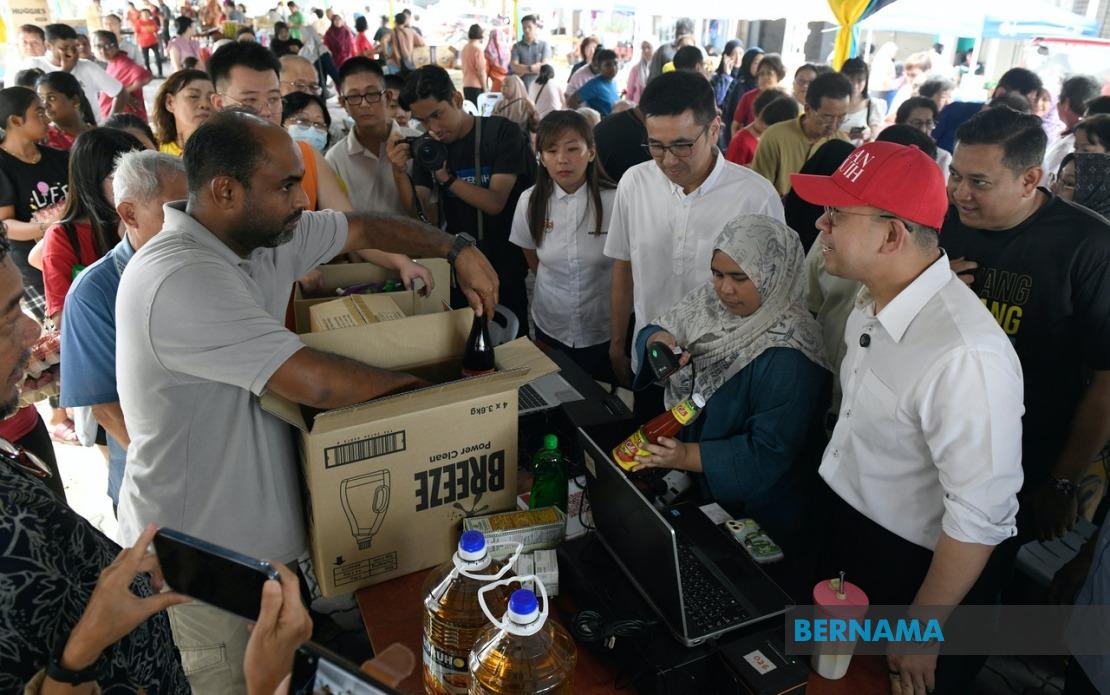
The government is doubling down on its commitment to strengthen micro, small and medium enterprises through targeted grassroots programmes, particularly in Malaysia's expanding wholesale and retail trade sector. Minister Steven Sim Chee Keong outlined the strategy during the launch of the Jualan MADANI KUSKOP initiative in Nibong Tebal, signalling that the Ministry of Entrepreneur and Cooperatives Development will prioritise direct engagement with local business owners and cooperative networks to ensure they benefit from the sector's robust expansion.
Recent economic data underscores the urgency of these efforts. The Department of Statistics Malaysia reported that the wholesale and retail trade sector achieved sales worth approximately RM175 billion in April 2026, representing a year-on-year increase of 15.3 per cent. This sustained growth reflects underlying strength in domestic consumption patterns, driven by government policy initiatives aimed at reducing the cost of living, stabilising prices, and boosting household incomes across the country.
Sim attributed the sector's resilience to a collaborative approach involving multiple stakeholders. The government's focus on price stabilisation and income support has created favourable conditions for retail spending, while the private sector has responded by expanding inventory and service offerings. This partnership has insulated Malaysia's domestic trade from some of the headwinds affecting global markets, though the minister acknowledged that tariff disputes, trade wars, and geopolitical tensions continue to pose risks to the broader economy.
The Jualan MADANI KUSKOP programme represents a tactical shift toward community-level engagement. Rather than relying solely on top-down policy directives, the initiative brings government support directly to entrepreneurs and cooperative members in local constituencies. This approach recognises that MSMEs and cooperatives often lack the resources to navigate bureaucratic processes or access information about government support schemes, creating barriers even when assistance is theoretically available.
For Malaysian entrepreneurs, the timing is opportune. The growth trajectory in wholesale and retail creates space for new market entrants and allows existing businesses to expand their customer bases without necessarily competing in saturated segments. Cooperatives, in particular, can leverage collective purchasing power and shared logistics infrastructure to reduce operational costs and improve competitiveness against larger retailers and e-commerce platforms.
The minister emphasised that ensuring inclusive economic growth remains a central government priority. As the nation's economy expands, policymakers are acutely aware that aggregate growth figures mask uneven distribution of benefits. Without deliberate intervention, growth in trade might concentrate among large retailers and established businesses, while smaller enterprises struggle to adapt. The KUSKOP initiatives aim to prevent this outcome by creating structured pathways for local entrepreneurs to participate in and benefit from sector expansion.
Malaysia's exposure to global economic volatility makes domestic trade stability particularly important. As an open economy dependent on international commerce, Malaysia faces persistent uncertainty from external shocks. However, a vibrant local wholesale and retail ecosystem provides some buffer against these pressures. When global demand softens, strong domestic consumption can sustain economic activity and employment. This rationale underpins government support for MSMEs and cooperatives, which collectively employ millions of Malaysians and form the backbone of community commerce.
The cooperative model holds particular appeal for smaller businesses in rural and semi-urban areas. By pooling resources and standardising practices, cooperatives can achieve economies of scale comparable to larger competitors while maintaining community ownership and local decision-making. KUSKOP's grassroots approach recognises that sustainable economic development requires strengthening these community-based institutions alongside individual enterprises.
Sim's remarks also highlight the government's awareness that market opportunities alone do not automatically translate into inclusive prosperity. MSMEs and cooperatives often lack access to credit, modern logistics systems, digital marketing platforms, and supply chain networks that larger businesses take for granted. Government programmes must therefore address these structural gaps, providing not just encouragement but concrete support in the form of training, financing, market linkages, and regulatory streamlining.
Looking forward, the sustainability of wholesale and retail growth will depend on the government's ability to deepen support mechanisms while allowing market dynamics to operate efficiently. Overly protective policies can reduce competitive pressure and innovation, ultimately harming the enterprises they aim to help. The challenge for KUSKOP is calibrating assistance to enhance capability and remove barriers without insulating businesses from performance accountability.
For Southeast Asian observers, Malaysia's experience offers insights into managing inclusive growth during uncertain times. The region faces similar pressures from trade tensions and geopolitical rivalry, making domestic consumption and local enterprise resilience increasingly valuable. Malaysia's strategy of channelling growth benefits through grassroots business institutions could provide a model for other nations navigating comparable challenges.
The broader economic implications are significant. If KUSKOP succeeds in broadening participation in the wholesale and retail expansion, the resulting gains in employment, incomes, and tax revenue could reinforce positive economic momentum. Conversely, if support programmes fail to reach their intended beneficiaries or prove ineffective in enhancing competitiveness, the sector's growth may leave many entrepreneurs behind, widening inequality and reducing the inclusive development that government policy prioritises.

