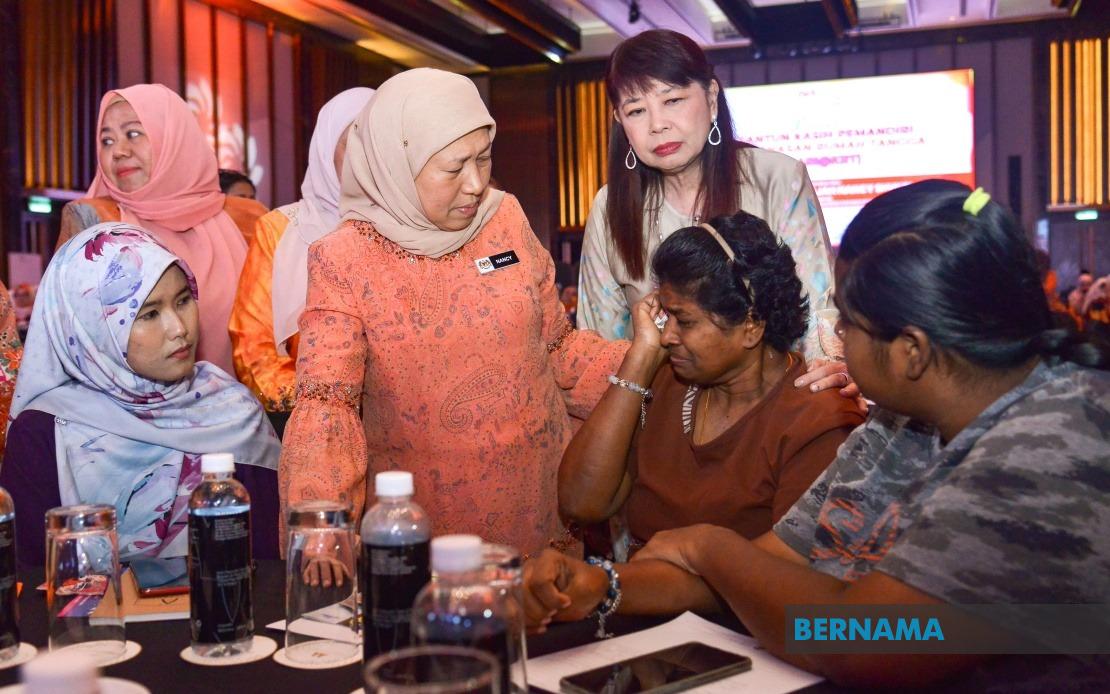
Malaysia's Ministry of Women, Family and Community Development has unveiled SARI@KRT: Road to Eliminate Violence Against Women (EVAW) 2026, an ambitious national programme aimed at providing comprehensive rehabilitation support to around 1,400 domestic violence survivors. The initiative represents a concerted effort by the government to move beyond awareness-raising campaigns toward meaningful intervention and long-term recovery pathways for affected individuals seeking to rebuild their lives.
Minister Datuk Seri Nancy Shukri articulated the programme's core philosophy during its official launch, emphasising that survivors would receive far more than symptomatic relief. The intervention encompasses three critical pillars: strengthening psychosocial support mechanisms, providing robust legal assistance, and facilitating economic empowerment. By targeting approximately 100 participants in each state, the programme demonstrates geographical reach and equity in service distribution, acknowledging that domestic violence transcends urban-rural boundaries and affects communities nationwide.
The minister framed the initiative as evidence of the government's commitment to breaking the cycle of silence that historically surrounded domestic violence in Malaysia. Rather than expecting victims to endure trauma privately, the programme positions official support systems as accessible pathways toward healing and independence. Shukri stressed that recovery requires more than emotional reassurance—it demands institutional backing to help survivors regain agency, confidence, and the capacity to pursue safer futures without dependency on their abusers.
Recent crime statistics underscore the urgency underlying this intervention. Royal Malaysia Police data reveals that domestic violence cases climbed to 4,014 during the first half of 2024, surpassing the 3,678 cases recorded in the corresponding period of 2023. Johor emerged as the state with the highest incidence at 721 cases, trailed by Selangor with 614 and Perak with 405. The geographic distribution highlights regional variations in violence prevalence, potentially reflecting differing demographic compositions, reporting patterns, and access to support services across states.
However, interpreting this upward trend requires nuance. While the absolute numbers appear alarming, the minister suggested that increases partially reflect heightened public awareness and diminishing stigma around reporting. As victims gain confidence that formal complaints will be taken seriously and lead to protective action, reporting rates naturally rise. This interpretation aligns with international experiences where enhanced support infrastructure and cultural shifts toward victim validation typically correlate with increased case identification. The true prevalence of domestic violence may have remained steady or fluctuated, with the statistics capturing evolving reporting behaviour rather than exclusively reflecting actual violence trends.
Analysing root causes provides critical insight into intervention design. Misunderstandings and communication breakdowns dominate the causal landscape, accounting for 1,967 cases—nearly half of all incidents. This preponderance suggests that many situations involve relational dysfunction rather than pathological violence, potentially amenable to mediation, counselling, and communication skills development. Substance abuse emerges as the second-largest factor in 444 cases, while financial stress precipitates 378 incidents. These determinants hint at the interconnected nature of violence: economic insecurity exacerbates relationship strain, substance dependency impairs communication and emotional regulation, and unresolved interpersonal conflicts escalate into physical or emotional harm.
Financial abuse represents a particularly insidious form of domestic violence that often escapes recognition as a distinct violation. The minister highlighted scenarios wherein a spouse possesses adequate income but deliberately withholds financial support, forcing the other partner to bear all household and childcare expenses. This coercive control through economic deprivation constitutes abuse even in the absence of physical violence, creating dependency and severely limiting victims' ability to exit harmful relationships. By naming financial abuse explicitly and establishing it as a legitimate concern, the ministry signals that economic coercion warrants the same legal and social acknowledgement as physical violence.
The programme's design incorporates recognition of these financial dimensions. KPWKM has established special allowances enabling survivors to attend court proceedings related to child maintenance claims, removing a practical barrier that might otherwise prevent victims from securing crucial financial safeguards. This targeted support acknowledges that legal recourse often requires time away from employment and associated costs, creating a secondary burden for economically vulnerable survivors. By subsidising participation in maintenance proceedings, the government removes a disincentive and facilitates access to financial protections for children dependent on separated parents.
The broader economic empowerment component of SARI@KRT addresses longer-term sustainability and independence. Rather than offering temporary respite, the programme aims to equip survivors with income-generating skills, employment connections, and business development support. For many victims, particularly those who abandoned education or career development during abusive relationships, such initiatives represent genuine pathways toward financial autonomy. Economic independence fundamentally strengthens survivors' capacity to resist returning to abusive partners or accepting abuse within new relationships, creating a protective factor grounded in material reality.
Psychosocial support constitutes the third pillar, acknowledging that trauma recovery extends far beyond material provision. Domestic violence survivors often experience complex post-traumatic stress, anxiety, depression, and compromised self-worth following prolonged abuse. Professional counselling, peer support groups, and trauma-informed therapeutic interventions become essential scaffolding for psychological healing. By integrating mental health services into a comprehensive support structure, the programme recognises that economic empowerment and legal protection prove insufficient without parallel attention to emotional and psychological rehabilitation.
The legal assistance component addresses a critical gap in survivor access to justice. Many victims lack knowledge of available legal remedies, financial resources to engage lawyers, or confidence navigating complex legal procedures. By embedding legal support within the programme, the government removes obstacles to pursuing protective orders, divorce proceedings, custody arrangements, and financial settlements. This democratisation of legal access ensures that financial constraints do not prevent survivors from securing formal legal protection and economic security for themselves and their children.
Moving forward, the success of SARI@KRT will depend substantially on effective implementation, adequate funding, and sustained political commitment. Reaching 1,400 survivors across Malaysia's diverse communities requires culturally sensitive service delivery, multilingual support for non-Malay communities, and recognition of intersecting vulnerabilities affecting immigrant domestic workers and indigenous populations. Additionally, preventing recidivism and addressing the systemic factors driving violence—including gender norms, substance abuse treatment capacity, and economic insecurity—requires interventions extending beyond survivor support to perpetrator accountability and prevention.
The ministry's emphasis on guiding survivors toward self-reliance and safer lives reflects an empowerment paradigm that positions survivors as agents of their own recovery rather than passive recipients of charity. This philosophical orientation, combined with concrete structural supports, represents genuine progress in Malaysia's response to domestic violence. Continued expansion and evolution of such programmes will be essential for reducing violence prevalence and ensuring that affected individuals access the support necessary to rebuild with dignity and safety.

