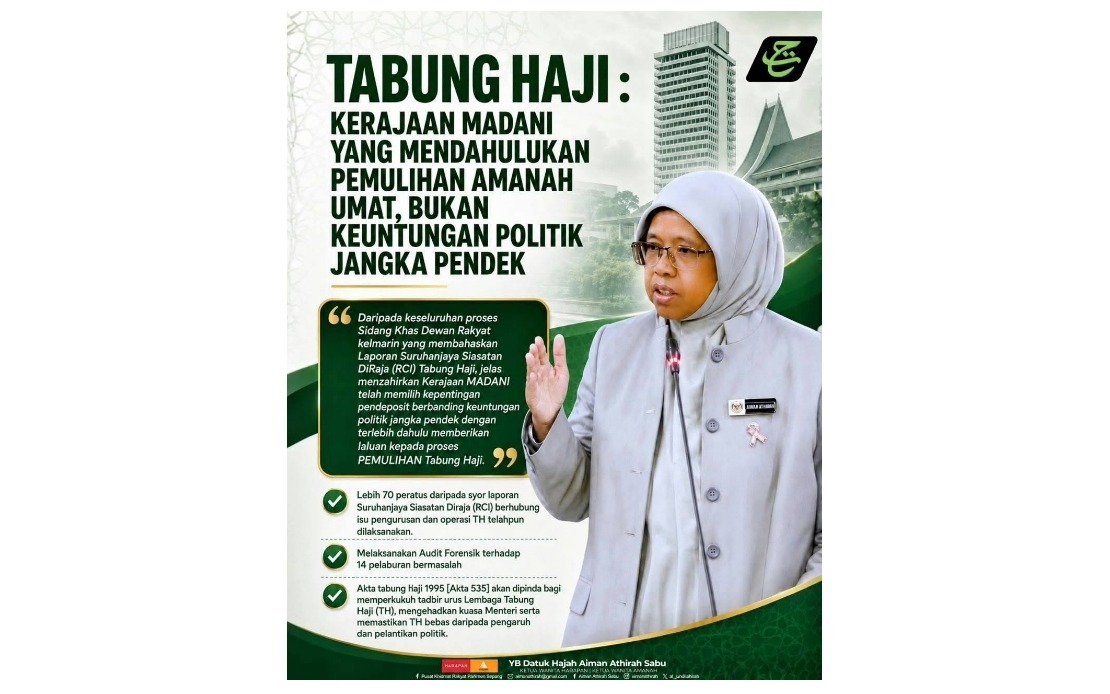
The government's deliberate approach to revealing the findings of the Tabung Haji Royal Commission of Inquiry reflects a strategic prioritisation of depositor welfare over immediate political advantage, according to Datuk Aiman Athirah Sabu, Deputy Minister of Housing and Local Government. Rather than rushing to disclose the RCI report, authorities are taking calculated steps to safeguard the financial institution that holds the savings of more than 10 million Malaysians, she stated in remarks made on August 12.
The caution surrounding the report's release stems from hard-learned lessons about the fragility of public confidence in financial institutions. In 2018, Tabung Haji experienced withdrawals exceeding RM6 billion after governance vulnerabilities came to light, demonstrating how rapidly public alarm can translate into liquidity crises. The current administration's measured disclosure strategy aims to prevent a recurrence of such destabilising panic, which could fundamentally undermine an institution central to Muslims' ability to save for pilgrimage to Mecca.
Tabung Haji occupies a unique position in Malaysia's financial landscape, transcending its identity as an ordinary savings institution. The organisation serves as a custodian of religious trust, directly enabling Muslims to fulfil the fifth pillar of Islam. This dual character—part financial services provider, part custodian of faith—means that governance failures carry implications far beyond conventional banking metrics. The institution's stability is inseparable from its spiritual and social purpose, making reckless disclosure potentially damaging to both its balance sheet and its moral standing within Muslim communities across Southeast Asia.
Aiman Athirah characterised recent criticism from certain political factions, particularly from PAS and Parti Wawasan Negara, as attempts to subordinate institutional stability to partisan advantage. These parties have publicly questioned the timing of the report's disclosure, suggesting the government is withholding information for political cover. She countered that such critiques lack factual foundation and represent rhetorical point-scoring rather than genuine concern for depositors. The distinction she drew reflects a broader debate about whether transparency should be pursued at all costs or calibrated to avoid systemic harm.
The involvement of the King, Sultan Ibrahim, in calling for thorough investigation of the matter has elevated it beyond routine administrative scrutiny. His statement indicated that the governance issues at Tabung Haji were not minor operational lapses but represented serious systemic deficiencies requiring comprehensive remedial action. This royal intervention signals that the matter carries constitutional weight and requires responses commensurate with the scale of the problems uncovered.
Recent parliamentary disclosures have quantified the extent of Tabung Haji's difficulties. Second Finance Minister Datuk Seri Amir Hamzah Azizan revealed that fourteen troubled investments generated nearly RM13 billion in cumulative losses, with seven investments resulting in complete capital loss. The government absorbed RM10.2 billion of this through a 2018 rescue involving Urusharta Jamaah Sdn Bhd, while Tabung Haji itself sustained RM2.6 billion in impairment charges between 2018 and 2025 on investments that remain on its books. These figures illustrate the magnitude of the institutional crisis underlying the RCI.
Minister in the Prime Minister's Department (Religious Affairs) Dr Zulkifli Hasan provided Parliament with evidence that the reform agenda is advancing substantively. More than 70 per cent of the RCI's recommendations concerning Tabung Haji's management and operations have already been implemented, according to his statement during a special Dewan Rakyat sitting. Implementation of forensic audits across the fourteen troubled investments represents a critical transparency measure, systematically examining how the institution's capital was deployed and lost.
Government commitments to legislative reform underscore the seriousness with which authorities are addressing structural governance failures. Proposed amendments to the Tabung Haji Act 1995 aim to strengthen oversight mechanisms, curtail ministerial discretionary power, and insulate the institution from political interference and patronage appointments. These changes acknowledge that previous governance frameworks were inadequate to prevent the conflicts of interest and decision-making failures that produced the current crisis.
Financial recovery metrics suggest that Tabung Haji's operational trajectory has improved substantially since 2018. Investment income reached RM4.64 billion in 2025, representing a significant recovery in earnings capacity. More meaningfully for individual depositors, profit distributions have risen from 1.25 per cent in 2018 to 3.5 per cent in 2025, improving returns on saved funds. The government has also maintained the cost of haj packages at RM33,000 across three consecutive seasons despite rising management expenses, protecting accessibility for pilgrims with limited means.
The government's decision to strengthen the institution's financial position and governance architecture before making the RCI report fully public reflects a deliberate sequencing strategy. By allowing reforms to take hold and recovery metrics to stabilise first, authorities aim to present depositors with evidence that the institution has been rendered more resilient and trustworthy. This approach differs from the alternative model of immediate full disclosure followed by panic and damage control.
Criticisms levelled by opposition lawmakers have centred on perceived delays and lack of transparency, with some parliamentarians walking out of the special sitting in protest. Aiman Athirah characterised such boycotts as irresponsible, arguing that constructive engagement with reform measures would better serve the interests of the millions of Malaysians whose retirement and pilgrimage funds depend on Tabung Haji's viability. The walkout reflected partisan positioning rather than substantive concern about depositor protection, she suggested.
For Malaysian and regional observers, the Tabung Haji situation illustrates broader tensions between transparency imperatives and institutional stability in the context of faith-based financial intermediaries. The case demonstrates that depositor confidence rests not solely on information disclosure but on tangible evidence that governance has been reformed and financial health restored. The government's wager is that measured revelation, coupled with visible operational improvement, will ultimately prove more protective of the institution's integrity than rushed disclosure of problematic findings.

