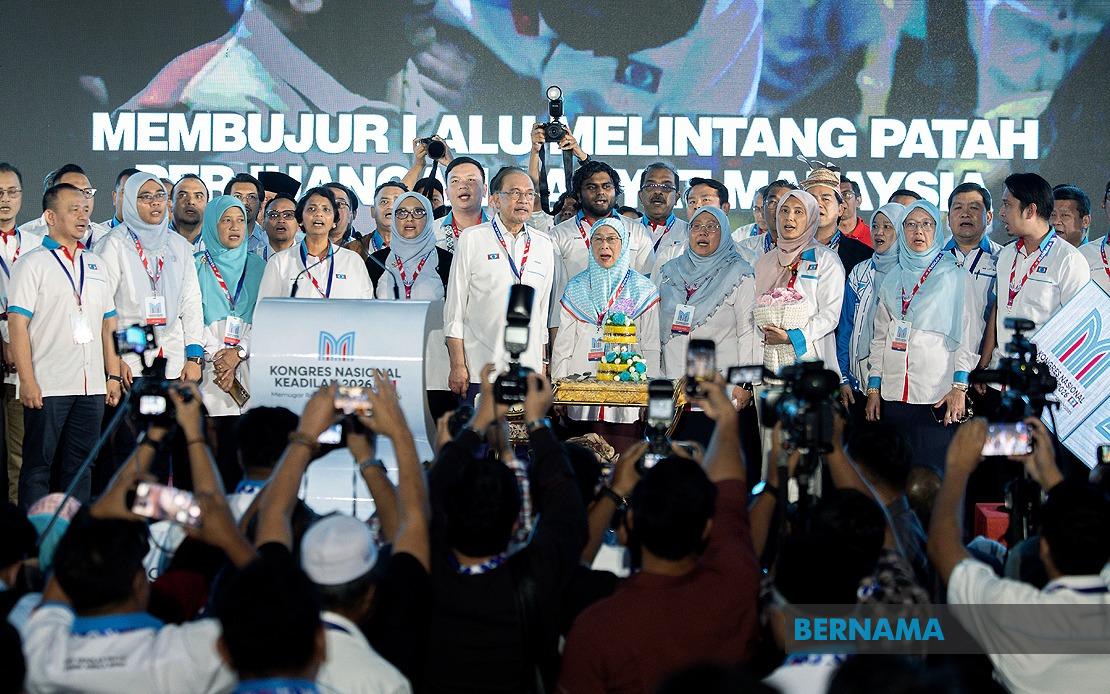
Prime Minister Datuk Seri Anwar Ibrahim has pledged that the government will undertake legislative amendments to the Tabung Haji Act 1995, framing the move as essential to preserving public confidence in one of Malaysia's most significant faith-based financial institutions. Speaking at the conclusion of the Parti Keadilan Rakyat (PKR) National Congress, Anwar, who simultaneously holds the Finance Ministry portfolio, characterised the reform as part of the MADANI Government's broader commitment to overhauling institutional structures and eliminating governance vulnerabilities that have accumulated over time.
The announcement reflects growing recognition within government circles that Tabung Haji, which manages the savings and pilgrimage funds of millions of Malaysian Muslims, requires modernised legislative architecture to meet contemporary governance standards. The institution has faced scrutiny over its operational frameworks and investment management practices in recent years, necessitating legislative intervention to restore stakeholder confidence. By positioning the amendment as a priority measure, the Prime Minister signals that addressing institutional weakness is not merely a peripheral administrative exercise but a core element of the administration's governance agenda.
Anwar elaborated that strengthening governance structures extends beyond Tabung Haji, encompassing a comprehensive institutional cleanup across the public sector. He emphasised that every identified weakness must be confronted directly and resolved decisively, suggesting that the government views institutional reform as fundamental to rebuilding public trust in state entities. This holistic approach indicates a philosophy wherein governance improvements are treated as foundational investments rather than cosmetic adjustments, potentially signalling more systematic reforms across multiple government agencies and statutory bodies.
In parallel remarks, the Prime Minister announced the government's intention to completely repeal the Universities and University Colleges Act (AUKU) 1971 without replacement by alternative restrictive legislation. This dual commitment to repealing restrictions on student expression while simultaneously tightening governance around financial institutions demonstrates a nuanced reform philosophy: expanding civic freedoms while simultaneously enhancing institutional accountability. The AUKU repeal specifically addresses longstanding criticism from student activists and civil society organisations regarding constraints on campus-based political speech and student organising, representing a substantive departure from previous administrative approaches.
The timing of these announcements during the PKR National Congress suggests they carry additional political weight. Anwar, speaking as party president, used the platform to articulate the party's foundational principles regarding governance reform and institutional integrity. He articulated that the party's strength derives not from concentrating power for partisan advantage, but from maintaining principled commitment to systemic reform and equitable resource distribution. This rhetorical framing appears designed to position PKR as fundamentally committed to institutional renewal rather than factional consolidation, distinguishing the party's approach to governance from previous administrations that faced corruption allegations.
Anwar further committed that economic growth under the MADANI Government must translate into tangible improvements in living standards across all demographic and geographic categories, irrespective of electoral preferences or state-level political alignment. This assertion carries particular significance given Malaysia's history of politically-differentiated development allocation, wherein opposition-controlled states received proportionally fewer federal resources. By explicitly stating that opposition-led territories deserve equivalent developmental attention, the Prime Minister signals an attempt to decouple welfare provision from partisan affiliation, challenging established patterns of resource distribution that have characterised previous administrations.
The emphasis on inclusive development reflects broader positioning of the MADANI agenda as transcending narrow factional interests. Anwar stressed that government responsibility encompasses the entire population and nation rather than merely supporting constituencies or geographical regions aligned with the ruling coalition. This framing responds to criticisms that federal development programs have historically favoured politically-aligned states, potentially representing an effort to rebuild institutional legitimacy through demonstrably equitable allocation mechanisms. Whether such commitments translate into substantive programmatic changes will significantly influence public perception of the MADANI Government's institutional reform credentials.
The Prime Minister's characterisation of PKR's identity emphasises clean administration, principled leadership, and organised effort as organisational foundations. He explicitly rejected the notion that political power represents an instrument for personal enrichment, family aggrandisement, or clientelist networks, instead presenting power as a custodial responsibility to champion popular interests, advance justice, and enhance human dignity. This articulation responds to decades of Malaysian political discourse emphasising institutional corruption and self-interested leadership, positioning PKR as seeking to construct alternative governance norms.
For Malaysian Muslim stakeholders specifically, the Tabung Haji reform carries substantial implications. The institution manages deposits representing accumulated savings for pilgrimage purposes and long-term investment vehicles for millions of adherents, making legislative governance improvements potentially consequential for beneficiary protections and fund management oversight. Enhanced statutory governance frameworks could strengthen financial transparency, investment management standards, and dispute resolution mechanisms, addressing vulnerabilities that have historically complicated beneficiary confidence. The amendment process will require substantial parliamentary deliberation and stakeholder consultation, potentially extending across multiple legislative sessions.
The broader institutional reform agenda outlined by Anwar positions the MADANI Government as fundamentally committed to governance renewal and public sector rehabilitation. By simultaneously advancing finance sector governance improvements while expanding civil liberties protections, the administration articulates a comprehensive vision of institutional reconstruction encompassing both accountability mechanisms and participatory freedoms. The success of these initiatives will substantially influence both public confidence in state institutions and the government's political legitimacy heading toward subsequent electoral cycles. Regional observers will likely monitor whether these announced reforms translate into legislative action and meaningful institutional transformation, or remain primarily rhetorical commitments without substantive implementation.

