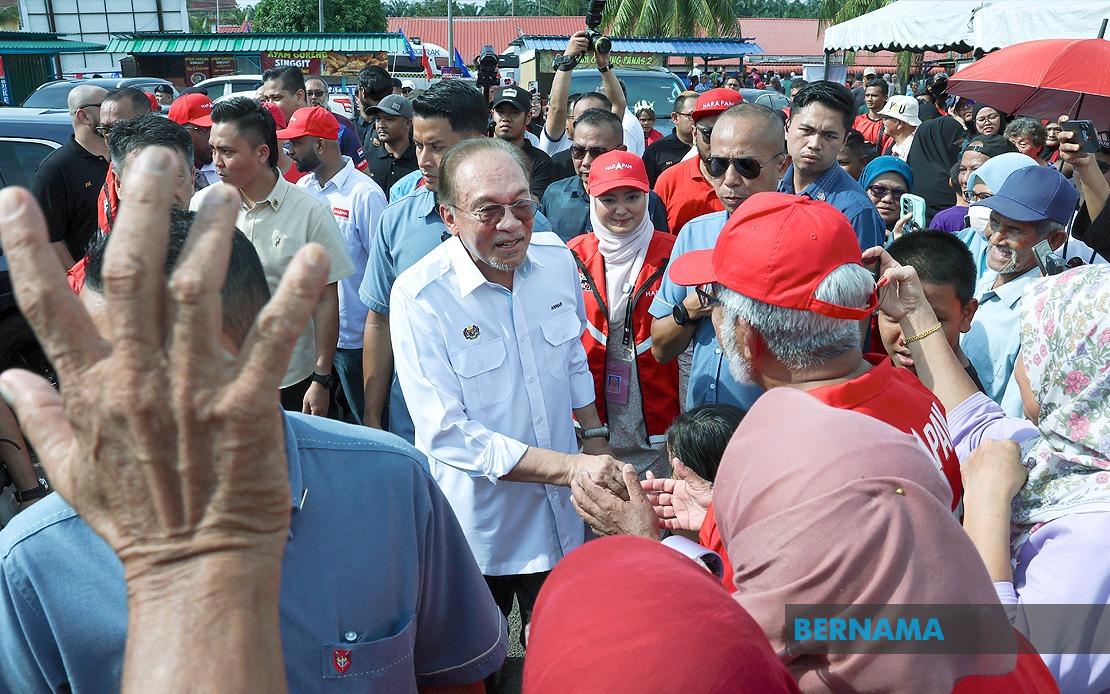
On a Sunday in July at Felda Palong Timur in Segamat, a nine-year-old boy's long-held aspiration was transformed from daydream into lived experience when his grandmother's determination to travel by motorcycle through rural Johor terrain bore fruit. Muhammad Afif Ikhwan had nursed a quiet but persistent wish to encounter Prime Minister Datuk Seri Anwar Ibrahim in person, a goal that seemed distant until his grandmother Rosimah Mohammad, aged 58, resolved to make the journey happen. What began as a modest motorcycle ride from Kampung Pudu, traversing through an oil palm estate, would eventually become one of the defining moments of the child's formative years, cementing a memory that extends far beyond a simple handshake.
The anticipation leading up to that fateful day was palpable within the household. Rosimah recalled how her grandson found sleep elusive in the nights before the event, his excitement building with each passing hour as he contemplated the prospect of finally standing before his idol. For a nine-year-old, the idea of meeting the nation's leader represented something profoundly meaningful—a convergence of admiration, hope, and the possibility of connection with someone he had come to regard with genuine respect. The grandmother's willingness to undertake the motorcycle journey underscored the significance she placed on fulfilling this childhood dream, demonstrating a commitment that transcended mere parental indulgence.
When grandmother and grandson arrived at the Felda venue, they strategically positioned themselves along the pathway leading to the stage, a vantage point that would place Muhammad Afif within visual and potentially interactive range of the Prime Minister. As Anwar approached the stage, greeting attendees and acknowledging the gathered crowd with the customary gestures befitting a public leader, the boy made his move. Squeezing through the assembled throng of people, Muhammad Afif extended his hand toward the Prime Minister, an act of courage for a child navigating through a sea of taller bodies and competing for attention in a crowded public gathering.
The encounter that followed transcended the formulaic nature of typical political meet-and-greets. Rather than simply acknowledging the boy's greeting and moving forward with his schedule, Anwar chose to elevate the moment by inviting Muhammad Afif onto the stage itself. There, in full view of the assembled crowd, the Prime Minister invited the nine-year-old to stand alongside him during his speech delivery, transforming a fleeting handshake into a substantial act of recognition. Rosimah observed her grandson's astonishment and overwhelming joy at this unexpected turn of events, a reaction that conveyed the magnitude of what was unfolding before them. For a child who had envisioned merely seeing his idol from a distance, being positioned on stage represented an almost surreal elevation of the encounter.
The ripples of this moment extended well beyond the event itself. When Anwar learned the fuller context of Muhammad Afif's wish and the grandmother's efforts to facilitate it, he determined that a follow-up gesture was warranted. Days later, PKR deputy information chief Siti Aishah Shaik Ismail visited the family's home in Kampung Pudu, acting as the Prime Minister's representative and conveying his personal appreciation for the boy's dedication and the grandmother's commitment. This secondary visit transformed the initial encounter from a spontaneous public interaction into a more deliberate and thoughtful engagement with the family.
The gifts presented during this home visit—a bicycle, a school bag, and a pair of shoes—were not merely material tokens but carried symbolic weight as gestures demonstrating that the Prime Minister had registered the boy's identity and aspirations beyond the moment on stage. These items addressed practical needs while simultaneously reinforcing that the child had been acknowledged and remembered. For many Malaysian families, particularly those in rural areas or smaller towns, such recognition from the highest levels of government can carry profound psychological impact, affirming a sense of inclusion and value within the national community.
What emerges most poignantly from Rosimah's account is the enduring emotional resonance of the encounter for her grandson. Months after the event, Muhammad Afif continued to sleep each night while clutching the very shirt he had worn during his meeting with the Prime Minister, an act that speaks to the depth of his emotional connection to the experience. The garment had transformed from an ordinary piece of clothing into a tangible talisman of an extraordinary moment, a physical object through which the boy could reconnect nightly with the memory of being seen, acknowledged, and elevated by the nation's leader.
This episode illuminates certain dimensions of political engagement and public representation that extend beyond the immediate mechanics of governance. For a child in a rural Johor setting, the accessibility of leadership and the willingness of those in power to acknowledge individual hopes and dreams can shape perceptions of democratic participation and social inclusion. The grandmother's agency in making the journey possible also underscores the role of familial support networks in facilitating children's aspirations, particularly within communities where resources may be limited but determination and creativity remain abundant.
The narrative also touches upon questions of privilege and access within the political sphere. While not every citizen can hope for such personalised attention from a sitting Prime Minister, the fact that this particular boy's circumstances—his evident admiration, his grandmother's practical effort, and the timing of a public event—aligned to create this opportunity suggests both an element of fortunate happenstance and a conscious choice by Anwar to invest in such human connections. In an era when political leadership can feel distant and transactional, such moments of genuine human interaction retain symbolic importance.
Furthermore, the story resonates within the context of Malaysian society's relationship with its leadership. Public figures who demonstrate attentiveness to individual citizens' hopes, particularly those of children, cultivate a form of political capital that extends beyond polling numbers and policy implementation. The visibility of such gestures, when reported through media channels, sends broader messages about the approachability and human-centredness of governance. For other families and children consuming this story, it reinforces the notion that dreams are not inherently beyond reach, even when they appear to involve the nation's highest offices.
The grandmother's motorcycle journey through the oil palm estate, while modest in material terms, became a metaphorical vehicle for dreams deferred becoming dreams realised. For Muhammad Afif, the memory crystallised into something more enduring than a celebrity sighting—it became evidence that his admiration had been reciprocated, that his hopes had been witnessed, and that in the context of the nation's political leadership, he mattered enough to be remembered and revisited with gifts and goodwill. In this fashion, what began as a child's fervent wish transformed into a family story that speaks to resilience, maternal dedication, and the occasional convergence of hope with circumstance that defines those moments we carry with us throughout our lives.

