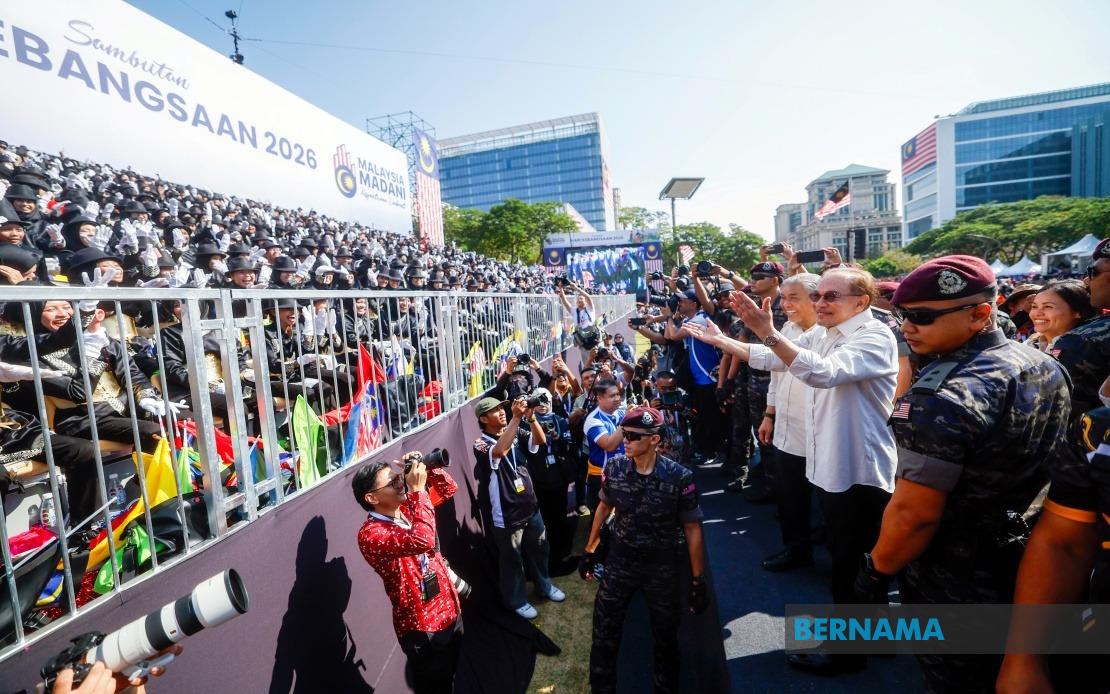
Prime Minister Datuk Seri Anwar Ibrahim offered warm commendation for the 2026 National Day celebration held at Dataran Putrajaya on August 31, describing the proceedings as a "great show" after observing the 69th National Day parade and public procession. His enthusiastic response reflected the scale and ambition of the festivities, which drew more than 100,000 citizens to the capital's ceremonial grounds, many of whom had camped overnight to secure viewing positions.
The celebration, which commenced at 8 am, benefited from the distinguished presence of His Majesty Sultan Ibrahim and Her Majesty Raja Zarith Sofiah, the reigning King and Queen of Malaysia. Anwar and his wife, Datuk Seri Dr Wan Azizah Wan Ismail, welcomed Their Majesties on arrival, alongside Communications Minister Datuk Seri Fahmi Fadzil, who chairs the 2026 National Day and Malaysia Day Main Committee. This ceremonial dimension underscored the importance placed on the occasion by the highest levels of government and the constitutional monarchy.
Operationalising the theme "Malaysia MADANI: Kesejahteraan Dinikmati"—which translates to a vision of shared prosperity and inclusive well-being—the day's programme began with traditional military pageantry before transitioning into cultural performances and a spectacle-laden parade. The procession itself represented a massive logistical undertaking, mobilising 10,819 participants distributed across 76 contingents and 22 marching bands. The display encompassed 11 decorated vehicles, 328 land, sea and air assets deployed for visual impact, 112 service animals, and 22 electric vehicles, the latter underscoring Malaysia's gradual pivot toward sustainable transport. A human graphics performance staged on the terraces added a contemporary dimension to the traditionally formal ceremonial framework.
Following the official proceedings, Anwar moved among the assembled crowds with evident pleasure, walking more than 500 metres across Dataran Putrajaya while accepting photographs and engaging directly with citizens. Such grassroots interaction carries political significance in Malaysia's democratic context, projecting accessibility and appreciation for public sentiment. One attendee seized the moment to express personal gratitude for an announcement made during the Prime Minister's National Day Address the previous day—namely, the restoration of the monthly basic eligibility quota under the BUDI MADANI RON95 programme from 200 litres to 300 litres. This spontaneous moment of appreciation illustrated how government fiscal policies directly intersect with citizens' daily economic realities.
The fuel subsidy adjustments announced by Anwar formed a substantial component of six key government initiatives unveiled in his National Day Address, aimed at tangibly improving standards of living across the population. The BUDI95 quota increase benefits more than 16 million users of subsidised RON95 petrol, a constituency representing a significant portion of Malaysia's driving population. The measure addresses longstanding complaints about the inadequacy of monthly allowances under the subsidy scheme, particularly given rising mobility demands and vehicle usage patterns in Malaysia's increasingly urbanised economy.
Complementing the petrol subsidy enhancement, the government announced that more than half a million eligible owners of diesel-powered pickup trucks and jeeps would receive up to 400 litres of BUDI Diesel monthly, effective from September 1. This measure specifically targets the commercial and semi-commercial vehicle segment, including small-business operators, farmers, and traders who depend on affordable diesel for their livelihoods. The timing of this expansion reflects government calculations about supporting sectors vulnerable to fuel-cost pressures while balancing broader fiscal constraints.
The scale of public participation in the 2026 National Day celebration speaks to underlying currents in Malaysian society regarding national identity and civic engagement. The arrival of substantial crowds beginning the previous evening, combined with early-morning gatherings on the actual day, suggests that National Day observance retains its capacity to mobilise Malaysians across demographic lines. In an era of fractious political divisions and competing narratives about national direction, such unified civic occasions carry symbolic weight beyond their immediate ceremonial function.
From a Malaysian governance perspective, the integration of the Malaysia MADANI vision into the National Day messaging represents a deliberate attempt to anchor government policy direction in a unifying national narrative. Malaysia MADANI, emphasising prosperity sharing and respect for diversity, seeks to position the Anwar administration as committed to inclusive development that transcends communal boundaries. The inclusion of environmental consciousness through electric vehicles in the parade, and the emphasis on social welfare through the fuel subsidy announcements, reinforces messaging about a modernising government attuned to both sustainability imperatives and immediate household economic concerns.
The celebration's emphasis on patriotic performance and inclusive symbolism also registers within the broader Southeast Asian context of nation-building. As regional governments navigate complex questions about cohesion, identity, and development trajectories, Malaysia's investment in elaborate National Day observances signals a commitment to reinforcing citizen attachment to the national project. The involvement of diverse contingents and the emphasis on cultural representation within the parade framework attempts to model how diversity can coexist within a unified national framework—a message with relevance across Southeast Asia's diverse societies.
Anwar's personal engagement with the crowds following the formal proceedings, including his receptiveness to citizen feedback about subsidy policies, illustrates a style of political leadership that emphasises accessibility and responsiveness. In Malaysia's contemporary political environment, characterised by rapid shifts in public opinion and expectations of executive accountability, such demonstrations of engagement carry practical political value. The Prime Minister's visible pleasure in the proceedings and his extended interaction with attendees project an image of leadership confidence and popular connection at a moment when government initiatives around economic policy remain subject to public debate and scrutiny.

