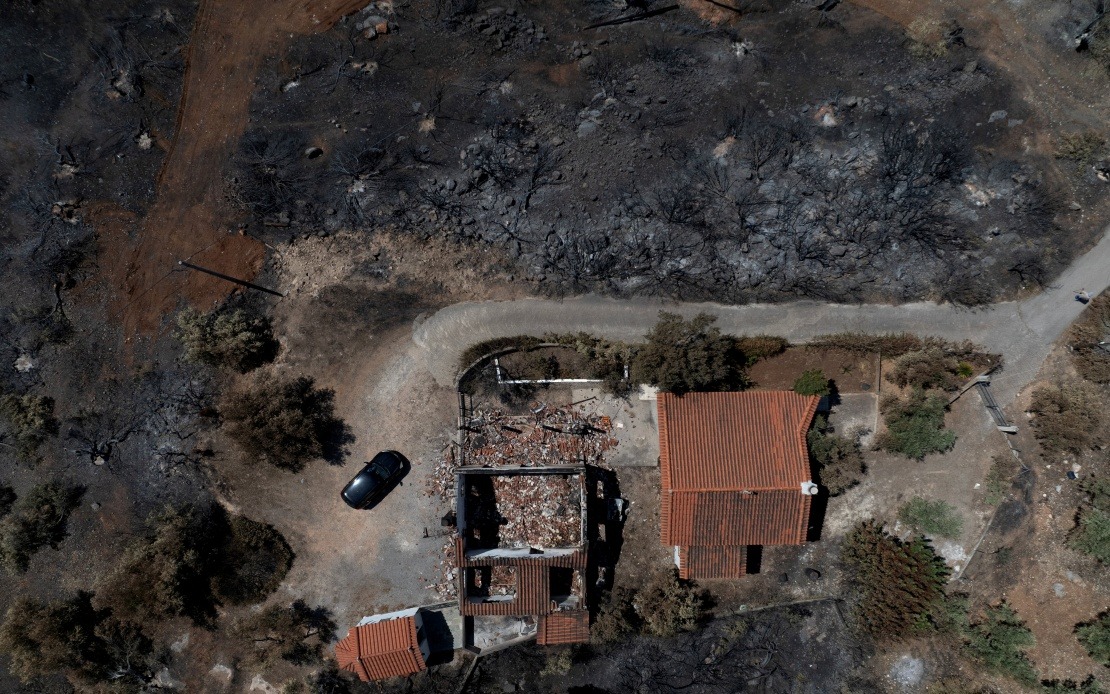
Greece has activated its highest emergency protocol for wildfire management across three critical regions, issuing what authorities term a 'red alert' for Attica, Viotia and Evia on Thursday. The General Secretariat for Civil Protection, operating under the Climate Crisis and Civil Protection Ministry, elevated the wildfire risk classification to Category 4—the most severe level—following assessment of meteorological and environmental conditions. This designation covers the greater Athens metropolitan area and surrounding regions, reflecting official concern that atmospheric and ground conditions are particularly conducive to rapid fire ignition and spread.
The implementation of this alert status triggers an escalated response framework designed to maximise the nation's firefighting capacity. The National Civil Protection Mechanism will operate at full operational strength, marshalling resources across multiple emergency services. Personnel from the fire service, national police and armed forces units will conduct both ground patrols and aerial surveillance operations across vulnerable territories, creating a visible deterrent against potential fire-starting activities while enabling rapid detection if blazes emerge. This multi-agency approach reflects the integrated crisis management structure Greece has developed to manage seasonal wildfire threats.
Government authorities have imposed preventive traffic restrictions and access controls affecting vehicles and civilian movement through forest zones and other areas deemed especially vulnerable to fire propagation. These temporary measures aim to reduce accidental ignition sources and ensure that emergency response routes remain clear for rapid deployment. The public has been urged to avoid any activities that could generate sparks or flames, including outdoor cooking, burning of waste materials, and use of machinery in dry vegetation. Such behavioural directives represent the administrative complement to surveillance and rapid-response strategies.
The heightened alert comes as firefighting personnel successfully brought under control a separate wildfire that emerged near Koropi, a municipality southeast of the capital. The fire ignited in low vegetation within the Driggia district at approximately 1.45 pm local time on Wednesday and required substantial resource deployment. Fifty-two firefighters participated in the operation, including three specialised forest commando units equipped for complex terrain and heavy vegetation engagement. This ground force was complemented by fourteen vehicles positioned strategically for water delivery and perimeter support.
The aerial component of the Koropi response demonstrates Greece's commitment to multi-modal firefighting tactics. Four helicopters and two dedicated water-dropping aircraft operated in concert, with one additional helicopter serving coordination functions to optimise tactical deployment of aerial assets. Local authorities contributed water tankers crewed by municipal personnel, while the operations coordination centre employed advanced thermal and optical drone surveillance systems to monitor fire behaviour in real time. This technological integration provides commanders with granular tactical information essential for directing resources effectively as conditions shift.
Investigators have established a formal arson inquiry team to determine causation factors for the Koropi fire, suggesting that initial assessments may have indicated human rather than natural origin. This investigation protocol is standard practice in the Greek fire management system, as determining fire origin influences both immediate response strategy and longer-term prevention policy. Evidence collection during active firefighting operations can prove challenging, making prompt dispatch of specialist investigators essential.
Beyond the contained Koropi incident, Greek authorities remain engaged in suppressing a substantially more extensive blaze that commenced the previous week within Viotia province and subsequently propagated into western Attica. This major conflagration represents a more complex firefighting challenge due to its scale and the duration of burning. Satellite monitoring data from the European Union's Copernicus system—an authoritative source for environmental observation—indicates the fire has consumed approximately 14,424 hectares of territory. To contextualise this figure for international audiences, this area encompasses roughly 35,642 acres, representing a significant environmental and economic loss.
Operations against this larger blaze have extracted a tragic human cost from the emergency services. On Sunday, during coordinated aerial operations, two firefighting helicopters collided in mid-air, resulting in the deaths of a Danish pilot and a Greek aerial coordinator. This incident underscores the inherent dangers that personnel encounter when combating large-scale wildfires in challenging geographical and atmospheric conditions. The collision represents a sobering reminder of the operational risks associated with intensive aerial firefighting activities, where multiple aircraft operate in close proximity in areas of active fire and smoke.
For Southeast Asian observers, this European crisis carries indirect relevance through multiple mechanisms. The Mediterranean region, where Greece situates itself geographically, has experienced escalating wildfire severity over recent decades, a pattern climate scientists attribute to warming temperatures and altered precipitation patterns. These trends parallel concerns affecting regions throughout Asia, including Malaysia and neighbouring territories, where seasonal wildfire seasons in peatland and forest areas have generated transnational haze events affecting air quality across multiple nations. Greece's emergency management response—the integration of satellite monitoring, aerial assets, inter-agency coordination, and public communication—offers a model framework applicable to Southeast Asian fire management systems.
The regional implications extend to disaster preparedness methodology. As climatic conditions continue shifting in unpredictable directions, countries throughout Asia have intensified their investment in emergency response infrastructure and protocols. The sophistication evident in Greece's Category 4 alert system, combining risk assessment, resource activation, behavioural directives, and technological surveillance, represents one approach to managing escalating fire risk in contexts where traditional containment strategies prove increasingly inadequate. Malaysian authorities and regional governments have similarly upgraded their wildfire management architectures in response to demonstrated threats and transnational impacts.
The occurrence of multiple simultaneous significant fires across geographically proximate regions highlights a systemic vulnerability that transcends individual incident response. When atmospheric conditions reach the extreme levels that trigger Category 4 alerts, the probability of multiple ignition sources igniting during the same temporal window increases substantially. This phenomenon challenges firefighting systems across the globe, as the total available resource pool—personnel, equipment, aerial assets—can become saturated when addressing multiple major incidents concurrently. Greece's response to the current crisis illustrates both the capabilities of advanced emergency management systems and their inherent limitations when facing simultaneous, large-scale incidents.
Looking forward, the outcomes of investigations into fire causation will inform prevention strategies and public education efforts. Determining whether significant wildfires result predominantly from human negligence, deliberate arson, or environmental factors shapes policy responses. If arson investigations establish intentional fire-setting as a significant causative factor, authorities may implement enhanced surveillance and enforcement measures. Conversely, if accident investigation reveals that unintended ignitions predominate, public awareness campaigns emphasising safe practices become the policy focus. This evidence-based approach to fire prevention represents best practice in emergency management systems across developed democracies.

