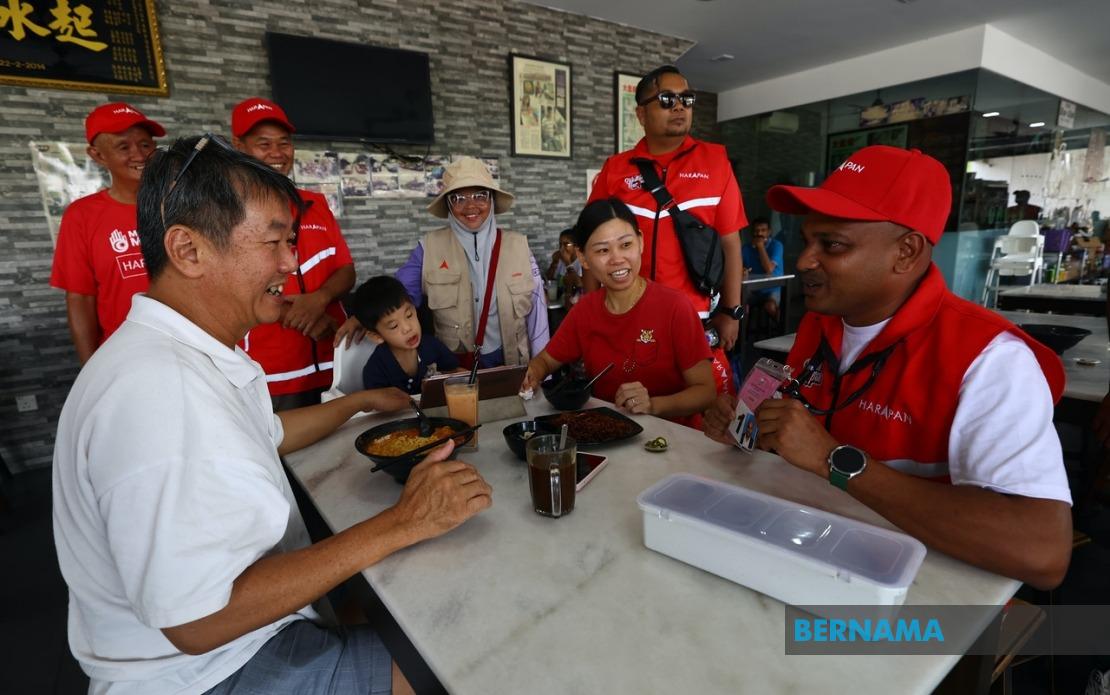
With just five days remaining before Johor voters head to the polls on July 11, Pakatan Harapan candidate Guna Balakrishnan is executing a final sprint across the Layang-Layang state constituency, determined to reach every remaining corner of his electoral division. The PH machinery has already blanketed nearly four-fifths of the 25,181-registered-voter constituency, but Guna acknowledges that the closing phase of the campaign demands an intensified effort to connect with the final 20 per cent of the electorate still to be directly canvassed. His team's strategy centres on maximizing personal contact with undecided and persuadable voters before the July 11 election, with early voting already scheduled for Tuesday, July 7.
The candidate's messaging in these final days reflects a shift from broad campaign rhetoric toward concrete, locality-specific pledges designed to resonate with Layang-Layang's particular concerns. Rather than relying solely on the ruling coalition's national narrative, Guna has unveiled a detailed manifesto that demonstrates granular understanding of the constituency's infrastructure shortcomings and social needs. This hyperlocal approach—promising remedies for chronic flooding, road rehabilitation, improved street lighting, and enhanced digital connectivity—signals an attempt to counter the narrative that opposition parties lack practical governance credentials. For Malaysian readers, this represents an important feature of the 2024 regional election cycle: the growing expectation that candidates articulate concrete, ward-level solutions rather than abstract ideological positions.
Among the manifesto's headline commitments is the resolution of persistent flood vulnerability in low-lying areas of the constituency, a recurring grievance that has likely cost previous PH campaigns support among affected residents. Guna's inclusion of specific infrastructure upgrades—drainage system improvements, street lighting enhancement, and road rehabilitation—suggests his team has conducted targeted voter research identifying which tangible amenities correlate most strongly with household satisfaction. The proposal to expand digital access and internet connectivity addresses a critical rural disadvantage: inadequate broadband remains a barrier to economic participation in Malaysia's outer regions, restricting e-commerce opportunities and remote work capacity for younger and entrepreneurial residents.
Beyond infrastructure, Guna's manifesto allocates considerable emphasis to human capital and social welfare initiatives. His commitment to launching women's entrepreneurship programmes reflects broader PH positioning on gender economic participation, while the expansion of Technical and Vocational Education and Training opportunities targets youth employment pathways outside the university-dependent traditional model. These initiatives align with emerging Malaysian policy consensus that vocational alternatives deserve equal prestige and investment as tertiary education. The proposed senior citizen activity centre, or PAWE, similarly addresses a demographic concern often overlooked in rural constituencies: social isolation and purposelessness among retirees lacking structured community engagement.
Local trader Tan Ah Kiat, aged 55, represents the category of established small-business figures whose support often determines constituency outcomes. His endorsement of Guna's flood mitigation and infrastructure focus validates the candidate's identification of genuine community pain points. Tan's specific mention of improved drainage systems and street lighting—seemingly mundane concerns—underscores a crucial political reality in Malaysian elections: marginal contests are frequently decided by voters' assessment of which candidate will tangibly improve their immediate living environment. Deficient drainage, inadequate lighting, and poor road conditions disproportionately affect small traders and working-class households, making these issues potent electoral differentiators even if they rarely feature in national news coverage.
Tan's observation regarding internet connectivity is particularly telling. Rural and semi-rural constituencies throughout Malaysia face persistent digital divides that national broadband initiatives have failed to adequately bridge. For micro-entrepreneurs, remote workers, and students relying on online education platforms, unstable connectivity represents genuine economic hardship. Guna's pledge to address this gap therefore carries weight among entrepreneurial demographics who might otherwise be attracted to BN's business-friendly messaging or skeptical of PH's governance track record. The candidate is effectively signaling that PH understands the specific barriers to rural economic advancement that extend beyond traditional rural policy frameworks.
R. Kalaiselvan, 48, exemplifies another crucial voting cohort: middle-aged professionals concerned simultaneously with youth prospects and aging parent welfare. His warm reception of the TVET expansion and women's entrepreneurship initiatives demonstrates that PH's human capital messaging resonates with voters seeking assurance that candidates think beyond short-term handouts toward structural economic inclusion. Kalaiselvan's explicit praise for the senior citizen welfare centre proposal is particularly significant, as it indicates that voters increasingly view political candidates as responsible for designing community-level social infrastructure, not merely delivering government transfers.
The three-cornered contest in Layang-Layang—between Guna's PH, Barisan Nasional's Chua Jian Boon, and the incumbent Abd Mutalip Abd Rahim representing Perikatan Nasional—reflects the fractured opposition dynamics that have characterized post-2018 Malaysian electoral politics. The presence of a PN incumbent adds complexity to traditional BN versus PH binary contests. For PH to claim the seat, the party must consolidate non-BN voters while simultaneously persuading swing voters that the coalition offers superior governance compared to either the traditional establishment or the Islamist-leaning newcomer. Guna's emphasis on inclusive, cross-communal development agendas serves this calculus: such messaging appeals to moderate voters wary of both BN cronyism narratives and PN's religious conservatism.
The final week of campaigning in Layang-Layang will test whether PH's detailed manifesto strategy and ground-level candidate visibility can overcome historical disadvantages in a constituency where incumbent advantage traditionally weighs heavily. The fact that Guna's team has invested significant effort in articulating specific, costed solutions to identifiable problems suggests a campaign operating with sophisticated voter intelligence. Malaysian elections increasingly turn on such localized persuasion, particularly in three-cornered contests where persuadable swing voters can determine outcomes. Guna's intensified final push, targeting the remaining fifth of the constituency, represents an attempt to convert manifesto commitments and local testimonials into actual votes before polls open on July 11.
The Johor state election itself carries ramifications beyond the peninsula's southern state. As one of Malaysia's largest and most economically significant regions, Johor's electoral direction influences national political momentum heading into the next federal election cycle. Contests like Layang-Layang, while locally focused, accumulate into state-level mandates that shape national coalition calculations. For PH, demonstrating that careful policy articulation and ground-level engagement can overcome incumbent advantage would represent a meaningful counter-narrative to recent electoral setbacks. Conversely, a PN or BN victory would reinforce perceptions of PH's vulnerability in suburban and semi-rural constituencies where incumbent advantage and effective localized messaging combine to produce difficult electoral terrain for opposition parties seeking to consolidate fragmented opposition support.

