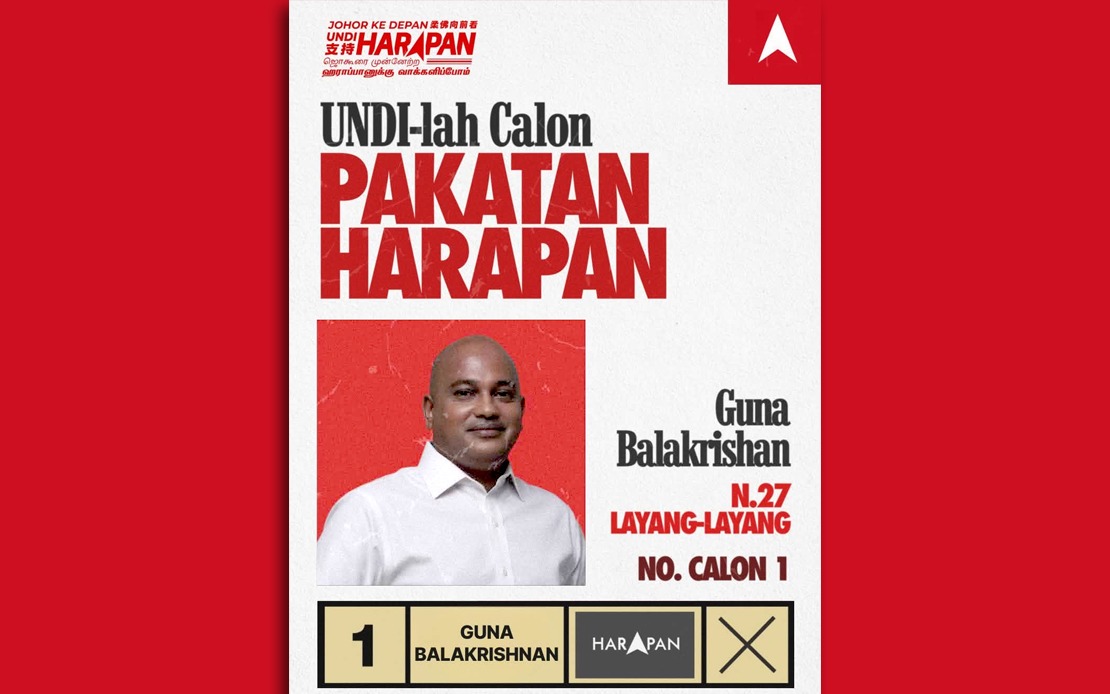
Guna Balakrishnan, the Pakatan Harapan contender for Layang-Layang in the Johor state election, has released an ambitious development blueprint centred on inclusive growth and community responsiveness. The manifesto, unveiled during campaigning in Kluang, reflects his positioning as a representative dedicated to bridging ordinary residents with government resources and decision-making structures. This approach marks a shift toward addressing granular local concerns rather than broader state-level policy platforms, reflecting how electoral dynamics in smaller constituencies increasingly hinge on tangible, neighbourhood-level problem-solving.
Flood management stands as the cornerstone of Guna's campaign pledge, addressing a perennial vulnerability affecting multiple settlements within the constituency. Communities in Kampung Senda, Sungai Sayong, Kampung Tengah Renggam, Ulu Benut, Simpang Renggam and Kampung Chokro have endured repeated inundation during monsoon seasons, undermining economic productivity and straining household finances. His commitment encompasses accelerating flood mitigation infrastructure projects, modernising drainage networks, and instituting preventive maintenance regimes for roads and public amenities. For residents who have watched previous administrations pledge similar initiatives without sustained implementation, Guna's emphasis on systematic coordination between state government, local municipalities and relevant federal agencies represents an effort to instil confidence in execution capacity.
Rural digital connectivity forms a secondary development pillar in his manifesto, addressing infrastructure gaps that have constrained economic and educational opportunities across peripheral communities. Enhanced street illumination and expanded internet coverage are presented as foundations for enabling online commerce, facilitating distance learning, and attracting digital-economy opportunities to areas historically dependent on agriculture and traditional trades. This recognition of technology's transformative potential reflects broader understanding within Malaysian politics that digital exclusion perpetuates geographic inequality. For a rural constituency like Layang-Layang, where young residents often migrate to urban centres for employment and education, improved connectivity could marginally alter the calculus of staying in place.
Youth development initiatives constitute a third strategic element, with Guna proposing expanded access to Technical and Vocational Education and Training programmes alongside a proposed motorsports facility. The motorsports track proposal carries particular resonance in Malaysian electoral contexts, where youth unemployment and underemployment drive migration and social fragmentation. By positioning vocational alternatives alongside a recreational facility framed as talent development infrastructure, Guna's platform acknowledges both economic necessity and the role of organized leisure in preventing drift toward informal or risky activities. Whether such facilities can genuinely compete with pull factors in Kuala Lumpur and Singapore remains debatable, yet the proposal signals receptiveness to youth aspirations beyond traditional paths.
Support for small-scale economic activity and leveraging Renggam's tourism potential represent Guna's approach to income diversification within the constituency. Rather than pursuing large-scale industrial development that might face environmental or land-use obstacles, his strategy targets incremental growth through supporting petty traders and positioning local heritage or natural assets for visitor appeal. This modest economic vision acknowledges constraints on what state-level representatives can deliver whilst emphasizing collaboration between grassroots entrepreneurs and government facilitation. Tourism development in particular has gained traction across Malaysian state elections as a relatively uncontroversial growth strategy, though actual implementation often lags political commitment.
Gender and elder welfare dimensions round out the six-point framework, with pledges to strengthen women's entrepreneurship pathways and establish a Senior Citizens Activity Centre. The proposed PAWE facility addresses social isolation and purposelessness affecting elderly residents, particularly in rural settings where nuclear family structures predominate and traditional support networks have weakened. Women's entrepreneurship support recognizes female economic participation as both a poverty-alleviation mechanism and a demographic dividend, reflecting language increasingly common across Malaysian political platforms regardless of coalition affiliation. These socially-oriented commitments signal awareness that electoral success requires addressing beyond-work dimensions of constituent welfare.
Guna has explicitly positioned his pledges as grounded commitments rather than ephemeral campaign rhetoric, emphasizing realistic implementation through institutional cooperation. This framing responds to pervasive voter cynicism regarding broken election promises across Malaysian elections at all levels. By stressing the assemblyman's role as intermediary between constituents and bureaucratic structures, he articulates a governance philosophy centred on responsive representation and institutional accountability. For constituencies where trust in political systems has eroded through repeated unfulfilled promises, this rhetorical strategy attempts to rehabilitate credibility through emphasis on process transparency and collaborative governance.
The Layang-Layang contest itself occurs within a three-way competitive structure featuring Guna, Barisan Nasional's Chua Jian Boon, and incumbent Perikatan Nasional representative Abd Mutalip Abd Rahim. With 25,181 registered voters, the constituency represents a typical Johor rural-suburban mix where swing votes frequently determine outcomes. The triangular contest structure complicates vote consolidation for all candidates, potentially elevating the importance of localized campaign messaging and granular constituent engagement. Guna's detailed manifesto may partly reflect strategic calculations around winning support among swing voters amenable to development-focused pitches rather than ideological or communal appeals.
The Johor state election, scheduled for July 11 with early voting on July 7, continues the Malaysian trajectory toward more frequent electoral cycles at state level. Voter engagement with constituency-specific manifestos varies significantly based on perceived credibility of candidates and historical delivery records. In Layang-Layang specifically, voter familiarity with incumbent performance versus challenger promises will substantially shape electoral outcomes. The emphasis across Guna's platform on resolving longstanding problems—particularly flooding—suggests his campaign has identified these as salient issues among persuadable voters, though whether identification with problems automatically translates to voting preference remains contingent on voter assessment of implementation capacity and alternative candidates' commitments.

