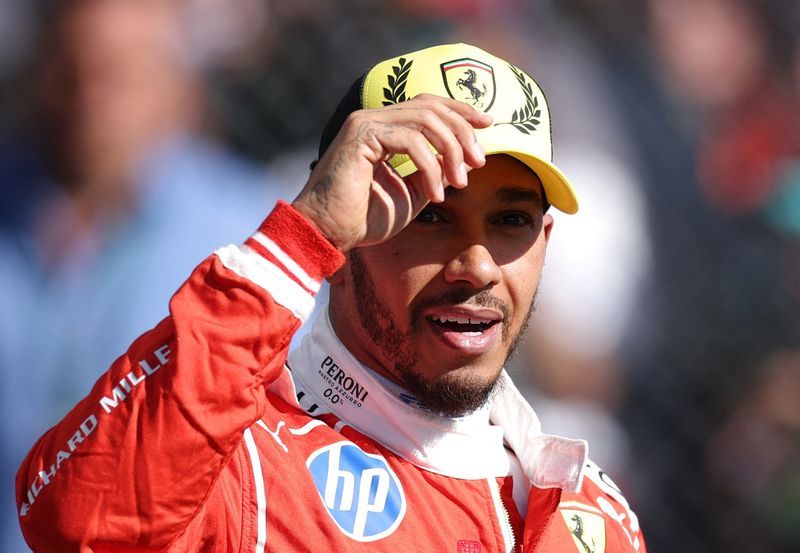
Lewis Hamilton arrives at the Hungaroring with an opportunity to lift Ferrari's spirits before Formula One's mid-season break, as Mercedes confronts a deepening technical crisis that has left George Russell languishing 50 points behind championship leader Kimi Antonelli. The Budapest venue holds special significance for the seven-time world champion, whose proven mastery of the track's technical demands offers a chance to reclaim momentum and provide a much-needed confidence boost for the Scuderia heading into the calendar's traditional shutdown.
Russell's deteriorating situation has become the paddock's dominant narrative following a third scoreless race of the season at Spa last weekend, where the Briton's car shed substantial time on high-speed sections. This mechanical deficit has proven particularly acute at circuits featuring long straights, exposing a fundamental performance gap that Mercedes engineers have struggled to diagnose or remedy. The contrast with his 19-year-old Italian teammate Kimi Antonelli, who has amassed six victories in ten rounds, underscores the severity of the problem and raises uncomfortable questions about the development direction chosen by the championship-leading outfit.
Russell's championship trajectory has collapsed from opening-season favourite status with his "Mr Consistency" moniker, a reputation thoroughly undermined by recent events that have shuffled the title race's complexion. His three non-finishes constitute a pattern that extends beyond mere driver error, suggesting systemic vehicle problems that engineering updates have failed to address. The accumulated deficit means his path to defending the championship has become mathematically daunting, particularly as rivals capitalise on every operational miscue.
Hamilton's repositioning into second place, now 45 points adrift of Antonelli, illustrates how quickly fortune shifts in Formula One's compressed calendar. His Hungarian pedigree is unmatched—eight previous victories at the Hungaroring represent an extraordinary achievement at any single venue, and another triumph would equal his all-time record of nine wins at Silverstone. His most recent pole position came here in 2023, evidence that recent track modifications have not diminished his competitive advantage at a circuit that demands precision over raw power.
Ferrari team principal Fred Vasseur approached the weekend with deliberate circumspection, resisting temptation to overstate the team's prospects despite favourable circumstances. His cautionary remarks acknowledged that Budapest's slow-speed nature, where aerodynamic finesse and setup mastery matter far more than straight-line velocity, may indeed reduce Ferrari's engine deficit relative to Mercedes. Yet Vasseur's insistence that "it's not a given" and that "it won't be easy" reflected the competitive reality facing even well-positioned teams at this stage of the campaign, where marginal gains separate victory from disappointment.
Charles Leclerc has established himself as Ferrari's in-form driver through recent rounds, capturing victory at Silverstone and finishing second at Spa, outperforming Hamilton's results over the same period. This competitive positioning provides Ferrari with two competitive entries pursuing different strategic objectives—Leclerc's immediate focus on extending the team's points tally, Hamilton's concentration on establishing momentum before the break and positioning himself as a genuine title contender for the second half.
Kimi Antonelli, despite his commanding lead, acknowledged that Budapest introduces genuine unpredictability into the competitive order, potentially benefiting multiple teams unaccustomed to dominance. The Italian drew parallels to Monaco's singular demands, where setup excellence and driver execution prove more decisive than mechanical horsepower. His assessment that four teams—Mercedes, Ferrari, Red Bull, and McLaren—remain genuinely capable of victory reflects the competitive equilibrium that slower circuits tend to produce, erasing some of the technological advantages that favour certain powerplants on faster layouts.
McLaren's strategic positioning centred on substantial technical upgrades destined for the Hungarian weekend, including a revised floor and aerodynamic modifications that development teams hope will restore competitiveness. The team simultaneously plans to continue experimental rear-wing evaluations, exploiting free-practice sessions to gather data without disrupting race-weekend preparation. Leonardo Fornaroli, Ferrari's 2024 Formula Two champion and current reserve driver, will pilot the McLaren during Friday morning practice while Oscar Piastri rests, providing valuable programme time for an emerging talent.
The broader technical landscape reflects how mid-season upgrades attempt to address earlier design miscalculations and manufacturing tolerances. Aston Martin secured a long-awaited chassis improvement but faces frustration waiting until the Dutch Grand Prix's conclusion of August before receiving its upgraded Honda power unit, condemning the team to compete with incomplete specifications during a crucial development window. This staggered introduction of upgrades across the field typically reshuffles the competitive order, introducing variables that statistical models struggle to predict accurately.
For Malaysian observers and Southeast Asian motorsport enthusiasts, the Hungarian narrative encapsulates Formula One's current competitive fluidity—established championship favourites crumbling while emerging talents seize opportunity, veteran sophistication confronting youthful energy, and technical ingenuity determining outcomes on tracks where driver brilliance alone proves insufficient. Hamilton's potential Hungarian success would constitute an important statement from Ferrari heading toward the campaign's decisive phase, reaffirming that their Maranello project retains credible championship ambitions despite previous difficulties establishing consistent performance delivery across varying circuit characteristics.
The August break arriving immediately after Budapest provides teams critical reflection time, permitting engineering departments to analyse two weeks of accumulated data and devise strategic corrections addressing identified shortcomings. For Russell and Mercedes specifically, the enforced pause offers opportunity to implement more radical solutions rather than incremental updates that have demonstrably failed to resolve underlying difficulties. Hamilton's performance at Budapest will largely determine whether Ferrari genuinely represents a genuine alternative to Antonelli's Mercedes or remains a secondary contender awaiting breakthrough moments.

