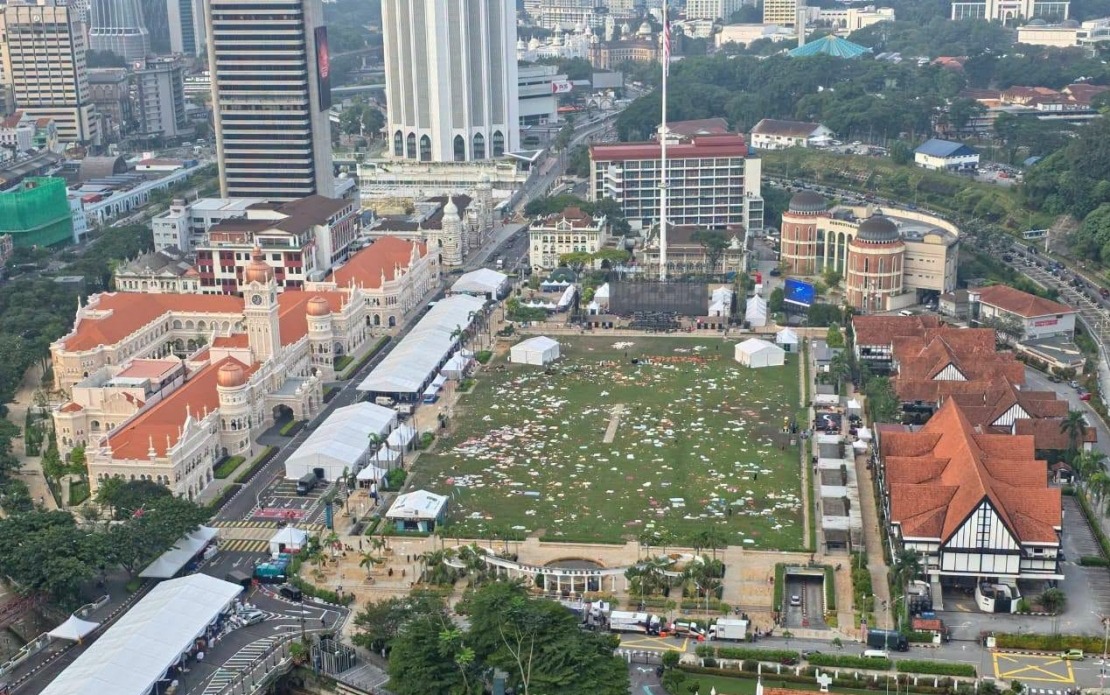
The Federal Territories Minister Hannah Yeoh has acknowledged the significant effort undertaken by Kuala Lumpur City Hall (DBKL) in restoring Dataran Merdeka following a public screening event of the 2026 FIFA World Cup final, which saw the historic venue become strewn with litter. Her remarks, shared on social media on July 20, represent a broader attempt to reframe conversations around urban cleanliness in Malaysia's capital, moving beyond blame and towards a more collaborative understanding of public space stewardship.
Yeoh's commendation of DBKL workers reflects recognition of the municipal authorities' commitment to their core functions. However, her statement carries a more significant message directed at the general public: that disposing of waste responsibly is fundamentally a personal obligation rather than an expectation to be wholly satisfied by government employees. She articulated this position with deliberate clarity, distinguishing between the legitimate right of taxpayers to expect quality public services and the accompanying expectation that citizens must themselves maintain basic standards of behaviour in shared environments.
The minister's intervention carries particular weight given her portfolio overseeing Federal Territories administration. By framing proper waste disposal as something that "should not be left entirely to public workers," Yeoh addresses a pattern of behaviour that has long troubled municipal authorities across Malaysia. The distinction she draws—between DBKL's responsibility to maintain public infrastructure and individual citizens' responsibility to avoid creating unnecessary work—attempts to establish a more realistic baseline for civic engagement in urban spaces.
Yeoh's assertion that public service provision does not extend to cleaning up deliberately discarded litter challenges a common assumption in some quarters that government services should absorb all consequences of public behaviour. This perspective aligns with emerging international conversations about sustainable urbanism, where citizen participation is increasingly recognised as essential rather than optional. Her words serve as a reminder that even the most efficient municipal authority cannot function effectively without corresponding public discipline.
The invocation of Dataran Merdeka's historical and symbolic significance adds weight to the minister's argument. Malaysia's independence square represents more than merely an event venue; it embodies national memory and the dignity of the capital city. This framing elevates the littering issue from a simple cleanliness problem to one concerning national pride and collective custodianship of heritage spaces. When citizens discard waste carelessly in such locations, they are not simply creating work for others—they are failing to respect shared national symbols.
Yeoh's reference to the Malaysia MADANI aspiration is particularly instructive for understanding the government's thinking on this matter. Malaysia MADANI, the overarching vision articulated by the current administration, encompasses not only infrastructural development and economic progress but also the cultivation of a responsible citizenry. In this framework, citizen conduct and shared civic values form an essential component of national advancement, ranking alongside physical development in importance. A cleaner, better-maintained city reflects not government capability alone but population-wide commitment to collective wellbeing.
The minister's emphasis echoes perspectives advanced by Prime Minister Datuk Seri Anwar Ibrahim regarding how national progress should be measured. Rather than relying solely on tangible infrastructure projects and economic indicators, Anwar has previously suggested that a nation's true development includes how its people treat public spaces and demonstrate respect for communal resources. This philosophical approach positions cleanliness and order as markers of societal maturity rather than merely aesthetic concerns, suggesting that a developed nation requires developed citizens.
Yeoh's memorable phrase—"Don't dirty our own home and expect someone else to clean it"—employs household management as a metaphor for civic responsibility. This domestic analogy resonates across Malaysia's diverse population because most households operate according to the principle that family members maintain their own living spaces rather than expecting service staff to clean up deliberately created mess. By extension, the nation-as-home concept encourages citizens to apply the same standards they maintain in private to the public realm.
The littering incident following a major sporting event is not uncommon globally, yet the Malaysian response demonstrates something noteworthy about how the country's leadership addresses public behaviour issues. Rather than simply criticising citizens or focusing blame on DBKL, Yeoh has attempted to reposition the conversation as one of mutual responsibility and shared purpose. This approach acknowledges that government capacity is finite and that sustainable public space management requires genuine citizen participation.
For Malaysian readers and Southeast Asian observers, this incident and response carry broader implications for how rapidly urbanising cities in the region manage public space challenges. As regional cities grow denser and host increasingly major international events, the model of expecting government services to manage all consequences of public behaviour becomes unsustainable. Yeoh's intervention suggests Malaysian policymakers recognise this fundamental reality and are attempting to cultivate a culture where civic participation extends beyond voting to daily behavioural choices.
The DBKL workers themselves represent an often invisible workforce whose efforts maintain the city's functionality. Their rapid response to the Dataran Merdeka situation prevented a prolonged deterioration of the public space, yet Yeoh's recognition of their efforts carries an implicit critique of a system where their labour is consumed in cleaning up preventable messes. By praising their work while simultaneously calling for reduced necessity for such work, the minister articulates a vision where public service workers can focus on improvements rather than remediation.
Moving forward, the messaging from the Federal Territories Ministry suggests an intention to foster greater awareness among Kuala Lumpur residents about their role in maintaining public spaces. This cultural shift, if successfully implemented, could reduce strain on municipal services and contribute to a city where public spaces remain dignified and functional. The challenge lies in translating ministerial statements into sustained behavioural change among a diverse urban population with varying levels of civic consciousness. Success will require consistent reinforcement of these principles across multiple public platforms and events.

