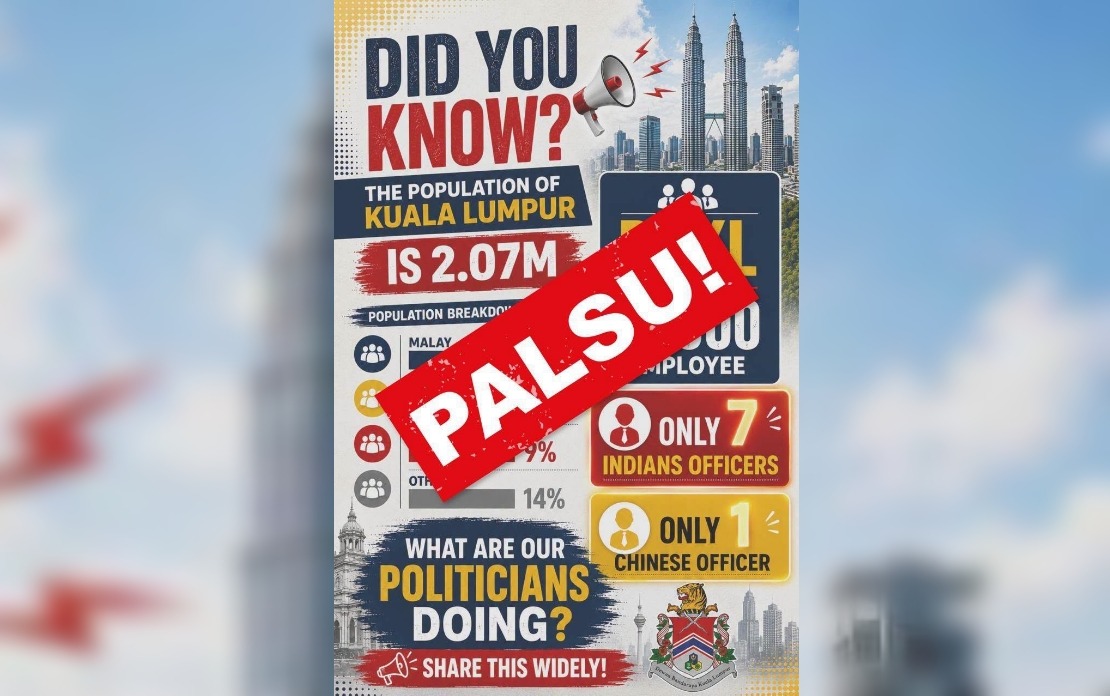
Minister in the Prime Minister's Department (Federal Territories) Hannah Yeoh has moved to counter misleading narratives about the composition of Kuala Lumpur City Hall's (DBKL) workforce, cautioning the public against accepting unverified claims that have surfaced during the ongoing election campaign. A widely circulated WhatsApp poster had falsely suggested that DBKL maintained an extremely narrow ethnic workforce, claiming only seven Indian employees and a single Chinese staff member on the payroll—a claim that Yeoh characterised as both inaccurate and potentially divisive.
The actual employment figures at DBKL tell a markedly different story. As of July 1, 2026, the local authority employed 9,131 staff members across its operations, a substantially larger workforce than the numbers suggested in the misleading poster. Within this broader employee base, 490 staff members identified as Indian, while 22 were Chinese. These figures underscore the significant gap between the fabricated claims and documented reality, demonstrating how misinformation can distort public perception of institutional diversity and hiring practices.
When examining positions within the Management and Professional Group—typically regarded as more senior and coveted roles within government agencies—the data reveals 10 Indian officers and two Chinese officers. This category is particularly significant because promotions into managerial and professional tiers often reflect an organisation's commitment to equitable advancement and leadership development across diverse communities. The presence of such officers in these positions indicates career progression opportunities that extend beyond entry-level postings, though Yeoh acknowledged that room for improvement remains across all levels.
Yeoh's response highlights a broader challenge facing Malaysian public institutions during election periods: the weaponisation of demographic data and the rapid spread of unverified claims through social media platforms. WhatsApp, with its encrypted messaging and viral sharing capabilities, has become a particularly effective vector for such misinformation, particularly when targeting specific communities or institutions. The speed at which false narratives circulate can overwhelm factual corrections, making proactive official responses increasingly necessary to preserve institutional credibility and prevent communal tensions.
Recognising that valid concerns about representation and equity should not be conflated with deliberate falsehoods, Yeoh struck a careful balance in her statement. She explicitly acknowledged that ethnic representation within DBKL could be meaningfully enhanced, avoiding the appearance of defensiveness or complacency. This concession is significant: rather than dismissing all criticism as baseless, the minister instead distinguished between fabricated claims and legitimate areas requiring systemic attention, thereby grounding the conversation in substantive policy discussion rather than inflammatory rhetoric.
In response to these findings, Yeoh instructed DBKL to undertake a comprehensive review of its recruitment and advancement systems. This internal examination encompasses four critical areas: recruitment data analysis, hiring practices evaluation, promotion processes assessment, and scrutiny of job advertisement channels. Such a multi-faceted review acknowledges that barriers to equitable representation can exist at multiple stages of employment, from initial job posting visibility through to advancement opportunities. The instruction to identify gaps and implement transparent, fair, merit-based improvements reflects standard governance practice while signalling genuine commitment to addressing systemic concerns.
The minister's call for all stakeholders to avoid exploiting the workforce composition issue for communal discord underscores the sensitivity surrounding ethnic representation in Malaysian public service. Such issues, while legitimate policy matters worthy of scrutiny and improvement, carry the potential to inflame intercommunal tensions if deployed as political ammunition without accompanying substantive analysis. Yeoh's framing positioned factual accuracy and institutional improvement as shared objectives transcending partisan politics, though such appeals face inherent limitations when made during competitive election periods.
The broader context of this intervention reflects ongoing tensions between electoral competition and social stability in Malaysia. During campaigns, candidates and parties often amplify concerns about community representation and access to public resources, sometimes with more enthusiasm for political advantage than solution-oriented policymaking. The circulation of false data about DBKL's workforce fits this pattern: it provides easy-to-understand fodder for communal grievances while remaining largely unverifiable through informal channels.
For Malaysian readers and observers, this episode illustrates several crucial dynamics. First, it demonstrates the persistence of misinformation in Malaysian public discourse, particularly regarding matters touching on ethnicity and institutional representation. Second, it shows how even demonstrably false claims can gain traction when they align with existing concerns about equity and access. Third, it highlights the importance of official institutions proactively releasing accurate demographic data and responding swiftly to false narratives before they become embedded in public perception. Finally, it underscores the challenge of conducting legitimate debates about improving diversity and representation when deliberate disinformation complicates the conversation.
The forthcoming review of DBKL's recruitment and promotion systems will provide an opportunity to distinguish between actual gaps requiring policy intervention and the manufactured grievances that circulate during election campaigns. Success in this review will depend partly on transparency in publishing findings and commitments to specific, measurable improvements. Should DBKL implement meaningful changes in response, it would validate Yeoh's approach of acknowledging legitimate concerns while dismissing unfounded claims—a delicate balance essential for maintaining institutional credibility and public trust in government during politically contentious periods.

