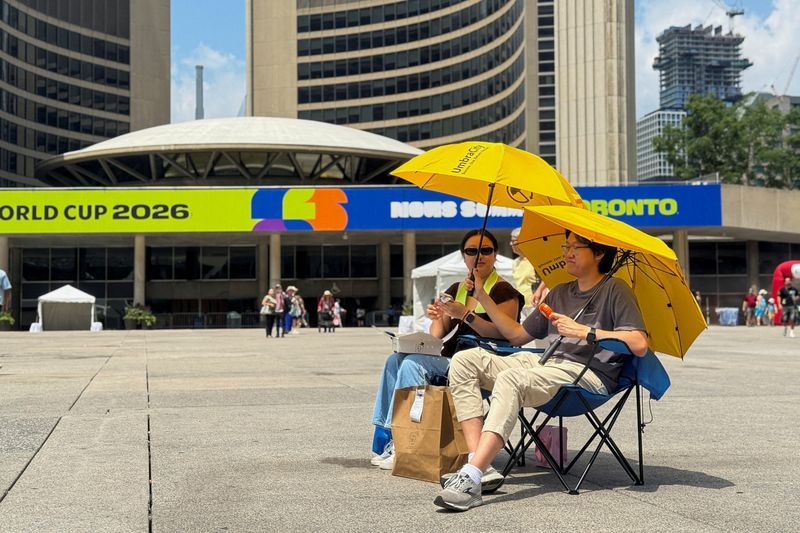
Thousands of football enthusiasts converging on Toronto for Thursday's World Cup round of 32 encounter between Portugal and Croatia face a formidable environmental challenge: oppressive heat and humidity that local health authorities are now actively managing through public advisories. The City of Toronto's medical officer of health Michelle Murti has issued explicit guidance for fans gathering to watch the match, emphasizing the critical importance of consistent water intake and cautious alcohol consumption during what promises to be an exceptionally hot day across the Canadian metropolis.
Environment Canada's official heat warning points to conditions that will push temperatures above 35 degrees Celsius, with the added factor of humidity potentially creating a perceived temperature of approximately 40 degrees Celsius. This combination creates genuine health risks, particularly for crowds assembled outdoors in public viewing areas and those sitting within Toronto Stadium, the tournament's smallest venue, where ventilation and air circulation may be compromised during peak match hours. Murti's message reflects broader public health concerns about heat-related illness, which can escalate rapidly in densely packed gatherings where individuals may underestimate their hydration needs.
The timing proves particularly challenging given that Thursday coincides with Canada's post-holiday period, when outdoor activities and fan gatherings typically attract maximum participation. Toronto Stadium is hosting its final World Cup match of the tournament on this date, lending added significance to the occasion and likely ensuring substantial attendance despite the meteorological hazards. The municipality has strategically organized multiple fan zones and public watch parties throughout the city, transforming the heat advisory from a simple warning into a logistical challenge for event organizers who must balance public enthusiasm with safety protocols.
Murti's specific recommendation against moderating alcohol intake speaks to a lesser-known but significant health consideration during heat events. Alcohol accelerates dehydration by increasing urine production and reducing the body's natural mechanisms for retaining fluid, meaning fans who consume beer or spirits while exposed to extreme heat face compounded risks of heat exhaustion and heat stroke. This guidance, while straightforward, runs counter to the social culture surrounding major sporting events, where alcohol consumption is often considered integral to the fan experience.
The threat of thunderstorms adds another unpredictable dimension to Thursday's event planning. Environment Canada's forecast includes possible severe weather that could materially disrupt outdoor viewing parties and fan gatherings, potentially forcing cancellations or relocations of planned activities. Such weather volatility has characterized much of Canada's summer pattern, with communities from British Columbia to Atlantic Canada experiencing unusual precipitation and extreme conditions in recent weeks.
Toronto's preparation for heat-related health emergencies reflects lessons learned from previous extreme weather events. The city has deployed misting stations at prominent public spaces, including Nathan Phillips Square, the landmark location that has become central to the city's World Cup celebrations. These installations provide immediate relief for crowds, though they represent only one component of a broader heat management strategy involving medical personnel positioned at viewing areas and clear communication protocols with local hospitals about potential surges in heat-related admissions.
Visitor perspectives captured in the downtown core reveal the genuine challenge posed by this meteorological event. Megan Rennie, a Toronto resident present at Nathan Phillips Square on Tuesday, expressed concern not only about her own comfort but about the physical demands on the players performing at maximum intensity in such conditions. Her consideration of leaving the public gathering early underscores how extreme heat can undermine event attendance even among enthusiastic supporters who have invested time in being present for significant matches.
The experience of Laura Albarez, a Colombian visitor unfamiliar with Canadian summer conditions, highlights how tourists and international guests may underestimate heat risks, particularly those arriving from tropical climates where intense heat is routine. Her initial impulse to retreat to air-conditioned hotel facilities and her recognition of the importance of continuous water access reflect adaptive responses to environmental stress that health officials hope will become widespread across Toronto's fan base.
For Malaysian and Southeast Asian observers, Toronto's struggle with extreme heat during a major sporting event carries particular resonance. While tropical heat and humidity are endemic to the region, the adaptation of urban infrastructure and public health protocols to manage heat-related risks during large gatherings mirrors challenges faced by regional host cities. The Canadian approach, emphasizing proactive public communication, strategic infrastructure deployment, and explicit health guidance, offers insights applicable to how Malaysian venues manage crowds during major events in similarly challenging climatic conditions.
The broader context of Canadian communities across the nation grappling with wild weather patterns ahead of Canada Day speaks to shifts in continental climate patterns that have generated unexpected challenges for event planning and public health management. Toronto's experience managing heat during the Portugal-Croatia match represents a microcosm of how cities worldwide must increasingly incorporate climate resilience into major event planning, ensuring that iconic sporting moments do not come at the cost of participant wellbeing.

