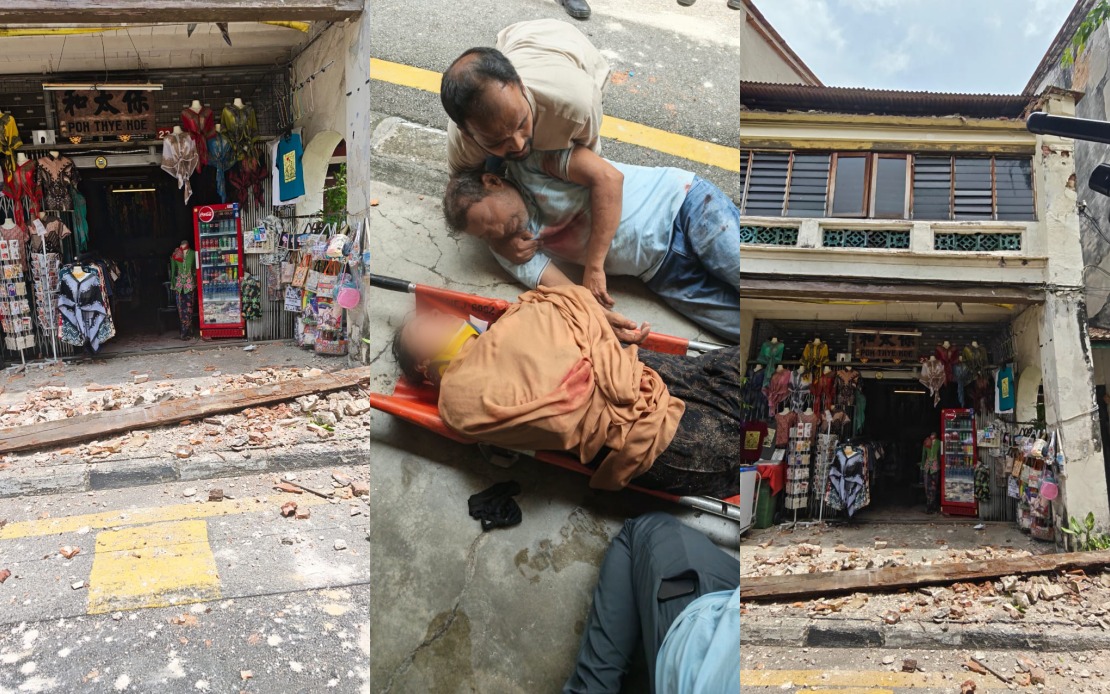
A deteriorating heritage structure in the heart of George Town's tourist precinct claimed two victims on August 4, when masonry and wooden beams crashed down onto pedestrians navigating Armenian Street. The incident has intensified scrutiny over the maintenance standards of Penang's aging building stock and raised concerns about visitor safety in the UNESCO World Heritage zone.
Mohamad Ammtar, aged 66, and Fatimah, 55, both tourists from Sri Lanka, sustained injuries when structural materials from the upper portion of a building gave way. Firefighters from Lebuh Pantai station responded to an emergency call placed at 1.11 pm, arriving swiftly to provide emergency assistance. The two victims received preliminary medical care at the scene from Health Ministry personnel before transport to Penang Hospital, where they were assessed for more serious injuries. The timing proved particularly unfortunate for the couple, who had planned to return home the following day.
According to Penang Fire and Rescue Department assistant director of operations John Sagun Francis, the structural failure involved a first-floor beam that gave way, releasing a combination of stone fragments and timber onto the street below. The building itself accommodates a grocery operation at ground level, while the upper storeys appeared vacant at the time of the collapse. This configuration suggests the structure may have been undergoing various uses over time, possibly without corresponding upgrades to safety standards or structural reinforcement.
The incident has catalysed swift governmental response, with State Tourism and Creative Economy Committee chairman Wong Hon Wai immediately convening meetings with relevant agencies. George Town World Heritage Incorporated and Majlis Bandaraya Pulau Pinang have been tasked with disseminating safety advisories to property owners throughout the state. Wong's directive signalled official recognition that this single incident represents a systemic vulnerability affecting multiple buildings across the heritage zone.
Wong's public statements emphasised that comprehensive structural audits must extend far beyond the immediate site of collapse. He articulated concern that heritage and older buildings throughout the district could harbour similar dangers, threatening both everyday pedestrians and the tourist population that forms the lifeblood of George Town's economy. The chairman acknowledged that structural safety in heritage zones represents not merely a property maintenance issue but a matter of public welfare that directly impacts Penang's reputation as a tourist destination.
The state government has committed to extending immediate support to the injured tourists, leveraging official channels to coordinate assistance through the Sri Lankan High Commission in Kuala Lumpur. This diplomatic engagement underscores the broader implications of such incidents for Penang's standing as a welcoming destination. A negative experience involving tourist injury could generate word-of-mouth consequences far exceeding the immediate incident.
Several factors compound the urgency of this situation for Penang's heritage preservation efforts. Many buildings in George Town date from the 18th and 19th centuries, predating modern building codes and constructed with materials that deteriorate progressively without proper maintenance. The transition from single-family residential use to mixed commercial and residential arrangements has often proceeded without corresponding structural evaluations. Economic pressures on building owners, particularly those operating marginal retail businesses, create disincentives for expensive safety interventions.
The Armenian Street incident illuminates the tension between heritage conservation and contemporary safety standards. UNESCO World Heritage designation brings prestige and tourist revenue but does not automatically fund the substantial maintenance programmes required to keep century-old structures sound. Property owners frequently face difficult choices between restoration compliance and financial viability, particularly when heritage buildings serve lower-income commercial tenants unable to absorb elevated operational costs.
Penang's government has signalled its intention to investigate the root causes of the structural failure thoroughly before determining liability or remedial requirements. This investigation will likely examine maintenance records, previous inspections, and whether the building had undergone any modifications that may have compromised structural integrity. The findings could shape future policy regarding mandatory inspection frequencies and standards across the heritage zone.
The implications extend beyond Penang. Several Malaysian cities maintain substantial heritage districts where similar aging structures serve active commercial and residential purposes. The George Town incident provides a cautionary template, suggesting that other heritage zones require comparable safety audits. Property maintenance standards that prove adequate for historical preservation may fall short of public safety requirements in high-traffic tourist areas.
Moving forward, Penang authorities face the challenge of implementing practical safety frameworks that do not impose prohibitive costs on heritage building owners while ensuring genuine structural protection. Solutions might include staged inspection programmes, technical assistance for owners identifying safety issues, targeted funding for critical repairs, and clear liability frameworks that encourage proactive maintenance. The balance between preserving authentic heritage character and meeting contemporary safety expectations remains delicate but necessary.
Wong's acknowledgement that the incident "viewed seriously" due to its location within a major heritage area suggests recognition that heritage tourism carries unique vulnerabilities. Visitors concentrate in specific precincts, creating mass-casualty potential if structural failures occur in busy locations. This reality demands that heritage preservation strategies integrate modern safety science without unnecessarily compromising historical authenticity. The August 4 incident serves as a costly reminder that such integration cannot be deferred indefinitely.

