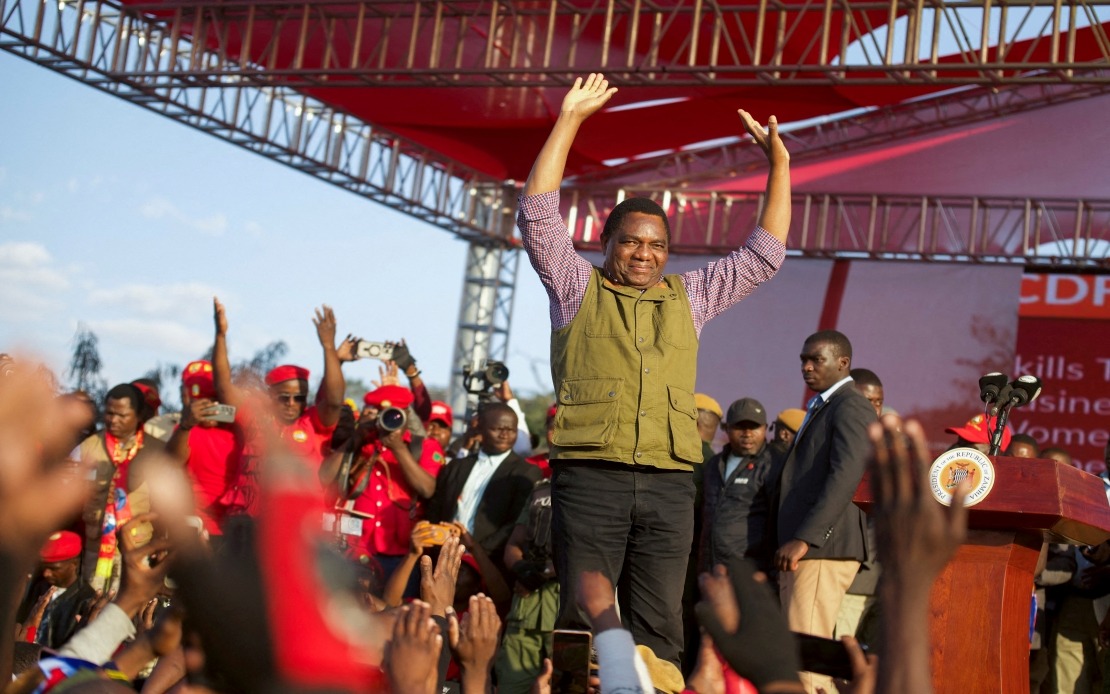
Zambian President Hakainde Hichilema has established a decisive lead in the country's presidential election, accumulating more than 1.5 million votes as tallying proceeded from partial returns across the nation. With results from 135 of the country's 226 constituencies counted by Sunday, the 64-year-old incumbent has positioned himself strongly for a second term in office. Electoral officials announced the consolidated figures at the National Election Results Centre in Lusaka, revealing the substantial margin separating the incumbent from his nearest challenger.
Hichilema, seeking re-election under the banner of the ruling United Party for National Development, has garnered 1,544,140 votes according to figures released by the Electoral Commission of Zambia. This total represents a commanding advantage in the multi-candidate race, positioning the incumbent well ahead of the field as counting continues. The commanding position reflects apparent popular endorsement of his administration's direction, particularly in regions that have benefited from his government's policy focus.
The president's closest competitor, Brian Mundubile of the National Reconciliation Party for Unity and Prosperity, trails significantly with 1,030,662 votes accumulated thus far. Mundubile, a 55-year-old lawyer competing among thirteen candidates total, nonetheless has demonstrated considerable strength in specific geographic areas, particularly across Zambia's urbanized corridor connecting the capital with the resource-rich Copperbelt region where his opposition alliance has secured numerous parliamentary seats. This concentration of support in particular zones suggests political polarization along geographic and sectoral lines, with urban constituencies showing different voting patterns than surrounding areas.
Hichilema's potential return to office would extend continuity in Zambian leadership at a critical juncture for the Southern African nation's economic development. The president first assumed office in 2021 after defeating then-incumbent Edgar Lungu in a landslide victory that saw margins exceeding one million votes. That decisive result followed mounting public frustration with the previous administration's handling of the nation's finances and economic direction, creating the political environment that propelled Hichilema to power less than four years ago.
During his initial term, Hichilema has undertaken substantial restructuring of Zambia's debt architecture, a challenge inherited from previous governments that accumulated unsustainable obligations. His administration has also pursued renewed emphasis on the mining sector, long Zambia's economic foundation but struggling amid international commodity price fluctuations and operational challenges. These initiatives represent core planks of his development agenda, underpinning the policy rationale his supporters cite when voting for another mandate.
Social sector expansion has constituted a prominent feature of Hichilema's governing approach, with visible programmes including the introduction of free education for students attending public primary and secondary schools. These populist initiatives carry direct household impact across Zambia's working families and rural communities, potentially translating into electoral support when voters assess their material circumstances. The implementation of such programmes reflects a governing philosophy emphasizing direct service delivery over capital-intensive infrastructure projects favoured by previous administrations.
Under Zambia's constitutional framework, presidential candidates require outright majorities exceeding 50 per cent of valid votes cast to secure the presidency on the initial ballot. This threshold mechanism introduces a potential complication into electoral outcomes when support fragments among numerous candidates, as has occurred in this election with thirteen individuals standing. Should no contender achieve the required majority when all votes are tallied, constitutional procedures mandate a runoff ballot between the two leading finishers, potentially altering the ultimate outcome depending on how eliminated candidates' supporters redistribute their votes.
The geographic distribution of political support emerging from partial results reveals important patterns in Zambian political competition. Mundubile's particular strength in urbanized corridors spanning Lusaka and the Copperbelt demonstrates opposition capacity to mobilize support in sophisticated urban environments, where voters may prioritize different policy concerns than rural or smallholder agricultural communities. This geographic sorting of electoral preferences reflects broader patterns evident across Southern Africa, where urban-rural divides increasingly structure political competition and shape coalition-building strategies.
Hichilema's economist background and career as a commercial rancher distinguish him from typical Southern African political leaders, introducing technocratic sensibilities into his governance approach. These credentials inform his emphasis on debt restructuring and mining sector revitalization, policy domains requiring specialized knowledge and international engagement. However, the tension between technical expertise and populist policy initiatives such as free education reveals the inherent balancing act confronting developing-world leaders navigating fiscal constraints alongside social demands.
For Southeast Asian observers, the Zambian election provides instructive lessons regarding electoral dynamics in resource-dependent developing economies undergoing democratic transitions. Like several regional nations, Zambia depends heavily on commodity exports vulnerable to external price shocks, creating macroeconomic vulnerabilities that constrain governing options. The electorate's apparent willingness to provide Hichilema another term suggests acceptance of his reform trajectory, despite ongoing economic constraints limiting government resource availability for expanded service delivery beyond existing commitments.
The election's trajectory will inform broader African democratic performance assessments, particularly regarding whether incumbent leaders successfully translate crisis-resolution achievements into electoral mandates for continued governance. Hichilema's apparent positioning for victory suggests voters have credited his administration's economic management relative to the previous administration, establishing a baseline for assessing how development-focused governance translates into electoral outcomes across the continent.

