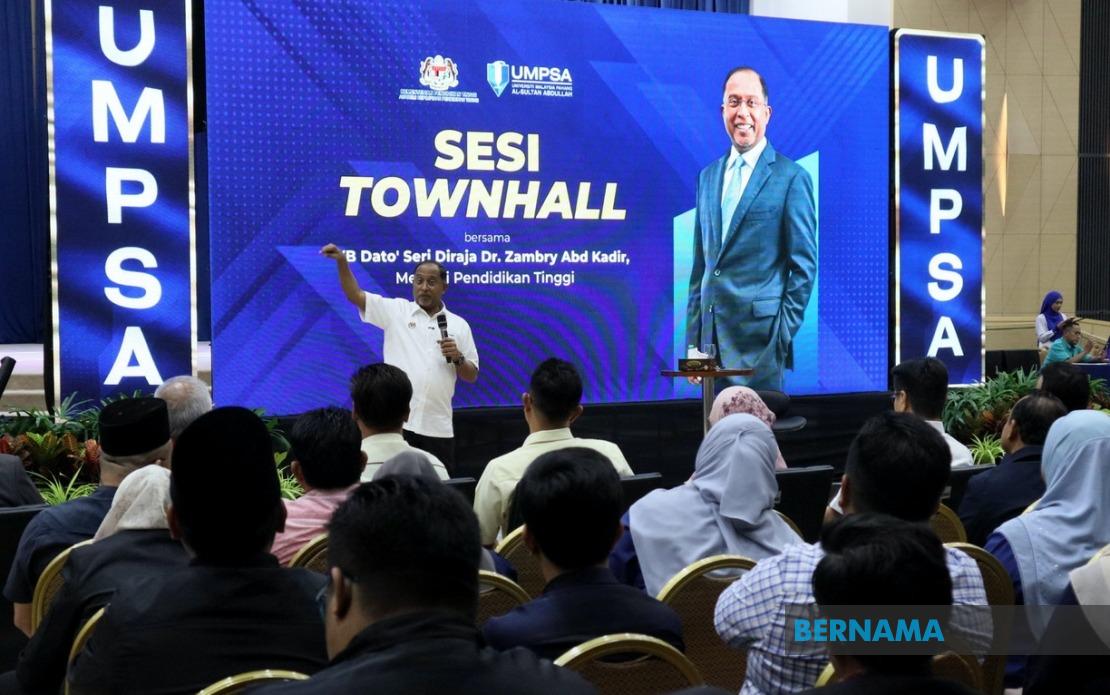
The Ministry of Higher Education (KPT) is moving forward with comprehensive follow-up measures stemming from Prime Minister Datuk Seri Anwar Ibrahim's recent instruction to reassess how Malaysian universities handle student disciplinary matters. Minister Datuk Seri Dr. Zambry Abd Kadir confirmed that the ministry is undertaking a structured approach to align institutional practices with the government's evolving stance on student rights and academic freedoms within higher education.
Dr. Zambry's remarks, made at the Universiti Malaysia Pahang Al-Sultan Abdullah convocation ceremony, indicate that the directive encompasses multiple layers of institutional review. The assessment framework takes into account legislative decisions and existing university regulations, with particular attention paid to provisions governing student freedom of expression and association. This multi-faceted approach reflects the complexity of restructuring disciplinary protocols across Malaysia's diverse higher education landscape, where institutional autonomy must be balanced against government policy objectives.
The procedural architecture for implementing these changes has already begun taking shape at the operational level. All vice-chancellors from public universities recently convened with the director-general of Higher Education to coordinate the response to the Prime Minister's instruction. This coordinated engagement signals that the ministry intends to establish consistent standards across institutions rather than allowing ad-hoc interpretations. A formal statement detailing the framework and expectations is expected to follow these discussions, providing clarity to universities about implementation timelines and specific requirements.
The initiative comes against the backdrop of PM Anwar's commitment to repealing the Universities and University Colleges Act (AUKU) 1971, a longstanding objective of student activists and civil society organisations who view the legislation as overly restrictive. At the Malaysia Madani Intellectual Forum Series 13, Anwar directed that students previously sanctioned for criticising government policies or officials should have those disciplinary records expunged. This amnesty reflects a deliberate policy shift toward greater tolerance of political speech within campus environments, acknowledging that democratic societies benefit from robust debate in educational institutions.
Crucially, the Prime Minister clarified that the absolution of offences applies specifically to university-level disciplinary proceedings and does not extend to matters falling under criminal law jurisdiction. This distinction is significant because it preserves law enforcement mechanisms while narrowing the scope of internal university sanctions. Students who may have violated criminal statutes—such as those concerning public order or security—would remain subject to police investigation and prosecution through conventional legal channels. The clarification suggests a calibrated approach that distinguishes between legitimate political expression and criminal conduct.
Dr. Zambry acknowledged that implementing uniform changes across Malaysia's entire higher education ecosystem presents practical challenges, particularly regarding private institutions. Private universities and colleges operate under the Private Higher Educational Institutions Act 1996 (Act 555), which creates a different regulatory framework from public universities governed by the Education Act. While the minister expressed hope that private and state-linked educational institutions would voluntarily adopt parallel measures, he recognised that legal obligations differ, necessitating a more nuanced implementation strategy.
The urgency surrounding disciplinary review reflects recognition that legislative amendments to AUKU will require extended parliamentary processes and stakeholder consultation. Rather than awaiting formal repeal of the Act, the government is pursuing immediate administrative remedies to address what it considers unjust disciplinary outcomes. This interim approach demonstrates responsiveness to longstanding complaints from student advocates while the more comprehensive legislative reform proceeds through regular channels. The strategy balances the need for swift action with the requirements of proper legislative procedure.
For Malaysian universities, the directive necessitates institutional soul-searching about the purposes and proportionality of student discipline. Historical practices developed under stricter regulatory regimes may no longer align with contemporary governance principles emphasising openness and democratic participation. Universities must review existing cases, establish appeals mechanisms, and recalibrate disciplinary guidelines to reflect the government's revised expectations. This institutional reckoning extends beyond individual cases to encompass broader questions about the student experience and academic freedom within Malaysian campuses.
The implications extend beyond individual students or isolated universities. This policy shift signals that the Malaysian government views restrictions on student political expression as counterproductive to national development and democratic maturation. By creating space for campus-based political debate and activism, policymakers implicitly endorse the role of universities as civic spaces where democratic participation develops. This conception aligns Malaysia with international norms regarding university autonomy and student rights, potentially enhancing the country's standing within global academic communities.
Implementation across East Malaysia presents additional complexities, given that Sabah and Sarawak maintain certain educational autonomies. Dr. Zambry's engagement with university leaders from Pahang, Terengganu, and Kelantan through the Kembara KARISMA programme reflects efforts to build consensus among stakeholders in regional institutions. These gatherings of young academics and administrators create opportunities to explain the rationale for policy changes and solicit input on practical implementation challenges specific to individual institutions.
Longer-term implications for Malaysian higher education remain to be clarified. The current initiative represents an opening toward institutional autonomy and student rights, but questions persist about whether universities will develop genuinely independent governance structures or whether policy changes merely reflect shifts in executive priorities. International experience suggests that sustainable academic freedom requires robust institutional mechanisms, transparent governance, and protection from external political interference—elements that extend beyond ministerial directives to encompass legal frameworks and institutional cultures.
The ministry's approach demonstrates sensitivity to a generational transition in Malaysian student activism and governance philosophy. Younger administrators and lecturers, represented prominently in the KARISMA gathering, have grown up amid global conversations about university autonomy and student rights. Their participation in policy implementation suggests potential for more progressive approaches to campus governance. However, realising this potential requires sustained commitment to reforms beyond the immediate disciplinary review currently underway.

