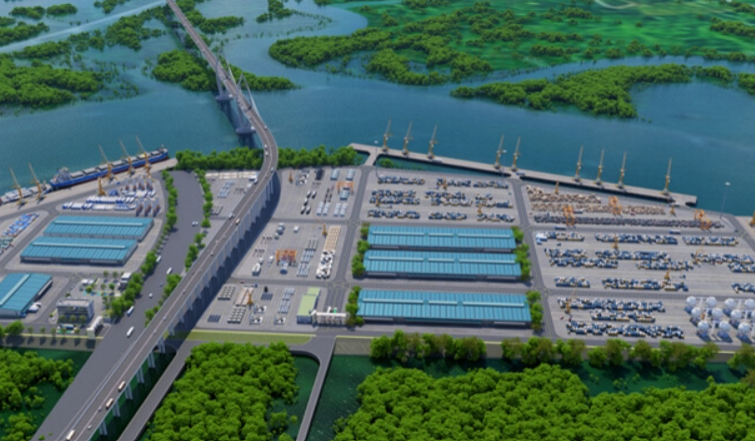
Ho Chi Minh City officially commenced development of the QTM International Port on Sunday, a major maritime infrastructure project valued at approximately VNĐ6.9 trillion (US$261 million). The undertaking underscores Vietnam's ambitions to position its largest economic centre as a world-class logistics hub capable of managing the escalating movement of cargo across Southeast Asia and beyond. Spanning over 80 hectares within the Phu My Ward area of the Cai Mep-Thi Vai deep-water port complex, the facility will fundamentally reshape the country's southern maritime landscape.
The port's architecture reflects contemporary logistics thinking, engineered to accommodate an annual throughput of 16 million tonnes once fully operational. Beyond the harbour itself, the development includes a substantial integrated warehousing and distribution centre covering nearly 200,000 square metres, creating a seamlessly connected supply chain ecosystem rather than an isolated port terminal. This comprehensive approach recognises that modern cargo handling demands far more than simple berthing capacity; it requires sophisticated facilities for inventory management, cross-docking operations, and value-added services that today's multinational shippers expect.
Construction will unfold across two distinct phases extending from 2026 through 2034, allowing for phased investment and operational maturation. The initial configuration will feature eight berths engineered to receive vessels carrying up to 60,000 deadweight tonnes, with future expansion accommodating ships of 100,000 DWT or larger. This scaling architecture proves particularly strategic, as it enables the port to remain competitive even as international shipping patterns evolve toward ever-larger container vessels dominating transpacific and transatlantic routes.
Hoang Nguyen Dinh, vice chairman of the HCM City People's Committee, framed the project within the context of recent municipal reorganisation. The consolidation of three localities under Ho Chi Minh City's administration has significantly amplified local demand for material transport and distribution services. Officials contend that existing infrastructure cannot adequately service this expanded economic zone, making the port expansion not merely desirable but strategically essential for sustaining development momentum across the broader southern region.
Current maritime activity through Ho Chi Minh City provides compelling evidence of growing demand. During the first half of this year, cargo volumes transported via sea and inland waterways surged by 7.3 percent, demonstrating that regional commerce continues accelerating despite international economic uncertainties. This trajectory suggests that port developers face not hypothetical future demand but immediate pressure to increase capacity simply to prevent congestion and bottlenecks that would undermine the city's competitiveness.
Deputy Prime Minister Pham Gia Tuc articulated the broader national dimension during the groundbreaking ceremony. Vietnam currently allocates between 14 and 16 percent of gross domestic product to logistics-related expenditures—a figure considerably elevated compared to developed economies. Modern port infrastructure, Tuc argued, could substantially reduce these costs by streamlining cargo handling procedures, minimising dwell times, and eliminating operational inefficiencies that plague older facilities. By extension, more competitive logistics expenses would enhance Vietnamese export competitiveness in increasingly price-sensitive global markets.
Tuc's remarks also carried an implicit emphasis on accelerated development timelines. He urged project developers to prioritise construction of the initial phase, with an ambitious target of achieving operational status within eleven months. This aggressive schedule presumably aims to support Ho Chi Minh City's aspiration for double-digit annual economic growth—an objective that requires sustained investment in foundational infrastructure and the elimination of supply-side constraints that could otherwise restrain output expansion.
Geographically, Ho Chi Minh City possesses approximately 110 kilometres of coastline, a natural advantage that many landlocked developing economies lack entirely. The city already hosts one of Vietnam's most sophisticated maritime transport networks, with decades of operational experience managing container vessels, bulk carriers, and specialised cargo ships. The Cai Mep-Thi Vai complex itself ranks among the world's major container port hubs, providing direct shipping connections to both Trans-Pacific and European trade corridors. This existing institutional capacity and geographic positioning give the QTM International Port project substantial potential for meaningful integration within global supply chains.
For Malaysian observers, the port's development carries significant implications. As Vietnam strengthens its logistics infrastructure, competing regional hubs including Port Klang and Port of Tanjung Pelepas will face intensified pressure to maintain competitiveness. Vietnamese cargo handling efficiency directly influences shipping line decisions regarding transshipment points and route optimisation throughout Southeast Asia. Additionally, the port's expansion may redirect certain regional trade flows, potentially affecting the volume of goods transiting through Malaysian terminals and the corresponding revenues generated by port operators and related service providers.
The project also reflects broader patterns of capital allocation within Vietnam's economic development strategy. Rather than dispersing investment across numerous modest improvements, policymakers concentrate substantial resources in flagship projects designed to achieve world-competitive standards. This approach contrasts with incremental, smaller-scale initiatives, potentially delivering superior outcomes in terms of operational efficiency, vessel scheduling reliability, and service quality that international shipping companies increasingly demand.
Beyond immediate logistics considerations, the port expansion carries broader ramifications for regional geopolitical positioning. Modern maritime infrastructure enhances a nation's capacity to control and benefit from international trade flows transiting its territorial waters. Vietnam's systematic investment in port capacity, combined with its geographic position along crucial shipping lanes, gradually repositions the country as an indispensable node within Asian supply networks rather than a peripheral location reliant on external logistics hubs for market access.
The eleven-month timeline for initial phase completion, while ambitious, reflects confidence in available financing and engineering expertise. Vietnam has accumulated considerable experience executing large-scale infrastructure projects, with domestic and international contractors demonstrating proven capability in managing complex port developments. Success in this endeavour would reinforce Vietnam's reputation as a reliable location for logistics investment, potentially attracting additional private sector capital to complementary transportation and warehousing facilities across the southern region.

