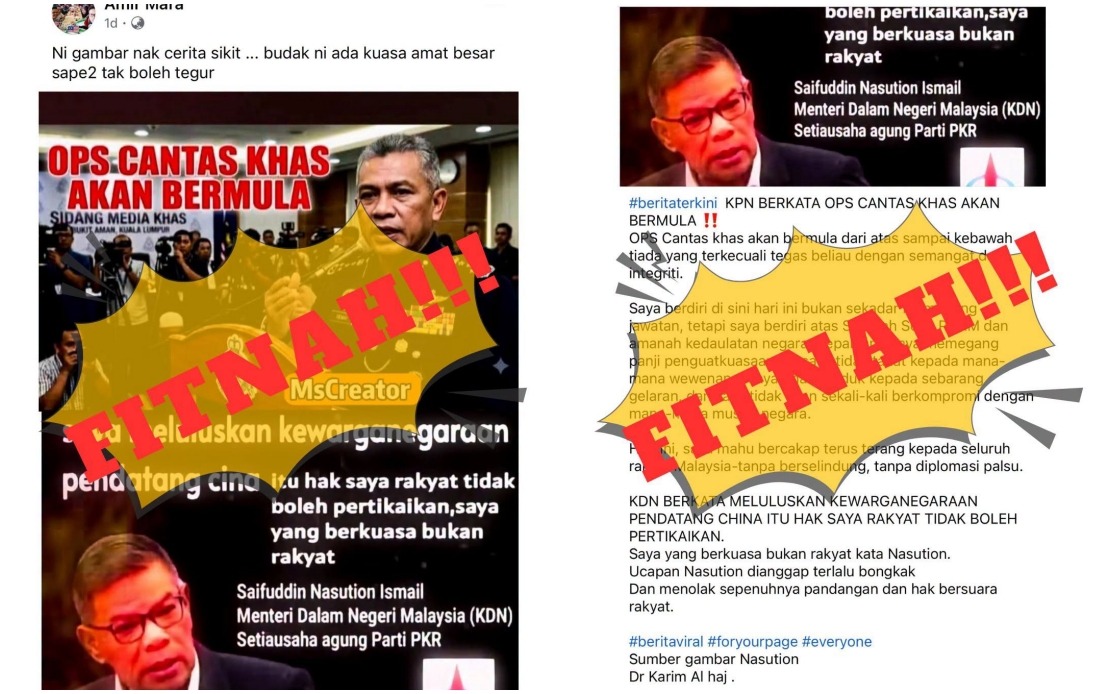
Home Minister Datuk Seri Saifuddin Nasution Ismail has firmly rejected persistent allegations that the Home Ministry (KDN) orchestrated mass citizenship grants to foreign nationals, including claims that 1.2 million Chinese nationals remain in Malaysia as undocumented residents. Speaking from Putrajaya on August 19, the minister emphasised that he has repeatedly addressed these claims with factual evidence and official data, yet the narrative continues to circulate across social media platforms in various forms.
The minister's latest statement reflects growing frustration with what he characterises as a coordinated effort to recycle discredited claims. Across social media channels, posters and videos alleging improper citizenship grants have gained considerable traction, particularly among communities concerned about demographic changes and immigration policy. Saifuddin Nasution's response signals that the government views this persistence not merely as misinformation, but as a calculated campaign intended to undermine public trust in state institutions.
Saifuddin Nasution underscored that the claims have already been thoroughly investigated and addressed through official channels. The facts and supporting documentation, he noted, have been presented in previous government statements and media reports, yet circulate anew stripped of their original context. This pattern of deliberate recycling suggests the claims have become detached from their factual moorings and function instead as political ammunition in broader debates about immigration and national identity.
The home minister articulated a broader concern about the societal damage wrought by persistent falsehoods. Beyond mere reputational harm to individuals or government agencies, such narratives risk corroding public confidence in institutions tasked with managing citizenship, border control, and demographic records. In the Malaysian context, where historical tensions around ethnicity and citizenship remain sensitive, repeated claims of institutional failure on these matters carry particular resonance and danger.
Crucially, Saifuddin Nasution connected the circulation of these claims to potential threats to national cohesion. He warned that widespread dissemination of unverified allegations can stir racial sentiment, incite hostility among communities, and ultimately disrupt public order. The framing shifts the issue from a simple factual dispute into one with implications for national security and intercommunal peace. This elevation reflects genuine government concern about how misinformation can catalyse real-world tensions in a multiethnic society.
The minister's appeal to the public emphasised personal responsibility in an age of rapid information sharing. He urged citizens to verify claims through official sources before amplifying them, whether through sharing, commenting, or creating derivative content. This call acknowledges the structural challenge governments face when competing against the velocity and emotional resonance of viral content, particularly when that content taps into existing anxieties about national boundaries and belonging.
Saifuddin Nasution's framing of the issue as one of deliberate distortion rather than innocent misunderstanding carries important implications. By characterising the claims as recycled falsehoods rather than good-faith questions, he positions the burden of responsibility on those amplifying the narrative rather than on government to continually rebut identical points. This rhetorical move attempts to shift public perception from viewing the claims as credible allegations requiring constant official response, to viewing their continued circulation as irresponsible behaviour.
The home minister's emphasis on data and facts reflects a broader challenge facing governments seeking to counter misinformation. While statistical records, citizenship databases, and official documentation exist to support the government's position, these materials lack the emotional immediacy and shareability of a provocative poster or short video clip. The asymmetry between the appeal of false claims and the tedium of official data represents a persistent difficulty for institutions seeking to establish truth in public discourse.
For Malaysia's political landscape, the persistence of these claims points to underlying anxieties about immigration, demographic change, and the coherence of state institutions. Regardless of the factual accuracy of the specific allegations, their continued circulation suggests a segment of the public harbours doubts about official narratives on these sensitive matters. This dynamic creates vulnerability that political actors may seek to exploit, making it difficult for the government to move beyond a perpetual defensive posture.
Saifuddin Nasution's call for responsible social media use reflects awareness that institutional authority and technical accuracy alone cannot counter misinformation effectively. Cultural practices around information sharing, media literacy, and community norms play equally significant roles. The minister's appeal essentially enlists the public as partners in combating false narratives, acknowledging that government cannot police all information without risking perceptions of authoritarianism.
The claims themselves, whether rooted in past administrative practices or entirely fabricated, touch on genuine policy questions about citizenship verification, undocumented residents, and immigration management. A government genuinely confident in its institutional performance on these matters might consider publishing comprehensive, accessible data on citizenship grants, deportations, and undocumented populations to address public curiosity. Such transparency could reduce the epistemic space where speculation and conspiracy flourish.
Looking forward, the home ministry faces a paradox: repeated denials keep the issue in public conversation, yet silence allows the claims to persist unchallenged. The approach Saifuddin Nasution has chosen—firm rejection paired with appeals for responsible behaviour—suggests the government believes further detailed engagement would grant undue credibility to claims it views as discredited. Whether this strategy ultimately contains the narrative or merely delays its evolution remains to be seen in Malaysia's contested information environment.

