The Home Ministry is charting an ambitious course to strengthen Johor's institutional infrastructure through a coordinated series of projects that will reshape how security and public services operate across the state. Home Minister Datuk Seri Saifuddin Nasution Ismail unveiled these plans as the state prepares for its 16th state election, framing Johor as a critical strategic region that demands sustained investment in its enforcement and administrative backbone. The announcement underscores how Malaysian policymakers continue to treat the southern state as a cornerstone of national security architecture, given its geographic position as a major international gateway and domestic security hub.
The Royal Malaysia Police will receive substantial resources under this initiative, with Johor witnessing the construction of a new district police headquarters in Segamat and land acquisition progressing for a corresponding facility in Pengerang. Beyond these flagship projects, the police force will benefit from targeted repairs to residential quarters and lift maintenance across its physical estate throughout the state. These efforts, while appearing incremental, reflect a broader strategy to modernise working conditions for frontline personnel and improve the operational spaces they occupy daily. For a state where police engagement remains central to both crime prevention and community relations, upgraded facilities can facilitate more effective coordination and boost morale among officers managing one of Malaysia's busiest enforcement jurisdictions.
Immigration infrastructure represents another pillar of this development push. The Home Ministry has prioritised upgrades at two critical border clearance points: the Sultan Iskandar Building and the Sultan Abu Bakar Complex. These facilities handle substantial volumes of cross-border traffic, particularly between Malaysia and Singapore, making their efficiency a matter of economic and security significance. Enhanced systems and reorganised layouts at these complexes aim to reduce processing bottlenecks while simultaneously maintaining rigorous security protocols. For Malaysian business and traveller communities, smoother immigration procedures translate to tangible benefits, and for the government, more efficient processing strengthens border integrity during periods of elevated security concerns.
The National Registration Department will establish a new district office in Batu Pahat, expanding local capacity to handle identity documentation and registration services. This reflects recognition that Batu Pahat's growing population and economic activity warrant dedicated administrative infrastructure rather than reliance on more distant regional centres. Decentralisation of such services typically improves citizen access to essential services and reduces administrative bottlenecks, particularly for rural and semi-urban populations who might otherwise face significant travel burdens to complete registration procedures.
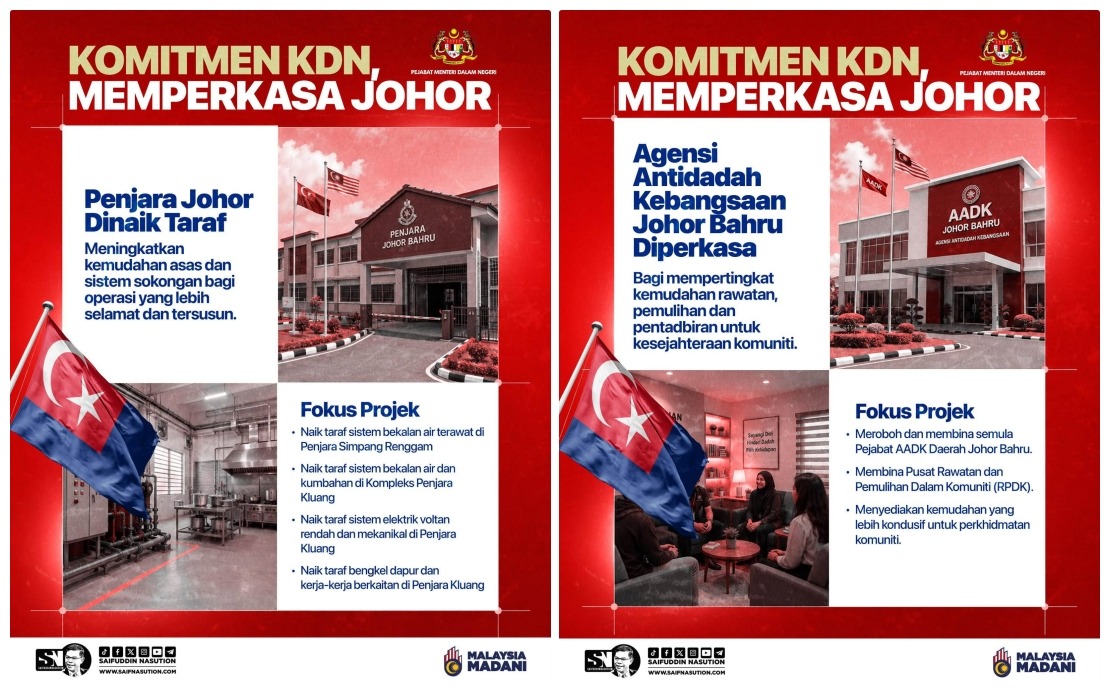
Penal infrastructure upgrading forms a critical component of the ministry's agenda, with Kluang Prison and Simpang Renggam Prison scheduled for basic systems modernisation. These upgrades typically encompass utilities, security systems, and facility maintenance that directly impact both prisoner welfare and staff safety. Investment in correctional institutions frequently receives less public attention than police or immigration initiatives, yet inadequate prison infrastructure can undermine rehabilitation objectives and create management challenges that ripple through the criminal justice system.
The National Anti-Drugs Agency will undergo office and treatment centre redevelopment across Johor, signalling sustained commitment to drug enforcement and rehabilitation at a time when substance abuse remains a persistent social challenge throughout Malaysia. Modern treatment facilities support better outcomes for individuals struggling with addiction, while upgraded administrative infrastructure enhances coordination of prevention and enforcement operations. This dimension of the Home Ministry's programme addresses both supply-side interdiction and demand-side intervention, reflecting sophisticated policy thinking about drug control.
The Malaysian Maritime Enforcement Agency's Abu Bakar Maritime Base will experience jetty and building upgrades, reflecting Johor's maritime security responsibilities. The state's extensive coastline and proximity to busy international shipping lanes position it as crucial for preventing smuggling, enforcing maritime regulations, and responding to sea-based emergencies. Enhanced facilities at this naval installation strengthen the agency's operational readiness and personnel capacity in a domain where infrastructure quality directly correlates with response effectiveness.
These initiatives collectively demonstrate how governmental investment in security and administrative agencies translates into capacity building across multiple operational domains. Rather than announcing piecemeal programmes, the Home Ministry's announcement treats Johor as an integrated system where police effectiveness, immigration efficiency, correctional management, drug enforcement, and maritime security operate interdependently. For Malaysian citizens and businesses in Johor, better-equipped public institutions theoretically deliver faster services, stronger law enforcement, and more secure borders.
The timing of these announcements, coinciding with Johor's state election in which approximately 2.7 million registered voters will select 56 state assemblymen, underscores how infrastructure investment features prominently in political messaging. Governing parties routinely highlight development projects as evidence of administrative competence, while opposition figures scrutinise implementation records and resource allocation. The Home Ministry's public framing emphasises benefits flowing directly to citizens and supporting personnel, a rhetorical stance designed to demonstrate responsiveness to constituent needs and professional workforce concerns.
For Southeast Asian observers, Johor's position as a laboratory for Malaysian security and administrative innovation merits attention. As Malaysia's gateway to Singapore and the broader region, how effectively it deploys resources and modernises institutions influences not only its own governance trajectory but also transnational security cooperation and cross-border service delivery. The projects announced reflect ambitions to position Johor as demonstrating best practices in institutional modernisation, though ultimate success depends on implementation rigour, maintenance commitment, and adaptive management of evolving security challenges.
The Home Ministry's pledge to ensure that allocations and projects deliver concrete benefits to residents while strengthening agency preparedness encapsulates a governance philosophy emphasising dual accountability to both the public and personnel within security institutions. Whether these intentions translate into realised improvements in service delivery, operational effectiveness, and community security will shape Johor's trajectory through the coming years and influence broader assessments of Malaysian institutional capacity.

