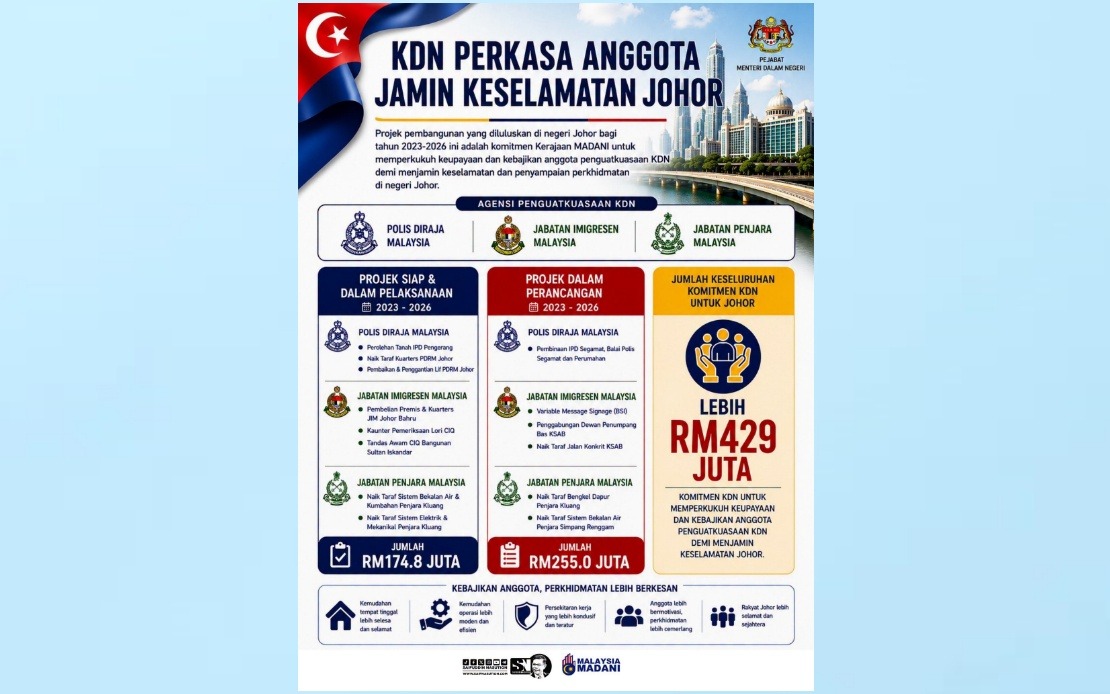
The Home Ministry has channelled more than RM429 million into Johor since 2023 to enhance both the wellbeing of enforcement personnel and the operational capacity of three key security agencies, signalling a substantial investment in the state's law enforcement infrastructure. Home Minister Datuk Seri Saifuddin Nasution Ismail announced the initiative covers the Royal Malaysia Police, the Malaysian Immigration Department, and the Malaysian Prisons Department, positioning personnel development as integral to broader national security objectives.
The minister's characterisation of personnel welfare investments as a strategic priority reflects a shift in how the federal government frames law enforcement budgeting. Rather than treating officer benefits as peripheral to operational spending, the Home Ministry now emphasises that improved working conditions directly enhance public safety outcomes. This approach recognises that enforcement personnel operating in substandard facilities or under resource constraints face compromised morale and effectiveness, ultimately affecting service quality for Malaysian citizens across all sectors.
The RM429 million commitment splits into two distinct tranches: RM174.8 million allocated to projects either completed or currently undergoing implementation, and RM255 million earmarked for initiatives still in planning phases. This two-stage deployment strategy allows the ministry to demonstrate immediate progress while preparing larger-scale infrastructure developments. For Johor specifically, the phased approach suggests a long-term commitment to systematic upgrading rather than ad-hoc responses to emerging needs.
Among ongoing projects, the acquisition of land for Pengerang District Police Headquarters represents expansion of the police footprint in peripheral districts, addressing coverage gaps in areas experiencing population growth and economic development. Concurrent with this, the immigration department is securing office premises and staff quarters in Johor Bahru, the state capital, recognising that migration management infrastructure requires dedicated, purpose-built facilities rather than shared government office spaces. Simultaneously, basic facility upgrades at Kluang Prison address deteriorating conditions that affect both inmate management and staff working conditions.
The pipeline projects reveal ambitions that extend beyond maintenance into systematic modernisation. The planned construction of Segamat District Police Headquarters, incorporating both operational facilities and residential quarters, demonstrates recognition that comprehensive police presence in secondary urban centres requires integrated infrastructure. The consolidation of bus passenger terminal operations at the Sultan Abu Bakar Complex addresses a practical intersection of transportation logistics and security screening, while kitchen and water supply upgrades at Kluang and Simpang Renggam prisons target essential service delivery infrastructure that directly impacts institutional functionality.
For Malaysian readers, the investment scale merits contextualisation within broader state development frameworks. Prime Minister Datuk Seri Anwar Ibrahim recently highlighted that Johor's overall development allocation has expanded substantially to approximately RM14.6 billion, representing a significant increase from the previous RM10.2 billion baseline. Within this expanding budget envelope, the Home Ministry's RM429 million commitment for enforcement infrastructure constitutes roughly 3 percent of Johor's development allocation, suggesting that security infrastructure represents a proportionate but prioritised component of state investment strategy.
The underlying rationale extends beyond simply upgrading facilities. Johor's geographical position as Malaysia's southernmost peninsula state, its significant port operations, and its extensive international land border with Singapore create distinct security and enforcement challenges. Enhanced police presence in districts like Pengerang and Segamat, strengthened immigration processing capacity in Johor Bahru, and improved detention facilities reflect recognition of these regional specificities. For enforcement personnel working in these environments, improved facilities and welfare support directly translate to capacity to manage complex operational demands.
The timing of this announcement and budget commitment aligns with the MADANI Government's broader equity framework, which emphasises ensuring all states receive development support proportionate to their requirements and demographic realities. The government narrative frames the Johor investment not as exceptional favouritism but as part of systematic resource redistribution addressing historical imbalances. This rhetorical positioning becomes politically significant in Malaysian context, where state-level development allocation remains contested terrain reflecting historical grievances and contemporary political alignments.
From a Southeast Asian perspective, Malaysia's investment in border security and immigration infrastructure carries regional implications. Enhanced capacity at Johor's land border and sea ports strengthens Malaysia's role in regional migration management and counter-trafficking operations, complementing multilateral cooperation frameworks with Singapore and other ASEAN neighbours. Improved detention facilities at prisons like Kluang and Simpang Renggam ensure Malaysia meets international standards for custodial care, affecting its standing in human rights dialogues and international relations.
The welfare dimension also addresses a persistent recruitment and retention challenge across enforcement agencies. Malaysian police, immigration, and prisons services have faced persistent staffing pressures, with working conditions and benefits frequently cited as factors influencing career choices among graduates. By signalling investment in better quarters, facilities, and operational equipment, the Home Ministry aims to enhance the sector's attractiveness to potential recruits, particularly among tertiary-educated candidates who might otherwise pursue private sector opportunities offering superior remuneration and working conditions.
Implementation quality and timeline represent critical variables determining whether these allocations translate into meaningful operational improvements. Malaysian development projects frequently experience delays, cost overruns, or quality shortcomings between announcement and completion. The minister's emphasis on optimal fund utilisation acknowledges this implementation risk while committing to accountability. For Johor residents and enforcement personnel, the practical value of these investments ultimately depends on timely, professional project delivery rather than merely budgetary allocation.
Looking forward, the RM255 million in planned-stage projects suggests a multi-year commitment extending beyond the immediate budgetary cycle. This forward planning approach provides enforcement agencies with certainty for operational improvement planning, though it also creates vulnerabilities to political or fiscal pressures that might defer implementation. The Home Ministry's framing of these investments as central to the MADANI Government's agenda attempts to insulate them from short-term budgetary fluctuations, though Malaysian budgetary history demonstrates that policy continuity remains contingent on political circumstances.

