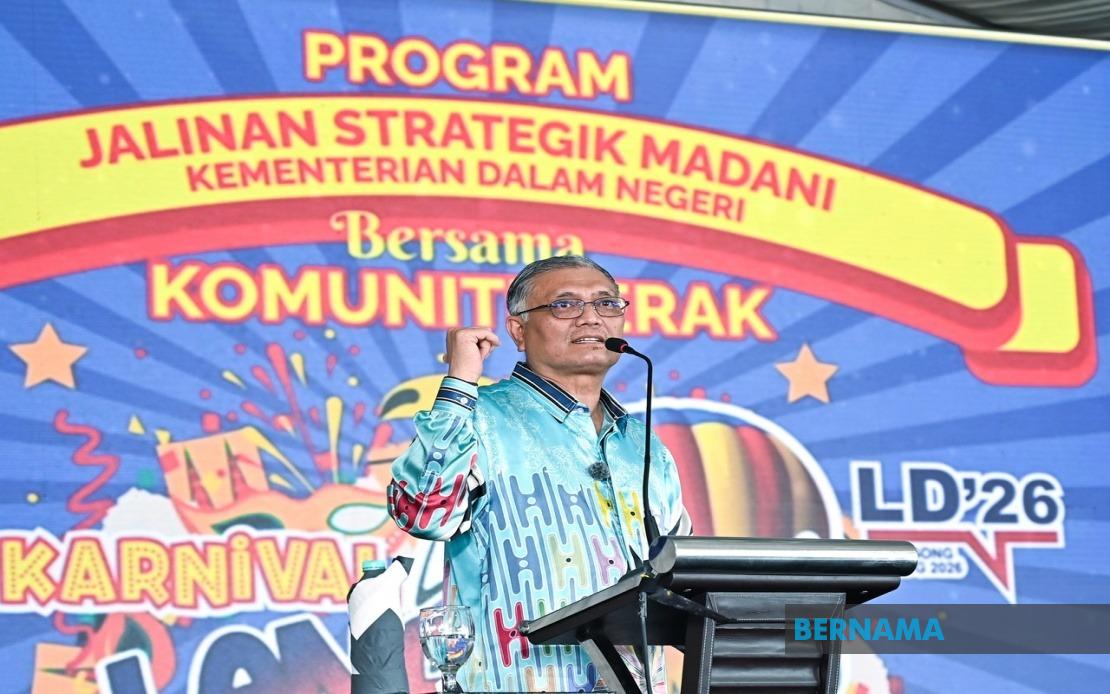
The Home Ministry (KDN) has launched an ambitious community outreach initiative in Lenggong, positioning accessibility and two-way dialogue at the centre of its service delivery model. The MADANI Strategic Partnership Programme, which unfolded over two days at Dataran Lenggong, represents a deliberate effort to dismantle barriers between bureaucracy and the public, allowing citizens to interact directly with key security and administrative agencies in a relaxed, community-focused setting rather than navigating formal office channels.
Deputy Home Minister Datuk Seri Dr Shamsul Anuar Nasarah framed the initiative as a response to a persistent governance challenge: how to make essential government services genuinely accessible to ordinary Malaysians, particularly in smaller towns and rural areas. Rather than requiring residents to travel to federal or state offices, the programme brought service counters operated by the Royal Malaysia Police (PDRM), the Immigration Department of Malaysia (JIM), and the National Anti-Drugs Agency (AADK) directly into the community. This decentralised approach acknowledges that many Malaysians lack the time, resources, or familiarity to navigate bureaucratic procedures in distant government buildings.
Beyond administrative transactions, Shamsul Anuar identified a deeper purpose for the MADANI programme: fostering genuine engagement between security agencies and grassroots communities on shared concerns. The framework positions law enforcement and public health officials not as distant authorities issuing directives, but as collaborative partners working alongside residents to address locally-defined problems—whether drug abuse, petty crime, or community safety gaps. This partnership model reflects a growing recognition within government that effective governance requires listening to communities and incorporating their insights into policymaking and service design.
The two-day event incorporated a diverse calendar of activities designed to appeal across age groups and interests. Religious talks catered to the town's spiritual dimension, while colouring competitions and children's creative performances ensured young residents felt included and engaged. This multi-faceted programming strategy serves a dual purpose: it attracts wider public participation while softening the formal atmosphere often associated with government agencies. When citizens encounter security officials in a context involving their children's creative performances or community celebrations, the interaction carries different emotional weight than a routine police station visit or immigration counter transaction.
The exhibition component showcased assets and operational capacities of participating agencies, allowing the public to develop concrete understanding of what these institutions actually do. Many Malaysians possess only vague awareness of the scope and functions of bodies like AADK or JIM. Through direct visual presentation and staff interaction, residents could grasp the practical roles these agencies play in national security, public health, and immigration management. This educational dimension contributes to broader civic understanding and potentially improves public cooperation with government initiatives.
Approximately 1,190 participants engaged in a Fun Ride and Fun Run organised jointly by the People's Volunteer Corps (RELA) and AADK, creating an active, health-focused component to the programme. Rather than passive attendance, this structured physical activity encouraged community members to move through Lenggong's villages, experiencing the surrounding landscape while simultaneously participating in an official government-sponsored event. The routing choice—deliberately traversing local villages—served to showcase Lenggong's natural environment and cultural heritage while deepening residents' sense of connection to both their community and the government agencies present.
Lenggong's status as a UNESCO World Heritage Site added strategic value to the programme's location. The town's designation reflects its archaeological and geological significance, particularly the Lenggong Valley's role in human prehistory. By situating the MADANI programme in this heritage context, KDN implicitly linked security and administrative modernisation to cultural preservation and national identity. This positioning suggests that government services exist not in isolation from community heritage and identity, but as supporting structures that enable communities to thrive and maintain their distinctive character.
Shamsul Anuar's dual role as both Deputy Home Minister and Lenggong Member of Parliament underscores how the MADANI programme intersects with parliamentary representation structures. As the local MP, his presence and sponsorship of the initiative demonstrates how federal-level policy translates into constituency-level benefit. This alignment strengthens the programme's credibility within Lenggong—residents encounter not distant bureaucrats but their elected representative directly facilitating access to government services.
The strategic emphasis on accessibility and public participation reflects a broader governance trend across Southeast Asia, where governments increasingly recognise that service delivery legitimacy depends on visibility, accessibility, and demonstrated responsiveness to local needs. Malaysia's MADANI programme fits within this regional pattern of governments seeking to rebuild public trust through decentralised, community-embedded service models. For Malaysian readers particularly, the programme illustrates how security and administrative agencies can operate beyond their traditional institutional silos, collaborating on integrated community welfare agendas.
Looking forward, the programme's success in Lenggong may establish a model for replication in other Malaysian towns and districts. The combination of practical service delivery with community celebration and cultural recognition appears calibrated to generate positive public sentiment while accomplishing concrete administrative objectives—residents update records, lodge complaints, and seek advice while simultaneously enjoying family-friendly community events. This dual achievement suggests that government accessibility and public engagement need not be purely transactional affairs, but can integrate cultural participation and celebration.
The emphasis on grassroots security collaboration—addressing crime, drug abuse, and safety concerns defined by communities themselves rather than imposed from above—represents a potentially significant shift in how Malaysia approaches security governance. When residents feel that security agencies listen to their specific local concerns and involve them in problem-solving, public cooperation with law enforcement and public health initiatives tends to improve substantially. The MADANI programme's framing thus hints at deeper institutional changes in how KDN conceives its relationship with the Malaysian public.

