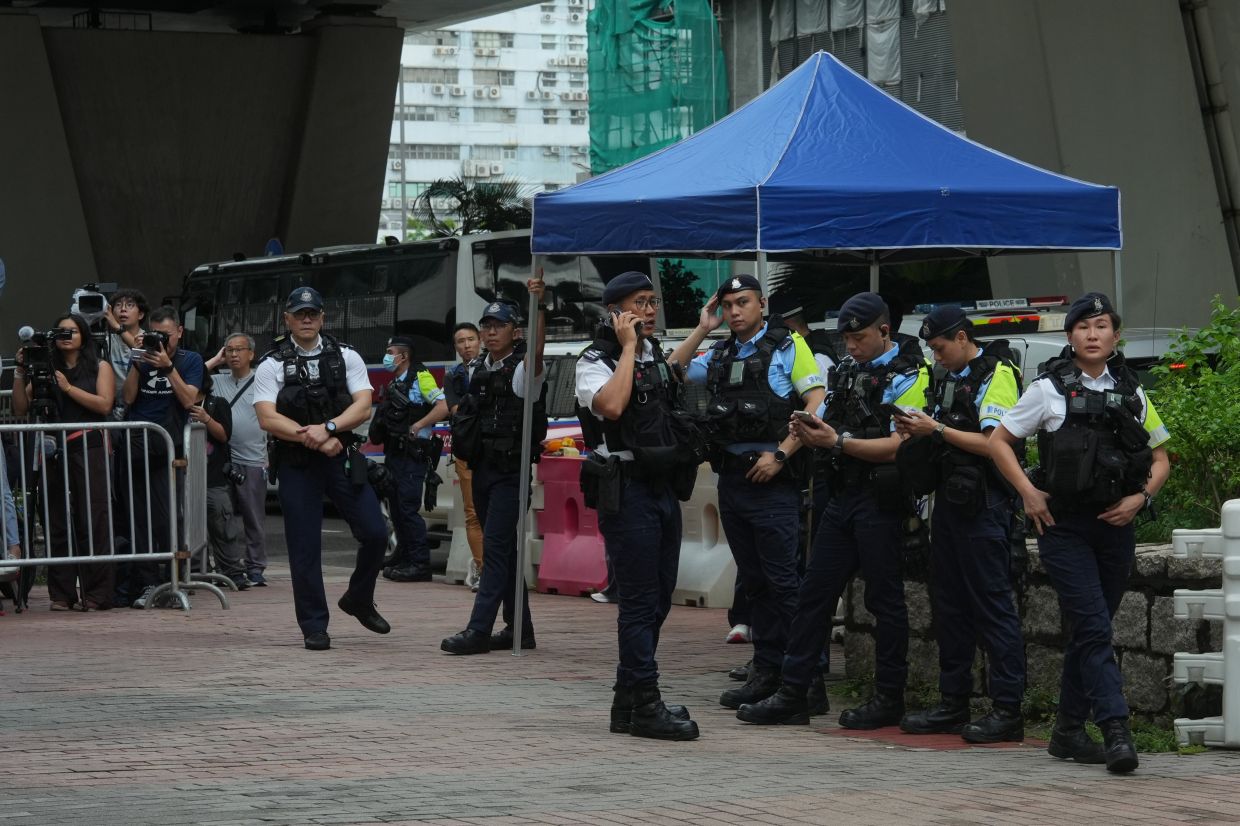
Hong Kong's police force has intensified scrutiny over public expression, detaining a woman last week for allegedly wearing a T-shirt bearing seditious content outside West Kowloon Court. The arrest, announced Monday night, occurred on suspicion of disorderly conduct in public, obstructing police officers, and acting with seditious intention—charges that reflect the widening net of enforcement under Hong Kong's national security framework. Authorities have declined to provide specifics about the operation, with a police spokesman offering only that the action was designed to maintain public safety and order.
The timing of the detention proved particularly sensitive. Early Friday morning, shortly after 5 o'clock, more than fifty people had gathered in a queue outside the courthouse to witness or cover the verdict in a significant case against two former leaders of the Hong Kong Alliance in Support of Patriotic Democratic Movements of China, a now-dissolved civil society organization that had orchestrated the city's long-running Tiananmen Square commemorations. According to media accounts and witnesses present, a plainclothes officer identified the woman during this vigil, noting her black T-shirt, which bore Japanese characters suspected of conveying subversive messaging. She was then escorted into a police vehicle while journalists documented the incident, with officers subsequently directing reporters away from the scene.
The arrest of Lee Cheuk‑yan, the alliance's former chairman, and Chow Hang‑tung, its former vice-chairwoman, proceeded on schedule. Both individuals stand accused under the national security law of inciting subversion by advocating for an end to what they termed "one-party dictatorship" in mainland China. The charges carry profound implications not merely for Hong Kong's political landscape but for the city's relationship with international norms regarding civil liberties and free expression. Lee, a seasoned lawmaker with decades of political engagement, and Chow, a practicing barrister, have remained in custody for nearly five years—an extended detention period that underscores the severity with which authorities are treating these matters.
The High Court judgment, delivered in a comprehensive 216-page ruling, represents a sweeping interpretation of what constitutes subversion under Hong Kong's national security legislation. Three judges determined that efforts to challenge or weaken the Communist Party of China's grip on power meet the legal threshold for subversion, grounded in reasoning that mainland China's constitution fundamentally prohibits Western-style democratic governance. This reasoning establishes a concerning precedent: advocacy for systemic political change, even when directed at mainland affairs rather than Hong Kong specifically, now falls within prosecutable bounds. The ruling effectively criminalizes a form of political speech that had operated in Hong Kong's public sphere for decades without legal jeopardy.
For Malaysia and other Southeast Asian democracies, the Hong Kong developments warrant close observation. The region has witnessed escalating restrictions on political expression across multiple jurisdictions, yet the crystallization of subversion law in Hong Kong provides a cautionary template. When courts legitimize the criminalization of calls for political change based on constitutional interpretations that exclude particular governance models, the foundation is laid for expanding restrictions that could extend beyond their original stated scope. The Hong Kong case demonstrates how national security legislation, initially framed as targeted measures against external threats, evolves into instruments for constraining domestic political contestation.
The broader context of these arrests reveals a coordinated enforcement environment. The Hong Kong Alliance itself was dissolved in 2021, effectively terminating the institutional capacity to organize annual Tiananmen vigils—an event that had operated continuously since 1990 as a cornerstone of Hong Kong's civil society. The organization's demise preceded, but complemented, the national security law's implementation in 2020. Now, even individual acts of commemorative or symbolic speech attract police intervention, suggesting that authorities are pursuing enforcement at granular levels previously untouched by formal legal action.
A fourth defendant in the case, Albert Ho Chun‑yan, the alliance's former vice-chairman, has endured detention exceeding four years. He entered a guilty plea in January and awaits sentencing, meaning the complete judicial process for this cohort of activists remains unfinished. The prolonged custody periods prior to verdict or sentencing raise questions about bail procedures and detention standards that extend beyond the substance of the charges themselves. For regional observers, these procedural dimensions matter as much as the verdicts, as they indicate whether due process protections remain operative in political cases.
The arrest of the woman in the T-shirt, while seemingly a minor incident, exemplifies the enforcement granularity now characteristic of Hong Kong's security apparatus. The fact that police identified, detained, and removed an individual based on suspected messaging on clothing—conducted in public view but with media access restricted—suggests a normalized readiness to intervene in symbolic speech. The officers' direction to journalists to vacate the scene further illustrates how restrictions on expression increasingly extend to restricting the documentation and reporting of such restrictions themselves.
For Malaysia, where concerns about sedition law application have historically centered on online speech and organized political activity, the Hong Kong case offers a preview of potential trajectories. When sedition frameworks become sufficiently broad, they capture acts of individual expression that fall outside institutional or organized contexts. A solitary person wearing a T-shirt with particular messaging, unaffiliated with any group, now faces criminal detention in Hong Kong. This expansion of enforcement reach, untethered from organizational affiliation or coordinated campaigns, represents a qualitative shift in how such laws function in practice.
The intersection of the T-shirt arrest with the high-profile verdict against Lee and Chow also reveals deliberate messaging by authorities. By detaining the woman in full view of media and witnesses gathered to observe the trial, police signaled that enforcement of sedition law extends to the moment and place of judicial proceedings themselves. This performative dimension of enforcement—visible, public, and timed to coincide with prominent trials—appears designed to establish deterrent effects through demonstration rather than through law alone.
As regional governments assess their own security legislation and enforcement priorities, the Hong Kong trajectory provides instructive lessons. The national security law, now five years into implementation, has expanded from initial applications against organized pro-independence activity to encompassing individual symbolic speech. The courts have validated this expansion through interpretive rulings that treat advocacy for political system change as inherently subversive. For Southeast Asia's democracies and electoral systems, maintaining guardrails against such expansive application of security law remains an ongoing governance challenge.

