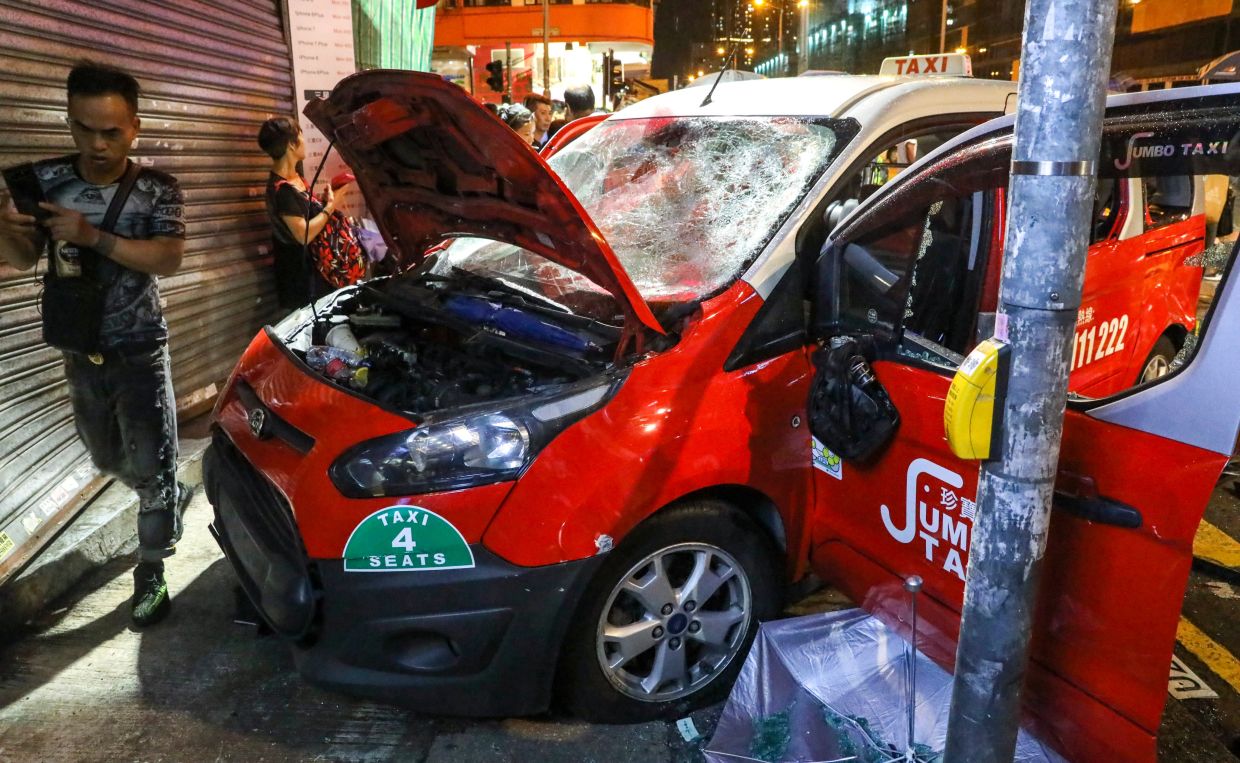
Park Hoi-lam's legal team made the case in court this week that taxi driver Henry Cheng Kwok-chuen bears responsibility for injuries sustained when his vehicle mounted the pavement and collided with her on October 6, 2019, during a demonstration in Sham Shui Po. The kindergarten clerk is seeking HK$8.4 million (US$1.07 million) in compensation, arguing that the accident fundamentally altered the trajectory of her life and continues to restrict her ability to work and engage in ordinary activities.
The collision occurred amid intense social and political turbulence in Hong Kong. Park testified that she had been attempting to travel to Tsim Sha Tsui by bus that afternoon when road closures forced her group to get off in Sham Shui Po. Upon discovering that railway services had also been suspended, she and her companions opted to walk toward Mong Kok. However, she became separated from her friends after walking ahead of the group, leaving her isolated when the incident unfolded near Yen Chow Street.
According to Park's testimony, she did not perceive the gathering as volatile or dangerous in those moments. The atmosphere appeared calm until she heard commotion near where Cheng's taxi was positioned. When she turned to assess the situation and attempted to move away, the vehicle struck her at considerable velocity. She stated clearly that she observed no passengers beside the driver inside the cab at the moment of impact.
The plaintiff's counsel, Susanna Leong, emphasized that the mechanics of the collision themselves demonstrate Cheng's negligence and failure to exercise reasonable care. Crucially, Leong argued that the taxi driver did not sound his horn or apply brakes before striking Park and another woman on the pavement. The defence's subsequent arguments about the driver being assaulted by protesters, while tragic in their own right, remained irrelevant to the question of how the initial accident occurred and what caused it, according to the plaintiff's legal position.
The injuries Park sustained proved severe and enduring. She underwent seven surgical procedures within three months following the October 2019 collision and remained hospitalized until January 2020. Even after discharge, she required ongoing outpatient therapy and rehabilitation. Medical professionals treating her condition indicated that further improvement was unlikely, and she may eventually face the prospect of knee replacement surgery. At present, nearly five years after the incident, she still experiences persistent knee pain that limits her mobility to roughly one hour of continuous walking before she must rest.
The practical impact on Park's employment and daily functioning has been substantial. She now works as a clerk at a kindergarten near her home in Tuen Mun, a position chosen partly because of its proximity to her residence. However, even this modified role presents challenges. Her injuries prevent her from performing standard childcare duties such as lifting objects or physically comforting distressed toddlers by carrying them. A cosmetic surgeon has recommended reconstructive surgery to address visible scarring on her legs, but Park indicated she lacks the financial resources to pursue this procedure.
The defence strategy adopted by Cheng's legal team reframed the narrative entirely. His lawyers maintained that the taxi driver himself was a victim of the violence that day, attacked with metal rods and hard objects while attempting to perform his job. They contended that seeking damages from another casualty of the broader protest-related violence did not constitute genuine justice, regardless of how serious Park's injuries were. This positioning shifted focus from the mechanics of the collision to the context of civil unrest and the competing victimhood narratives it created.
Central to the defence's challenge was surveillance footage obtained through a private detective agency. This covert video appeared to show Park engaged in ordinary activities—shopping and dining after work—seemingly indicative of someone leading a functional life. The defence leveraged this evidence to suggest that her claims of disability and restricted capacity were exaggerated. However, Park's response highlighted the gap between appearing normal in isolated moments captured on camera and actually sustaining meaningful activities. She questioned whether footage of routine shopping and eating genuinely reflected someone's overall life quality and capacity, pointing to the distinction between performing basic human tasks and living without significant limitation.
The question of Park's involvement or intentions regarding the protest became a secondary line of inquiry. Defence counsel Ashok Sakhrani questioned why she had retained legal representation when providing her police statement in March 2020, suggesting possible protestor connections or concerns about legal exposure. Park rejected these insinuations, asserting that she had merely sought to protect her personal interests and had not participated in the demonstration. She maintained that her presence in Sham Shui Po that day was circumstantial, the result of transport disruptions rather than purposeful activism.
The legal proceedings before Justice Simon Leung Chun-man are expected to extend across six days, giving weight to the complexity of the case. Beyond the immediate question of monetary compensation, the trial reflects broader tensions within Hong Kong society regarding accountability, victimhood, and justice during periods of political upheaval. The case illustrates how individuals caught peripherally in major social events can experience life-altering consequences while responsibility becomes contested and clouded by competing narratives about who suffered and why.
For Malaysian observers, this case offers perspective on how protest-related incidents in urban centres can create lasting complications for ordinary citizens not directly involved in political action. It also demonstrates the role of civil courts in adjudicating injuries and damages when public order breaks down, a consideration relevant across Southeast Asia where demonstrations remain common. The outcome will likely influence how Hong Kong courts balance the interests of injured civilians against drivers and other workers whose livelihoods intersect with protest activity.

