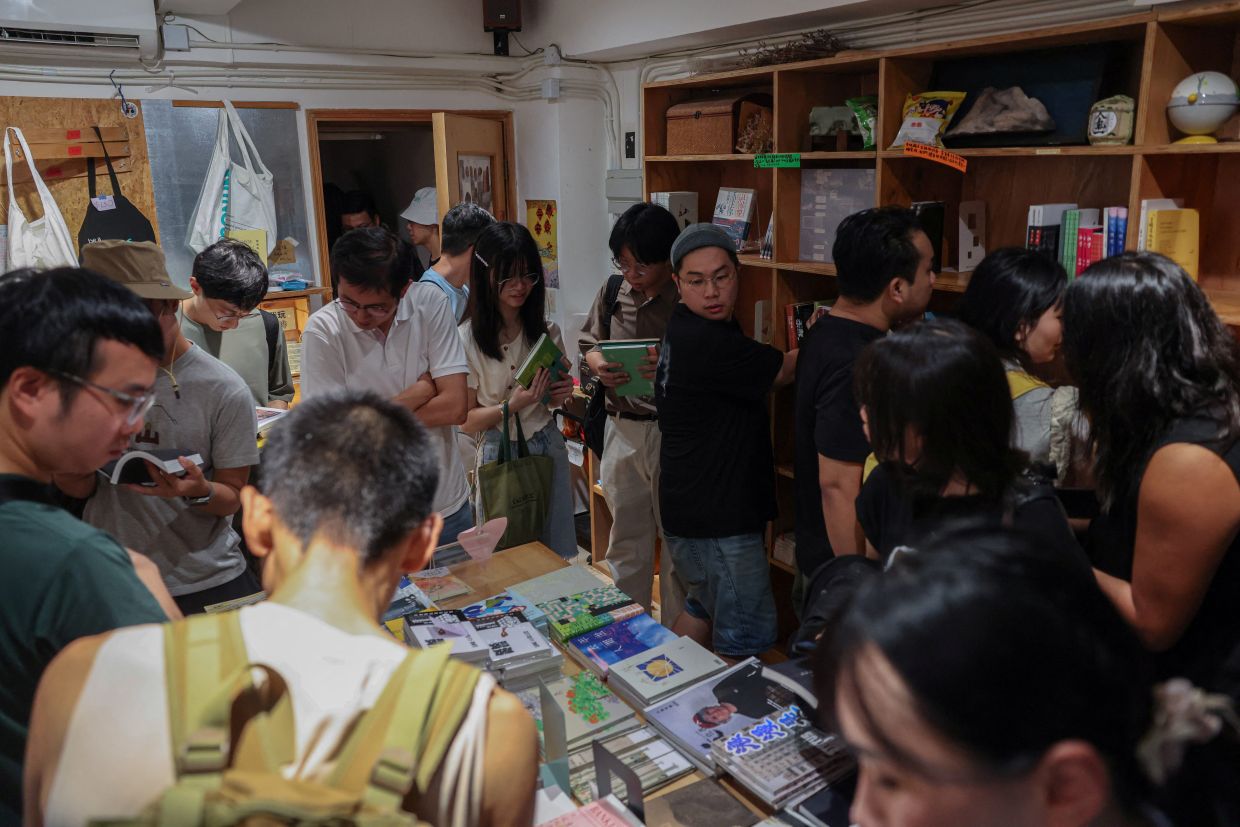
For Fleming Cheng, a mainland Chinese university student, stepping into Greenfield Book Store last year represented an unprecedented opportunity to hold physical copies of books he had only glimpsed through internet searches back home, accessed furtively via VPN to circumvent Beijing's digital barriers. Beyond merely acquiring forbidden literature, he encountered perspectives entirely absent from mainland discourse—works critically examining China's leadership and the aftermath of the 1989 Tiananmen Square pro-democracy movement. What began as a simple shopping trip became an intellectual awakening, one that underscored Hong Kong's distinctive role as a gateway to ideas suppressed across the border.
For decades, Hong Kong's independent bookstores—many inconspicuously housed in nondescript buildings away from commercial thoroughfares—have functioned as intellectual sanctuaries for mainland readers navigating an environment where state censorship controls which narratives are permissible. The bookshops operated as cultural bulwarks, preserving access to politically heterodox works and maintaining publishing traditions that mainland counterparts could not maintain. This distinction between Hong Kong and the mainland represented one of the remaining tangible expressions of the city's post-1997 autonomy, a living embodiment of the "one country, two systems" framework that once appeared to protect distinct governance structures.
That protective framework is now visibly deteriorating. Within just four months, police conducted targeted operations against multiple independent bookstores, resulting in arrests of booksellers on allegations of sedition under Hong Kong's 2024 National Security Law. Book Punch faced police action in March, Hunter Bookstore in June, and both Greenfield and Have A Nice Stay in July. Greenfield, operating for fifty years, announced its closure upon lease expiration following the police action. Have A Nice Stay, established by former journalists who sought to combine retail operations with intellectual activism, shut down even before its staff were arrested, citing unclear regulatory boundaries and unsustainable financial pressures. The pattern suggests not isolated incidents but rather a coordinated intensification of oversight targeting the sector's entire ecosystem.
The escalation follows the implementation of two successive security regimes. The 2020 National Security Law introduced by Beijing initiated the first wave of restrictions, prompting the disappearance of activist leaders, forced disbandment of civil society organizations, and systematic removal of books addressing sensitive historical events like the Tiananmen crackdown from public library collections. Public institutions became inhospitable to politically inconvenient narratives. The 2024 sedition law intensified this pressure, introducing criminal liability for publications deemed to carry "seditious intention"—a concept authorities have deliberately left undefined, creating an environment where self-censorship becomes rational risk management rather than ideological choice.
Authority figures justify these measures through national security rhetoric. Secretary for Security Chris Tang has asserted that the legal framework clearly delineates prohibited conduct and refuses to acknowledge the existence of any formal banned book list, insisting instead that booksellers bear personal responsibility for ensuring their inventory poses no threat to state security. He compared this obligation to food vendors ensuring their products contain no toxins. Yet this analogy obscures the fundamental distinction between objective health hazards and subjective political judgment. The absence of explicit guidelines transforms sellers into unwitting participants in a security apparatus where compliance requires predicting official preferences rather than following defined rules.
Front-line booksellers operate under conditions of profound uncertainty. One proprietor, speaking anonymously to avoid government retaliation, described the psychological toll of attempting to distinguish permissible criticism from prohibited sedition. The distinction between protected political speech and criminal advocacy has become so ambiguous that conservative bookstores now hesitate to stock volumes addressing contemporary Chinese politics, entirely self-censoring based on fear rather than explicit prohibition. Complicating matters further, landlords themselves have begun scrutinizing tenant operations after experiencing government pressure, threatening to revoke commercial leases from bookstores facing official investigation. This creates a cascading effect where political pressure cascades through property networks, effectively censoring commerce through economic mechanisms rather than explicit legal prosecution.
The implications extend beyond individual merchants. Student readers from neighboring Guangdong province, such as Iris Wang, have consciously sought out Hong Kong bookstores specifically for their intellectual character—establishments that cultivate critical thinking rather than merely moving inventory. For these mainland visitors, the bookshops represent institutionalized intellectual freedom, physical embodiments of a different China, however constrained that difference has become. Conversely, longtime Hong Kong residents like Brian Leung describe a palpable sense of cultural loss, observing that each independent bookstore possessed distinct character and community function that is systematically disappearing. When arrests occur at venues one has visited and patronized, it registers not as enforcement against criminal activity but as attack on a cherished way of life—the visible dismantling of spaces where unconventional thought could circulate relatively openly.
Taiwan has increasingly assumed the role Hong Kong is relinquishing. The island's publishing industry, operating under conditions of genuine democratic pluralism, has dramatically accelerated production of Chinese-language titles addressing Hong Kong's political trajectory. According to Tunghai University sociology professor Cheng Tsu-Bang, Taiwan's publishers issued six times more books about Hong Kong between 2020 and 2024 compared to the preceding five-year period. This proliferation reflects conscious effort to preserve and circulate narratives about Hong Kong's pro-democracy movement precisely as Hong Kong itself becomes inhospitable to such discourse. Publishing has transformed into a medium of cross-strait solidarity, with Taiwan's freer environment enabling documentation of experiences that cannot be freely discussed in their place of origin.
Yet even this alternate channel faces deterioration. In July 2024, Taiwan's FTV broadcaster reported that a logistics firm suspended shipments of books from Taiwan to Hong Kong bookstores under police investigation, subsequently requiring comprehensive book inventories before servicing other Hong Kong retailers. This logistical constraint, nominally justified by operational caution, effectively imposes additional friction on the already-tightening corridor between Taiwan's free publishing environment and Hong Kong's increasingly restricted market. Authors who have relocated from Hong Kong to Taiwan, such as Lee, who wrote extensively about the city's pro-democracy movement, explicitly describe themselves as displaced chroniclers attempting to preserve Hong Kong's historical narrative in exile. For Lee, independent bookstores functioned as "flower fields where people could breathe"—fragile ecosystems of intellectual space amid broader civil society collapse.
The broader trajectory appears unmistakable. Fleming Cheng's observation that complete convergence between Hong Kong and mainland governance would constitute "a tremendous loss for us mainlanders too" captures the stakes for readers throughout the Chinese-speaking world. As Hong Kong's independent bookstores face closure and arrest, the city loses its distinctive function as a publishing haven where Chinese-language intellectual pluralism could survive. For mainland readers, access to alternative interpretations of history and politics becomes correspondingly constrained. For Taiwan and the diaspora, the burden of preserving uncensored Chinese-language intellectual production intensifies. The transformation of Hong Kong's independent bookstores from thriving commercial spaces to targets of security investigations marks another step in the city's institutional alignment with mainland governance structures—and signals deepening questions about whether any geographic or institutional spaces within the Chinese-speaking world can maintain sustained commitment to intellectual pluralism.
The closure of these bookstores represents more than commercial difficulty or regulatory pressure on individual proprietors. It signals the systematic narrowing of spaces where divergent narratives about history, politics, and society can physically circulate within the Chinese-speaking region. Each storefront that closes, each author who relocates, and each book that cannot be shipped reinforces an ecosystem increasingly dominated by single-narrative dominance. Whether alternative publishing channels can sustain meaningful intellectual diversity across Taiwan, the diaspora, and remaining Hong Kong publishers remains uncertain, but what appears certain is that Hong Kong's distinctive role as a publishing anomaly within the Chinese-speaking world is definitively ending.

