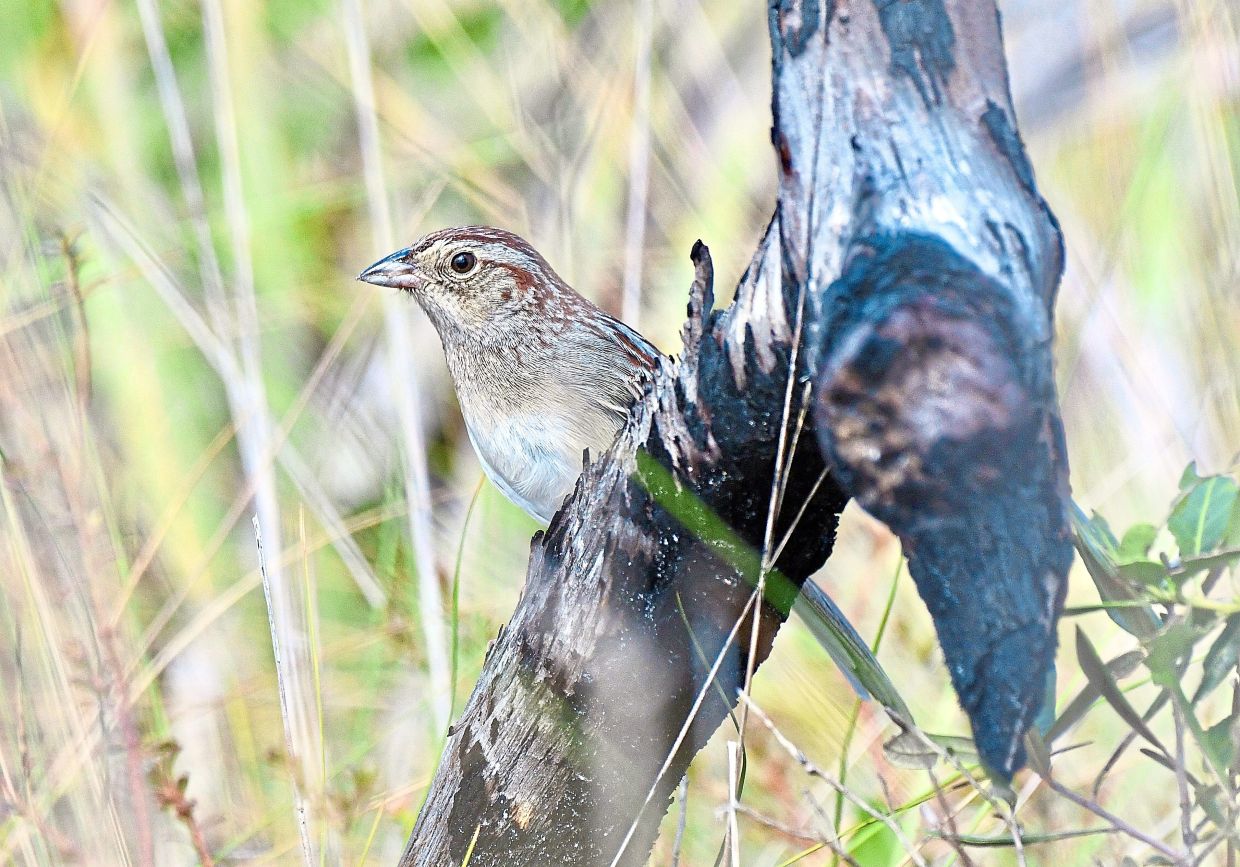
The flatwoods of South Florida resonate with the calls of Bachman's sparrows, tiny brown birds that perch among pine branches to sing their intricate melodies. While these vocalizations may sound remarkably similar to untrained human ears, each population of these birds deploys an astonishingly diverse repertoire—up to 120 distinct song types—to communicate with one another. This vocal complexity mirrors aspects of human language systems, demonstrating how animal communication evolves and adapts across generations as each cohort makes deliberate choices about preserving, refining, or abandoning particular sounds.
Understanding how individual sparrows select which songs to learn has occupied ornithologists for decades. A single Bachman's sparrow will master only about 48 of the total songs available within its community, raising the fundamental question of what drives these choices. Researchers have traditionally attributed song selection to social and cultural dynamics, hypothesizing that young birds preferentially imitate successful adult males—those who achieve breeding success or display elaborate plumage. This framework suggested that cultural prestige and reproductive advantage determined which vocalizations persisted and which faded from the population.
A groundbreaking study published in March 2024 challenges this conventional wisdom by introducing a previously underexplored variable: the physical habitat itself. Researchers at Florida Atlantic University, led by behavioral ecologist Rindy Anderson, propose that environmental factors fundamentally shape which songs become common and which gradually disappear. The acoustic properties of trees, dense vegetation, wind patterns, and other environmental features act as filters that either facilitate or degrade sound transmission. This physical degradation of songs may systematically discourage young birds from learning compromised vocalizations, creating a form of environmental selection pressure on avian culture.
To test this hypothesis, the research team conducted a meticulous series of experiments comparing acoustic properties across the sparrow's repertoire. All Bachman's sparrow songs share a characteristic structure—a buzzing or whistling initial note followed by a trill—yet individual song types vary considerably in trill speed, frequency complexity, and harmonic content. Some songs contain rapid trills while others feature slower, more sustained sounds; certain variants include multi-frequency trills that create additional acoustic complexity. By recording both rare and common song variants and then replaying them through different environments where sparrows naturally forage, researchers could measure how environmental conditions affected signal clarity and integrity.
The experimental results provided compelling evidence for the environmental hypothesis. When songs were played back through dense forest vegetation, open windy plains, and other habitat types characteristic of sparrow territories, the researchers observed a clear pattern: rarer song types underwent greater acoustic degradation than common variants. The physical landscape systematically filtered out the acoustic properties of uncommon songs while preserving the clarity of frequently sung types. This finding suggests that young sparrows, during their critical developmental window for vocal learning, unconsciously select undegraded songs while filtering out those that emerge from their environment as corrupted or distorted signals.
This discovery aligns with a broader scientific framework called the acoustic adaptation hypothesis, which posits that an animal's vocalizations evolve to match the acoustic properties of its habitat. Numerous examples support this principle across diverse species. Monkeys inhabiting rainforests have evolved deep, low-frequency bellows that penetrate dense vegetation more effectively than higher-pitched calls would. Frogs living near rushing streams produce shrill croaks that cut through aquatic noise. These examples demonstrate how environmental pressure shapes the acoustic characteristics of animal communication across evolutionary timescales.
However, the picture remains complex and multifactorial. Recent analysis of 5,085 songbird species suggested that sexual selection—the preference of potential mates for specific song characteristics—might be a more dominant force driving song variation than environmental factors. Even within Bachman's sparrow populations, Anderson acknowledges that acoustic clarity likely represents only one component of a much larger puzzle determining which songs persist across generations. Social and cultural factors, including the prestige of successful singers and the attractiveness of elaborate song variants, probably exert equally significant influence on vocal transmission and evolution.
The implications of this research extend beyond ornithology to illuminate broader principles of cultural evolution. Animals transmit learned behaviors—including vocalizations, foraging techniques, and social customs—through generations much like humans do, creating distinct dialects and traditions within populations. The discovery that physical environment shapes which cultural variants survive introduces an important mechanism by which habitat fundamentally constrains cultural diversity. A similar principle might apply to human societies, where geographic isolation, acoustic properties of terrain, and environmental factors historically influenced language development and linguistic diversity across different regions.
David Wheatcroft, an ornithologist at Stockholm University who was not involved in the study, emphasizes both the logical coherence and surprising robustness of the findings. He notes that the principle—that songs failing to transmit clearly through habitat should be learned less frequently—follows logically from how perception shapes learning. Yet demonstrating this mechanism in natural field conditions, where countless variables beyond acoustic degradation influence song rarity, represents a significant methodological achievement. The complexity of natural systems means that multiple selective pressures operate simultaneously, making it difficult to isolate single causal factors.
For readers in Malaysia and Southeast Asia, these findings carry particular relevance given the region's extraordinary avian diversity and ongoing habitat transformation. Many Southeast Asian songbirds occupy rapidly changing landscapes where deforestation, agricultural development, and urbanization alter the acoustic properties of their environments. If habitat structure fundamentally influences vocal culture transmission, these environmental changes could accelerate the loss of acoustic diversity within bird populations. Some song types might disappear not through direct extinction of populations but through the environmental degradation that prevents young birds from effectively learning those vocalizations from their elders.
Understanding these mechanisms becomes increasingly important as conservationists design strategies to protect biodiversity in the face of habitat loss. The research suggests that preserving not just bird populations but also the acoustic integrity of their habitats—maintaining forest structure, reducing noise pollution, and protecting the vegetation characteristics that allow sounds to transmit clearly—may be essential for maintaining the cultural diversity of avian communities. This perspective reframes habitat conservation as necessary not only for species survival but for the preservation of accumulated cultural knowledge embedded in birdsong traditions.
The study opens new avenues for investigating how environmental change influences the transmission of learned behaviors across generations. Future research might examine how rapid habitat transformation affects vocal culture in endangered species, how urbanization and noise pollution alter song selection in city-dwelling birds, and whether similar environmental filtering mechanisms operate in other animals that transmit learned behaviors. By recognizing that culture and environment interact in shaping animal behavior, scientists develop a more nuanced understanding of how species adapt to their changing worlds.

