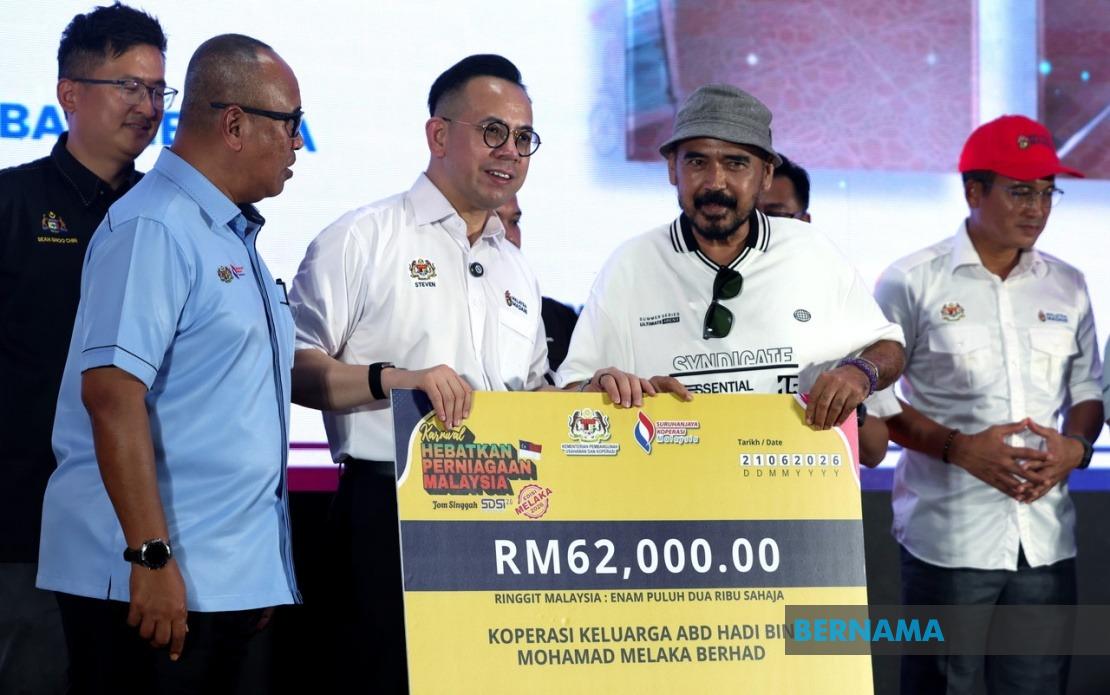
Malaysia's Ministry of Entrepreneur Development and Cooperatives has declared the three-day HPM 2026 Carnival in Melaka a resounding success, with the event generating substantial economic activity that underscores the government's renewed commitment to grassroots entrepreneurship. Held from June 19 to 21, the carnival accumulated RM8.45 million in combined business matching value and financing potential—a figure that signals growing momentum in Malaysia's push to strengthen the micro, small and medium enterprises sector that forms the backbone of the domestic economy.
The gathering drew an impressive crowd of 70,000 visitors to the Melaka venue, demonstrating robust public interest in entrepreneurship opportunities and business networking. Beyond foot traffic, the carnival achieved tangible commercial results, with entrepreneurs recording direct product sales worth RM532,802.77 during the three-day window. This direct-to-consumer revenue stream offers immediate validation for participating vendors and reflects the event's practical value as more than merely an awareness platform—it functioned as a genuine marketplace where buyers and sellers could transact.
Central to the carnival's impact was an intensive business matching programme that connected entrepreneurs with potential partners and investors. Across 72 dedicated matching sessions, organisers facilitated connections involving 25 entrepreneurs seeking growth capital and business partnerships, culminating in RM6.4 million in identified business matching value. These sessions represent the kind of structured networking that many Malaysian SMEs struggle to access independently, particularly those operating outside major urban centres or lacking established corporate networks. For participants, the opportunity to sit directly across from potential investors and business collaborators can prove transformative in securing growth funding.
Financing accessibility emerged as another critical outcome. Fifty-five MSMEs participated in dedicated financial interaction sessions designed to connect them with lending institutions and financial service providers. From these interactions, participants identified RM2.05 million in potential financing opportunities, addressing one of the persistent challenges Malaysian small business owners face: accessing affordable capital on reasonable terms. The figure suggests that when intermediaries actively facilitate introductions between MSMEs and formal financial institutions, workable solutions can materialise.
The carnival functions as a flagship initiative within the broader Hebatkan Perniagaan Malaysia agenda, championed by Minister Steven Sim Chee Keong of KUSKOP. This overarching programme operationalises the government's ABCD strategic framework—Accelerating Productivity, Bureaucracy Reduction, Capital Accessibility and Developing Market Access—four pillars designed to remove friction points that typically constrain small business growth. The carnival serves as the physical manifestation of these principles, creating spaces where entrepreneurs encounter fewer bureaucratic barriers, can access capital more readily, and can forge market connections that might otherwise require years of independent networking.
The Melaka carnival represents the third instalment of the HPM 2026 series, suggesting that earlier iterations established a working template worth repeating. The Ministry has already announced that Penang will host the next edition from July 17 to 19 at the Penang Waterfront Convention Centre, indicating the government's intention to establish a rotating schedule that brings these opportunities to different regions. This geographical rotation proves significant for Malaysian entrepreneurship, as it acknowledges that not all small business owners possess the means or flexibility to travel to centralised events in Kuala Lumpur—by bringing carnivals to state capitals, organisers democratise access.
The platform created by the carnival extends beyond simple transactional opportunity. For many participating MSMEs, exposure to government ministries, industry peers, financial institutions, and potential supply chain partners represents a critical step toward business formalisation and professionalisation. Small operators working in isolation often lack awareness of available government support schemes, regulatory compliance pathways, or industry standards that could enhance their competitiveness. Bringing them together with such a diverse ecosystem in a single venue accelerates knowledge transfer and relationship-building.
For Southeast Asian observers, Malaysia's emphasis on carnival-style engagement with small business communities reflects a broader regional recognition that inclusive economic development requires active, persistent government effort to connect entrepreneurs with resources and opportunities. While other markets have experimented with similar approaches, Malaysia's integration of the initiative with a clearly articulated strategic framework—the ABCD agenda—distinguishes it as a purposeful rather than purely promotional exercise. Each carnival ostensibly measures its success against concrete metrics: business matching values, financing opportunities identified, direct sales recorded, and participant count.
The emphasis on direct metrics also matters for accountability. Rather than measuring success through attendance alone or abstract awareness metrics, the HPM Carnival reports specific economic outcomes that stakeholders can verify and build upon. Future carnivals will establish benchmarks against which success can be assessed. If the Penang edition and subsequent regional carnivals generate similar or superior results, the Ministry can claim evidence of systematic impact. If results decline, organisers will face pressure to adjust format or execution.
Looking forward, the carnival model addresses a genuine gap in Malaysia's entrepreneurship ecosystem. While the country possesses various government funding schemes, tax incentives, and regulatory frameworks supporting small business, the information often remains scattered across multiple agencies and difficult for grass-root entrepreneurs to navigate. Carnivals that bring together financing options, business matching opportunities, and peer learning under one roof effectively create information and relationship transparency that entrepreneurial initiatives typically lack. For Malaysian business owners and aspiring entrepreneurs seeking capital, partnerships, or market access, the HPM 2026 Carnival series represents one of the more tangible and accessible avenues currently available to pursue growth.