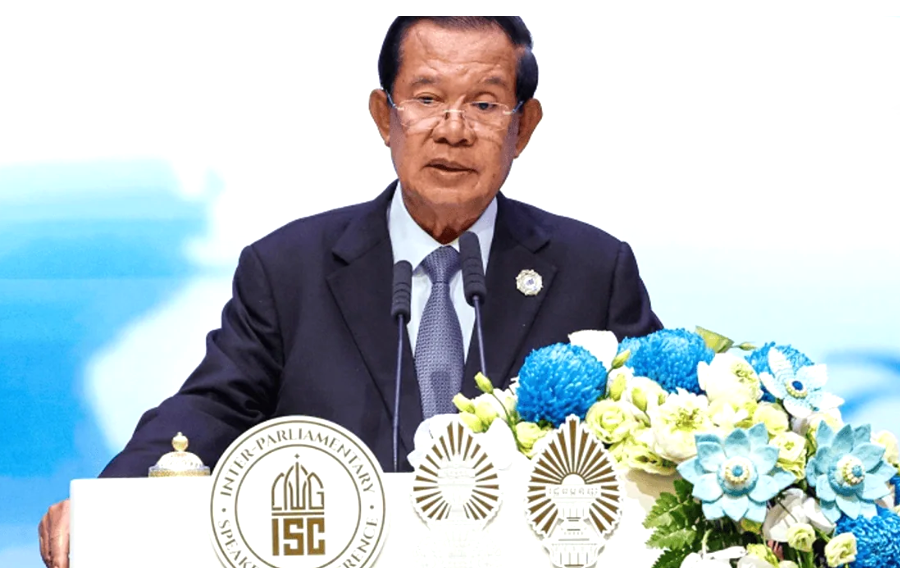
Cambodia's Senate president Hun Sen has delivered a sharp rebuke to Thailand, asserting that Bangkok exploited international concerns about online scamming as a cover for what he characterises as illegal territorial occupation. Speaking at the 2nd Inter-Parliamentary Speakers' Conference in Phnom Penh on Thursday, Hun Sen presented an interpretation of the Cambodia-Thailand border dispute that places it within a much larger pattern of what he calls modern warfare conducted under false pretexts. The conference, which drew parliamentary delegations from Pakistan, Malaysia, Myanmar, Australia, Russia and several other nations, provided Hun Sen with a regional and international platform to articulate Cambodia's grievances against its powerful neighbour.
Hun Sen's central argument centres on the notion that Thailand has weaponised the cross-border criminal phenomenon of online scam operations to justify military presence on disputed territory. He framed this tactic as emblematic of contemporary conflict, wherein powerful states employ international issues as justification for actions that breach sovereignty and undermine established international agreements. Without specifying which ceasefire accords he referenced, Hun Sen contended that Thailand has treated such agreements as merely symbolic documents rather than binding commitments, suggesting a deliberate disregard for formal conflict resolution mechanisms.
The Senate president positioned Cambodia's experience within a broader critique of how modern statecraft increasingly operates outside traditional legal frameworks. Beyond border disputes, he identified several contemporary conflict methodologies that have become normalised in international relations. Trade wars utilise tariff structures and withdrawal of preferential market access as instruments of coercion. Technology competition manifests through fierce strategic rivalry over semiconductor manufacturing capabilities and cyber infrastructure dominance. Resource nationalism, particularly surrounding energy reserves and rare earth minerals essential for modern economies, intensifies geopolitical tensions and leaves developing nations vulnerable to pressure from resource-rich powers or nations with superior technological capacity.
Hun Sen's warning extended to what he characterised as a dangerous erosion of the international non-proliferation framework. He argued that when vulnerable nations perceive international treaties and institutions as inadequate protection against external aggression, they are incentivised to pursue independent military capabilities. This security dilemma, he suggested, creates a cascading effect where systemic insecurity breeds an arms race, particularly among nations that feel simultaneously threatened and abandoned by the collective security architecture established during the post-World War II era. His analysis suggests that the current trajectory could precipitate abandonment of decades-old non-proliferation agreements as nations prioritise survival over collective stability.
The Cambodian leader framed his nation's predicament as emblematic of structural inequalities embedded within the international system. He objected to what he characterised as selective application of standards, particularly regarding human rights, environmental protection and cross-border crime enforcement. Hun Sen contended that wealthy, developed nations impose expectations on economically struggling countries that ignore the latter's ongoing recovery from conflict, limited institutional capacity and developmental constraints. This critique reflects Cambodia's historical experience with civil war and its subsequent development challenges, suggesting that international pressure represents a form of coercive policy divorced from contextual realities facing post-conflict societies.
Hun Sen highlighted how accusations regarding involvement in online scam operations appear particularly instrumentalised in Cambodia's case. He argued that these allegations, whether substantiated or exaggerated, have become intertwined with broader geopolitical friction, allowing neighbouring powers to justify territorial claims or military action under humanitarian or law-enforcement guise. The invocation of transnational crime represents a particularly effective pretext because it activates international concern and can generate pressure through diplomatic channels and multilateral institutions, leveraging collective anxiety about cybercrime to legitimise unilateral action.
The Senate president's remarks directly challenge the legitimacy of the rules-based international order that has governed state conduct since 1945. He argued that the nations and institutions that established these rules now routinely violate or selectively enforce them, undermining their credibility and creating perverse incentives for other states. Economies and trade relationships have become weaponised, Hun Sen suggested, with rules changing capriciously rather than remaining predictable foundations for international commerce and diplomatic relations. This unpredictability, he indicated, forces weaker nations into constant adaptation and vulnerability, unable to plan long-term development or security strategies with confidence.
Central to Hun Sen's argument is an assertion that the international system has fundamentally failed in its core function of providing collective security. He specifically referenced violations of international law by powerful actors claiming exclusive self-defence rights and executing preemptive military strikes without international authorisation. These transgressions, he suggested, have shattered any genuine collective security mechanism, leaving smaller nations effectively isolated despite their formal participation in international institutions. This analysis reflects Cambodia's geopolitical reality as a smaller Southeast Asian state bordered by more powerful neighbours, making adherence to international norms theoretically appealing but practically precarious.
Hun Sen called for restoration of what he termed the rules-based order, alongside renewed commitment to the UN Charter and the ASEAN Charter. His appeal for institutional revival, however, was shadowed by scepticism about whether such reinvigoration remains feasible given the demonstrated willingness of major powers to disregard established frameworks. For Southeast Asian nations watching this dispute, Hun Sen's warnings carry particular resonance given the region's dependence on international law, ASEAN consensus mechanisms and rules-based maritime conduct to manage competing territorial claims and development interests across the South China Sea.
The timing and venue of Hun Sen's remarks merit consideration. Addressing parliamentary leaders from diverse nations provided an audience positioned to influence their home governments' foreign policies and international stances. By framing Cambodia's border dispute as symptomatic of systemic international collapse rather than a bilateral disagreement, Hun Sen sought to reposition what might otherwise be dismissed as a smaller nation's complaint into a broader crisis affecting global stability and predictability. This rhetorical strategy attempts to generate support among nations similarly concerned about erosion of international law and the rise of great-power politics unconstrained by institutional frameworks.
For Malaysia and other ASEAN members, Hun Sen's statements underscore persistent anxieties about reliance on international law and institutions for managing regional disputes. The Cambodia-Thailand border tensions, despite their geographic distance from Malaysia, exemplify vulnerabilities facing all Southeast Asian nations dependent on maritime and terrestrial agreements with more powerful neighbours. Malaysia's own experiences with maritime disputes and concerns about sovereignty protection in the South China Sea suggest likely sympathy with Hun Sen's critique, even if Malaysian officials may be circumspect about public endorsement of his accusations against Thailand.

